Wholesale Voice Termination in 2026: 3 Setup Choices That Scale Your Platform 100x
Wholesale voice termination in 2026: 3 setup choices that scale your platform 100x, 4 mistakes most teams make, and 24-hour sandbox provisioning explained.
Wholesale Voice
Wholesale Voice Termination in 2026: 3 Setup Choices That Scale Your Platform 100x
Introduction
Your wholesale voice termination setup has three configuration choices that decide whether your platform comfortably handles 100 calls a day or 100 million. Most teams optimize for the first scale and discover the gap to the second only after a viral campaign, a customer spike, or a Sunday-night incident exposes the seams.
The configuration that survives both ends of that range isn't more expensive than the one that doesn't. It's just designed by someone who's seen the failure modes before. Buyers still evaluating the carrier layer can compare wholesale VoIP termination providers or review the wholesale voice carrier business model to understand what sits upstream.
Wholesale voice termination is the carrier-side service that makes outbound calling work at any meaningful volume — and the difference between a well-architected termination setup and a fragile one rarely shows up in the sales pitch.
This guide breaks down what wholesale voice termination is, how it works under the SBC and routing layer, the three configuration choices that decide your scaling ceiling, who needs what kind of setup, and the mistakes that show up six months after launch.
What Is Wholesale Voice Termination?
Wholesale voice termination is the bulk delivery of outbound voice calls from a buyer's network to destination phone numbers worldwide. The service handles SIP signaling, route selection, STIR/SHAKEN attestation, and final-mile handoff to destination carriers, billed per minute against destination rate decks.
Buyers connect their platforms to a wholesale termination provider's SBC and ride the provider's tier-1 carrier interconnects (AT&T, Verizon Business, Lumen, T-Mobile in the US) to reach any dialable destination. Compare our voice rates before committing.
How Wholesale Voice Termination Works Under the Hood
The provider's SBC authenticates the inbound session, normalizes codecs, applies STIR/SHAKEN signing for US-bound traffic, and hands the call to a routing engine. The engine scores available routes on cost, ASR, ACD, PDD, and FAS rates, then picks the best onward partner per call. The call traverses one or more tier-1 backbones before terminating on the destination network.
The whole sequence typically completes in 180-300 milliseconds.
What happens during the call matters more than most buyers realize. RTP packets flow directly between endpoints (your SBC and the destination network) while the signaling layer keeps the routing record open. Mid-call route failover is technically possible but rarely implemented because it interrupts audio. The decisions you make at setup determine what happens when something goes wrong.
The 3 Configuration Choices That Decide Scalability
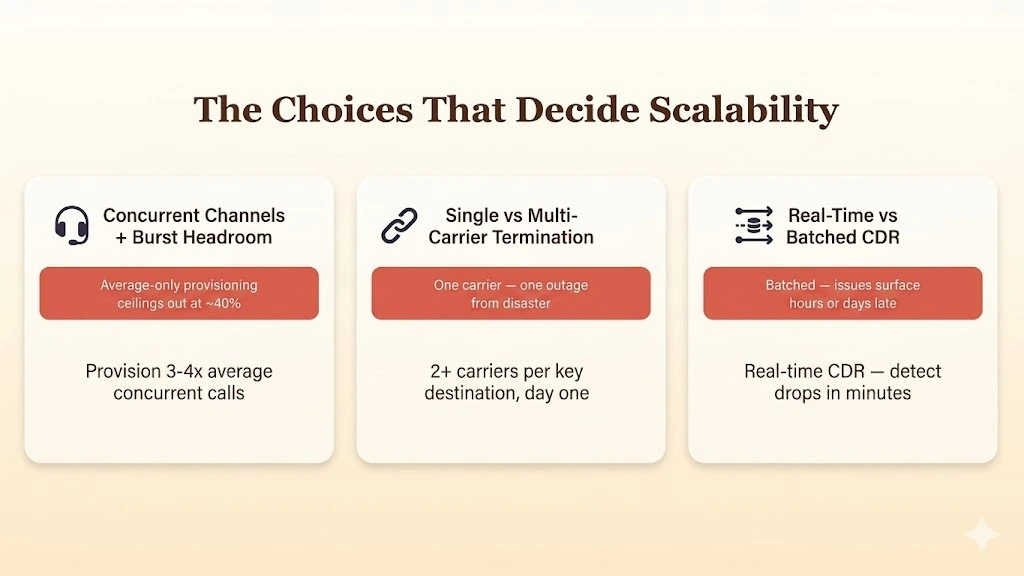
Three choices made during wholesale voice termination setup determine your scaling ceiling. Each looks small at provisioning time and large at scale.
1. Concurrent Call Channels (CCs) Plus Burst Headroom
Most teams provision for average traffic and discover at the first campaign spike that they've ceiling'd out at 40% of intended capacity. Provision for 3-4x average concurrent calls minimum. Modern wholesale voice termination platforms can scale concurrent channels elastically without redeploying SBC infrastructure, but the contracted floor matters during the first incident.
2. Single-Carrier vs Multi-Carrier Termination
Single-carrier termination is simpler at launch and one outage away from disaster at scale. Architect for at least two carriers per important destination from day one — retrofitting is significantly harder and significantly more expensive. Production setups typically send revenue-critical traffic to a primary carrier with a secondary carrier active on backup and specific destination corridors.
3. Real-Time CDR Pipeline vs Batched
Real-time CDR ingestion lets you detect quality drops within minutes; batched pipelines surface issues hours or days later. At small scale, batched works. At scale, batched fails customers. Plan for real-time CDR from day one if you expect to grow past 1 million minutes per month.
Choose the right answer to all three at setup and you've eliminated the most common failure modes that take down growing platforms.
The three setup choices that decide your scaling ceiling — concurrent channels + burst headroom, single vs multi-carrier termination, and real-time vs batched CDR.
Wholesale Voice Termination by Audience
Different buyer profiles need different termination setups. Matching the architecture to the actual workload matters more than vendor selection.
Short-call optimization, low PDD, reliable global reach
Per-call billing + direct interconnects
Enterprises (in-house telecom)
Direct interconnect access, compliance attestation transparency, audit-ready CDR
SOC 2-compatible CDR + Level A STIR/SHAKEN
The honest answer most blogs don't print: there is no universal "best" wholesale voice termination setup. The right architecture follows the workload. For context on per-minute economics that underpin any architecture decision, the guide to termination rates covers how billing increments, ASR, and FAS interact to determine real cost.
Common Wholesale Voice Termination Setup Mistakes
Four patterns account for most preventable termination failures:
Under-provisioning concurrent call capacity. Teams provision for average traffic and break at the first burst. Always provision for 3-4x normal load.
Single-carrier dependency. Cost-saving consolidation looks smart until your one carrier degrades on a corridor carrying 40% of your traffic.
Skipping the 30-day audit. Real production traffic surfaces problems sandbox tests never reach. Audit before signing.
Treating STIR/SHAKEN as optional. US-bound traffic without proper attestation gets filtered out within weeks. Compliance must be in the deployment from day one.
US-Specific Compliance for Wholesale Voice Termination
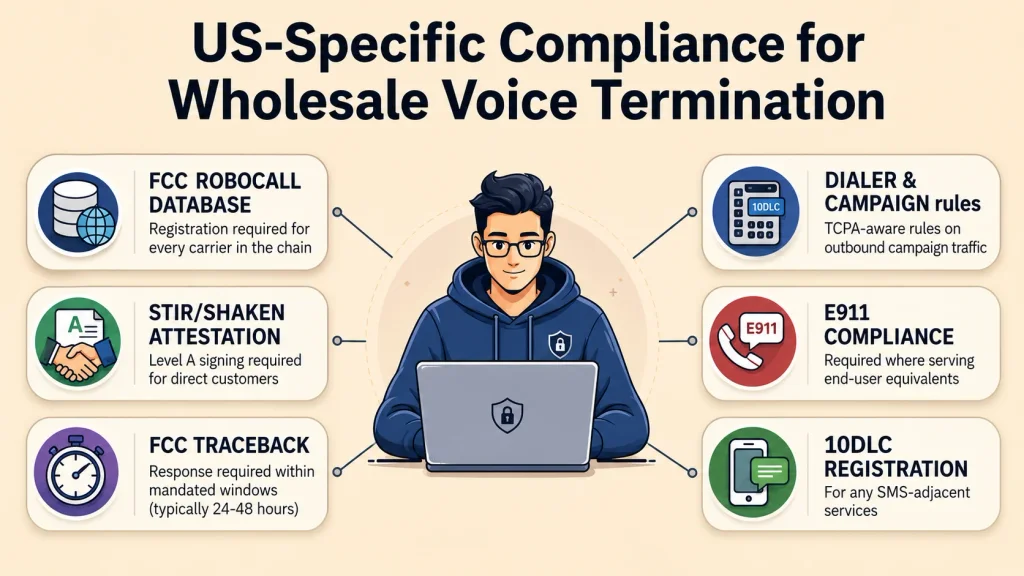
US-bound wholesale voice termination in 2026 has non-negotiable compliance requirements:
FCC Robocall Mitigation Database registration on every carrier in the chain
STIR/SHAKEN attestation with Level A signing for direct customers
FCC traceback response within mandated windows (typically 24-48 hours)
TCPA-aware dialer rules on outbound campaign traffic
E911 compliance where serving end-user equivalents
10DLC registration for any SMS-adjacent services
The non-negotiable US compliance checklist for wholesale voice termination in 2026 — FCC Robocall Mitigation DB, STIR/SHAKEN Level A, traceback response, TCPA dialer rules, E911, and 10DLC.
The 2026 Wholesale Voice Termination Landscape
Three shifts are reshaping wholesale voice termination this year. AI-driven routing is replacing static least-cost routing for any traffic where quality matters. Pay-as-you-go billing is opening modern carriers to smaller resellers. STIR/SHAKEN enforcement is widening the cost gap between properly attested CLI routes and cheaper gray paths.
Buyers who set up termination today with these shifts in mind are setting themselves up for the 2026-2028 landscape rather than the 2018-2020 one most architectures still reflect. The wholesale voice services overview explains how termination fits within the broader service stack alongside origination, transit, and SIP trunking. Report fraud to the FTC.
Conclusion
Wholesale voice termination isn't a commodity decision — it's an architecture decision. The three setup choices made at provisioning time (concurrent call channels with burst headroom, multi-carrier termination from day one, real-time CDR pipelines) determine whether the platform you build today still works at 100x the volume.
Businesses evaluating wholesale VoIP providers alongside their termination setup should run the same 30-day parallel test on both — ASR and ACD data cuts through any provider's sales claims.
Match the architecture to the audience: UCaaS resellers need tenant isolation and CLI preservation; BPOs need AI-routed CC paths and dual carriers; CPaaS platforms need REST APIs and per-call billing; verification flows need low PDD and direct interconnects; enterprises need SOC 2-compatible CDR and Level A STIR/SHAKEN. There is no universal "best" setup.
Choose the configuration that fits the workload, set the compliance posture from day one, and audit 30 days of real production traffic before scaling. The carriers who measure honestly are the ones worth signing.
Frequently Asked Questions
What is wholesale voice termination in simple terms?
Wholesale voice termination in simple terms is the carrier-grade service that delivers your outbound voice calls to destination phone numbers worldwide. You hand calls to your termination provider via SIP; they route through tier-1 carrier networks; the destination network rings the called phone. Billing is per minute against destination rate decks. Termination is the opposite of origination, which handles inbound calls arriving on your DIDs.
How quickly can I provision wholesale voice termination?
Wholesale voice termination provisioning timelines vary dramatically by provider archetype. Modern AI-native platforms including Ajoxi can spin up sandbox accounts within 24-48 hours, with production traffic flowing within a week. Traditional tier-1 carriers requiring KYC, credit checks, contract negotiation, and SBC integration typically take 4-12 weeks. The faster providers don't usually compromise on quality — they just have streamlined onboarding workflows and modern customer architecture.
What is the difference between wholesale voice termination and SIP trunking?
Wholesale voice termination is the upstream layer that delivers outbound calls to destination networks in bulk. SIP trunking is one product built on top of wholesale voice termination — typically sold to enterprises or end customers as a fixed-channel voice connection between their PBX and the carrier. Most SIP trunk providers buy wholesale voice termination from upstream wholesalers.
Resellers can buy wholesale voice termination directly and white-label SIP trunks downstream.
How many concurrent calls can wholesale voice termination support?
Wholesale voice termination scales to support millions of concurrent calls at the carrier level, but your specific capacity is determined by your contracted concurrent call channels (CCs) plus burst headroom. Most platforms over-provision by 3-4x average traffic to absorb campaign spikes and viral events.
Modern wholesale voice termination platforms can scale concurrent channels elastically without redeploying SBC infrastructure, but the contracted floor matters during the first incident.
What US compliance is mandatory for wholesale voice termination in 2026?
US wholesale voice termination requires FCC Robocall Mitigation Database registration, STIR/SHAKEN Level A attestation for direct customers, FCC traceback response within mandated windows, TCPA-aware dialer rules on outbound campaigns, E911 compliance where serving end-user equivalents, and 10DLC registration for SMS-adjacent services. Failure on any of these triggers downstream call blocking, Spam Likely flagging, or regulatory penalties.
Run your voice on Ajoxi.
AI receptionists, wholesale routes, virtual numbers — built on one platform with transparent pricing and a 24/7 NOC.