Wholesale Call Routing: How Carriers Route Voice at Scale
Every wholesale call has to find a path from the network it starts on to the network it ends on. This guide explains how that path is chosen, how least-cost routing works, what separates a good route from a cheap one, and how routes are kept secure.
Wholesale VoIP
Wholesale Call Routing: How Carriers Route Voice at Scale
Why Call Routing Decides Everything
When a call leaves one network and has to reach a phone on another, somewhere in the middle a decision gets made: which path will carry it? That decision is wholesale call routing, and it happens millions of times a second across the world's voice networks without anyone on either end of the call ever noticing.
They notice only when it goes wrong — a call that will not connect, a two-second silence before the ringback, audio that arrives in fragments.
For a wholesale carrier, routing is not a back-office detail. It is where cost, quality, and compliance are all settled at once. Route well and you deliver clear calls at a margin. Route badly — chasing the cheapest path with no regard for quality — and you bleed customers through dropped calls and inflated effective costs.
This guide unpacks how routing actually works at scale and what to look for in a provider that does it well. If you are new to the field, our overview of wholesale VoIP sets the broader context.
What Is Wholesale Call Routing?
Wholesale call routing is the process by which a carrier selects the path a voice call takes from its origin to its destination across one or more interconnected networks. In the wholesale world, a single carrier rarely owns a direct link to every phone on earth.
Instead it holds agreements with many other carriers, and routing is the logic that picks which of those carriers should carry a given call to a given destination.
The decision is rarely about a single factor. A routing engine weighs the per-minute cost of each available path, the live quality each one is delivering, the regulatory rules that apply to the destination, and whether the path has spare capacity right now.
The output is a routing table — an ordered list of which carrier to try first, second, and third for every prefix the wholesaler sells. When traffic patterns or rates shift, that table is rebuilt, often automatically.
Done at scale, this is what lets a wholesaler offer global reach without owning a global network. It buys reach from others and routes intelligently across it.
How Wholesale Call Routing Works
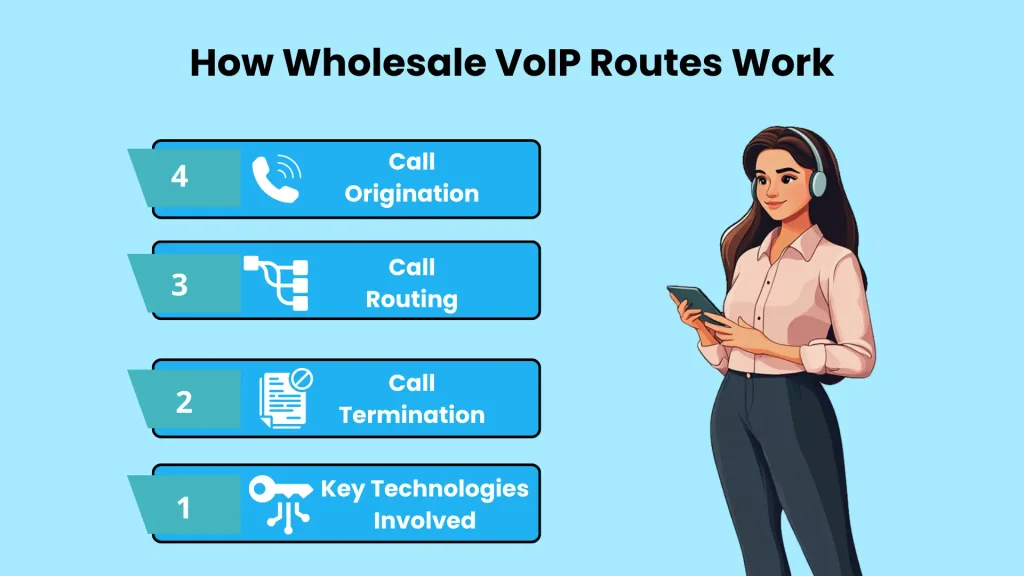
A routed call moves through three broad phases, all of it riding on the standard IP voice protocols.
Origination. The call enters the wholesaler's network from a customer — a reseller, a call center, an app. It arrives as a SIP session, with SIP (Session Initiation Protocol) handling the setup, teardown, and negotiation, while the actual audio travels separately as RTP (Real-time Transport Protocol) packets.
The routing decision. The softswitch reads the dialed number, matches it against its routing table, and selects a path. This is where least-cost routing runs, where quality data is consulted, and where any compliance filter — blocking a prohibited prefix, enforcing caller-ID rules — is applied.
If the first-choice carrier rejects the call or fails to connect, the engine fails over to the next path in the list.
Termination. The chosen carrier delivers the call onto the destination network through its voice termination, the far-end phone rings, and the two-way RTP media path opens. From the customer's perspective the call simply went through; underneath, it may have been offered to two or three carriers before one accepted it.
Routing and VoIP termination work hand in hand, and the buy rates behind it are set by wholesale VoIP termination rates.
The routing path — origination, LCR decision, termination.
Least-Cost Routing, Explained
Least-cost routing (LCR) is the technique at the center of wholesale routing. In its simplest form it does exactly what the name says: given several carriers that can reach a destination, send the call down the cheapest one. Because a wholesaler's margin is the gap between buy rate and sell rate, shaving the buy rate on every minute compounds into real money at volume.
The trap is treating LCR as a pure price contest. The cheapest route is often cheap for a reason — a longer chain of intermediary carriers, lower answer rates, or quietly degraded audio. A naive LCR setup that ranks purely on price will happily send every call down a route that connects 60% of the time, and the customer churns.
That is why mature routing engines run quality-weighted LCR: the cost is balanced against live performance, so a route a fraction of a cent cheaper does not win if its answer rate or audio is materially worse.
Good LCR is also dynamic. Rates change constantly across hundreds of carriers, and quality fluctuates by hour and by destination. The strongest providers recompute routing continuously from live data rather than a rate sheet uploaded once a week, so the path a call takes at 9am may not be the path an identical call takes at 9pm.
What Makes a Route Good: CLI, ASR, and ACD
Not all routes are equal, and the differences have names worth knowing.
CLI vs Non-CLI. A CLI route passes full caller-line identification through to the recipient, so they see an accurate caller ID. Because people answer calls from identified numbers far more often than unknown ones, CLI routes tend to deliver higher answer rates and they comply with caller-ID regulations in markets that require it.
A Non-CLI route drops the caller ID to cut cost — a legitimate choice for some bulk outbound traffic, but only when the route type is disclosed and matched to the use case.
ASR (Answer-Seizure Ratio) is the share of call attempts that actually connect. A healthy CLI route sits above 90%; a route limping along at 60% is signalling either a poor path or a fraudulent one, and it quietly destroys campaign economics.
ACD (Average Call Duration) tells a complementary story. Very short average durations across a route can point to false-answer billing or calls that connect and immediately fail, while normal durations suggest real conversations are happening. Read alongside ASR, ACD helps a carrier tell a genuinely good route from one that merely looks good on the rate card.
Securing Wholesale Routes Against Fraud
Routing touches money on every call, which makes it a magnet for fraud. The threats are well known — International Revenue Share Fraud (IRSF) pumping traffic toward premium numbers, Wangiri one-ring scams, and SIM-box abuse injecting traffic that bypasses legitimate interconnects. Left unmonitored, any of these can run up enormous charges before anyone notices. Report fraud to the FTC.
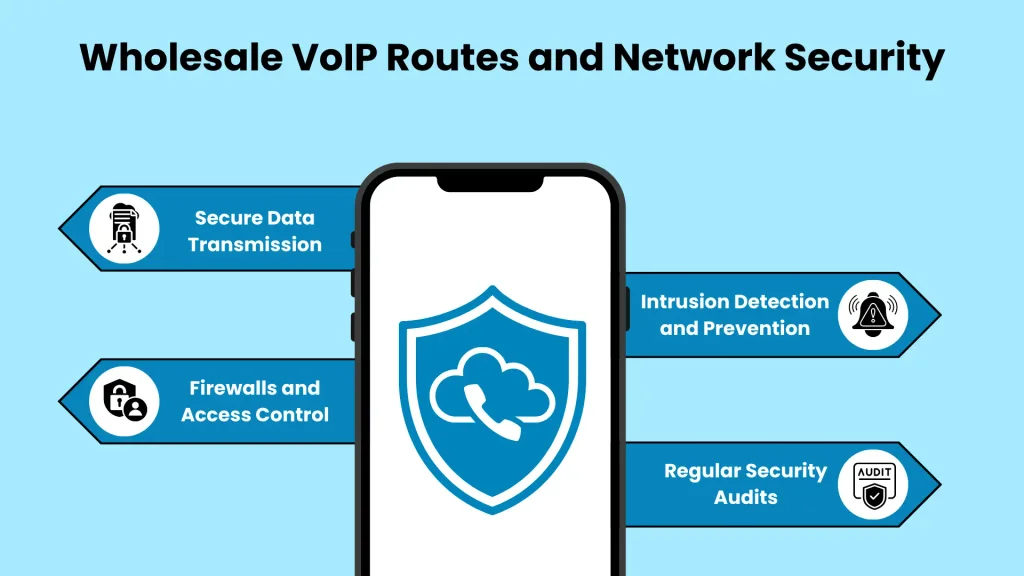
The defenses layer together. Encryption with TLS on SIP signaling and SRTP on media keeps routes from being intercepted or hijacked. Continuous monitoring watches traffic for the patterns fraud creates — sudden spikes toward unusual prefixes, answer rates that look manufactured, durations that do not add up.
And automated fraud detection can throttle or block suspect traffic in real time, before a billing incident becomes a billing disaster.
A wholesaler that treats routing security as an afterthought eventually pays for it. The providers worth working with build detection into the routing layer itself, so a suspicious route can be pulled the moment it starts behaving like fraud rather than after the invoice lands.
Wholesale call routing is the quiet machinery that decides whether a call connects, how clear it sounds, what it costs, and whether it is legal to deliver.
The carriers that do it well do not just chase the cheapest path — they weigh cost against live quality, read the signals that separate a real route from a fraudulent one, and build security into the routing layer rather than bolting it on.
For anyone buying wholesale voice, the routing engine behind a provider is worth as much scrutiny as the rate card in front of it. The rate is what you are quoted; the routing is what you actually get.
FAQ: Wholesale Call Routing
What is wholesale call routing?
Wholesale call routing is how a carrier chooses the path a voice call takes from its origin to its destination across interconnected networks. Because no carrier owns a direct link to every phone, routing logic picks which partner carrier should carry each call to each destination, balancing cost, quality, capacity, and compliance.
What is least-cost routing (LCR)?
Least-cost routing is the technique of sending each call down the cheapest available path that can reach its destination. Mature systems use quality-weighted LCR, which balances price against live performance so a marginally cheaper route does not win when its answer rate or audio quality is materially worse.
What is the difference between CLI and Non-CLI routes?
A CLI route passes full caller-line identification to the recipient, which improves answer rates and meets caller-ID regulations. A Non-CLI route drops the caller ID to reduce cost. Non-CLI can be legitimate for certain bulk outbound traffic, provided the route type is disclosed and matched to the use case.
What do ASR and ACD measure in call routing?
ASR (Answer-Seizure Ratio) is the percentage of call attempts that connect, with healthy CLI routes above 90%. ACD (Average Call Duration) reflects how long connected calls last; abnormally short durations can signal false-answer billing or failing connections. Read together, they reveal whether a route is genuinely good.
How are wholesale routes protected from fraud?
Routes are protected with TLS/SRTP encryption, continuous traffic monitoring for the patterns fraud creates such as IRSF and Wangiri, and automated detection that can throttle or block suspect traffic in real time before it generates a large billing incident.
Run your voice on Ajoxi.
AI receptionists, wholesale routes, virtual numbers — built on one platform with transparent pricing and a 24/7 NOC.