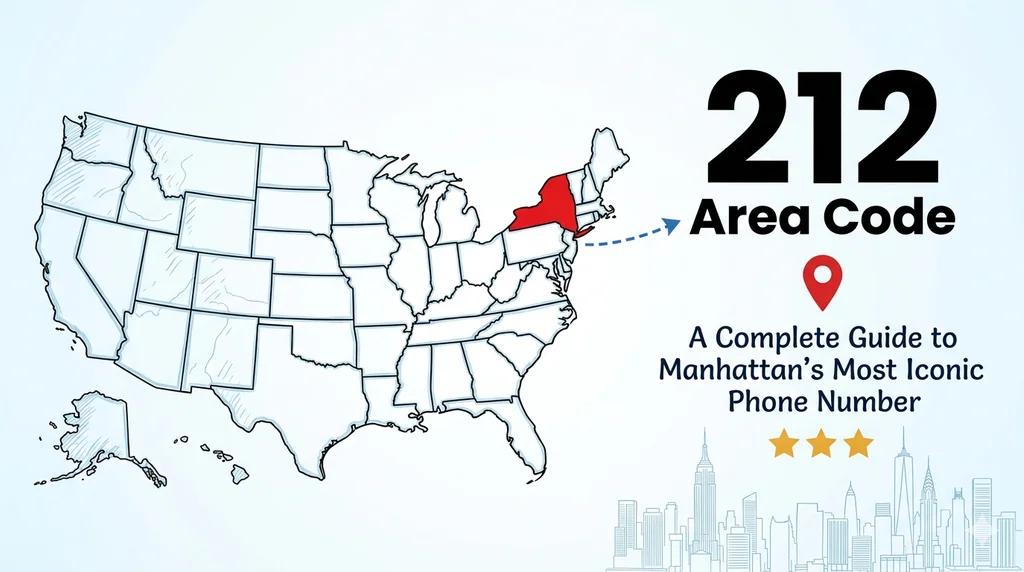
212 Area Code: Manhattan's Most Iconic Phone Number Guide
The 212 area code covers Manhattan, NYC — established in 1947 as the original NYC code. History, business benefits, dialing format, local SEO value, and how to get a 212 virtual number.
The 203 area code has covered southwestern Connecticut since 1947 — the finance-heavy Gold Coast of Stamford and Greenwich, plus Yale's New Haven, Bridgeport, and Norwalk. Whether you just got a 203 call or want a Connecticut number for your business, this guide covers its location, the 475 overlay, time zone, and how to get one.
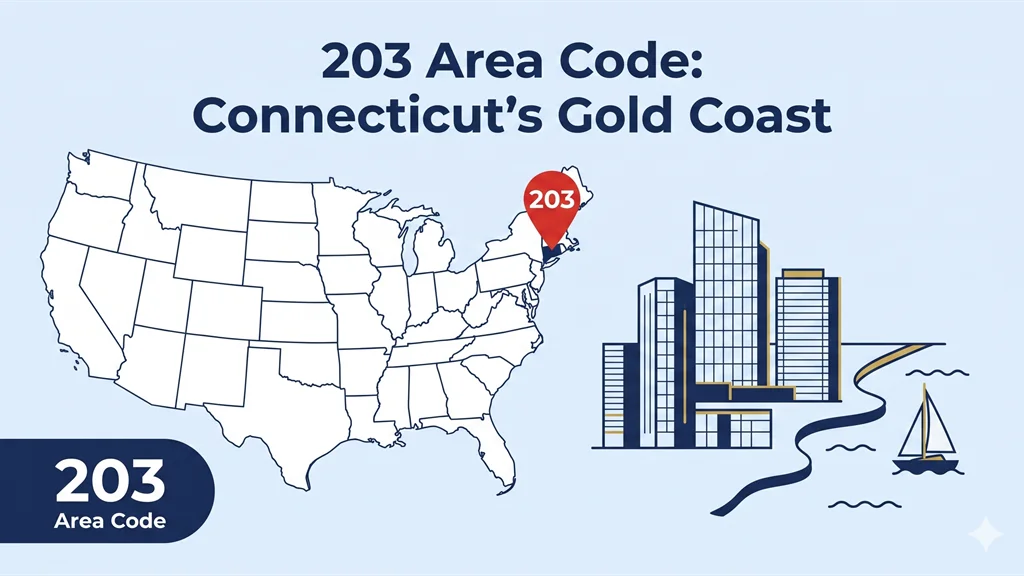
When a 203 area code number lights up your screen, the call is coming from southwestern Connecticut — the affluent commuter belt that hugs Long Island Sound between New York City and New Haven. It is the code of Stamford's corporate towers, Greenwich's hedge funds, Yale's New Haven, and Bridgeport, the largest city in the state.
One of the original area codes from 1947, 203 once covered all of Connecticut on its own.
Whether you received an unexpected 203 call, you want to know where is 203 area code and what state it belongs to, or you are setting up a Connecticut business line, this guide explains where 203 reaches, how the 475 overlay works, dialing and time zone, spam safety, and how to get a 203 phone number.
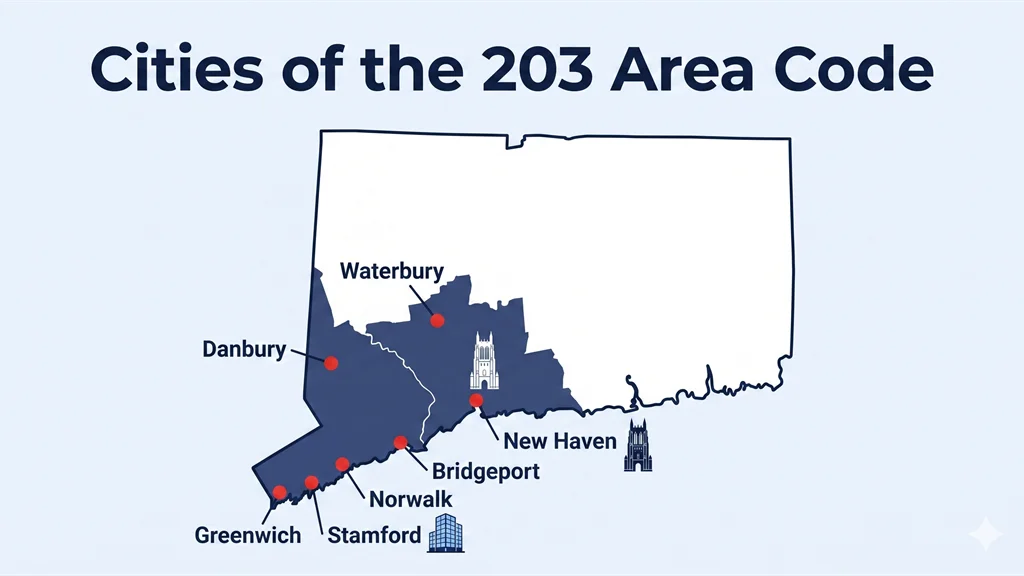
The 203 area code location is southwestern Connecticut — Fairfield County and New Haven County. To answer the most common search, where is 203 area code: its largest cities are Bridgeport, New Haven, Stamford, Norwalk, Danbury, and Waterbury, alongside the wealthy shoreline towns of Greenwich, Westport, Darien, Fairfield, and Milford.
The 203 area code is in Connecticut — not California. If you have seen the search 203 area code California, that is a misconception: 203 is a Connecticut code on Eastern Time. It also covers one of the most densely populated and prosperous stretches of the United States, a compact corner of the state facing Long Island Sound and bordering New York.
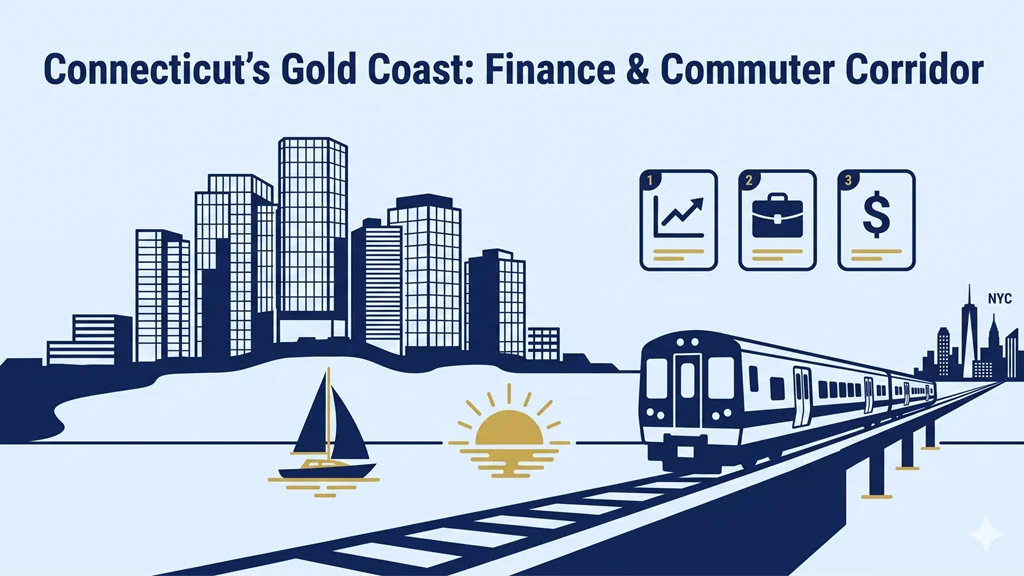
The southwestern shoreline of Connecticut is nicknamed the Gold Coast — a chain of towns with some of the highest household incomes in the country, tied to New York City by the Metro-North commuter railroad. For decades, executives and financiers have lived in 203 territory and commuted into Manhattan, and increasingly the businesses have followed them across the state line.
Greenwich is one of the hedge-fund capitals of the world, and Stamford packs a downtown of corporate headquarters and financial firms into a skyline that rivals far larger cities. The same customers who recognize New York City's 212 area code as a mark of prestige treat a 203 number as the local badge of Connecticut's finance corridor.
Fairfield County is consistently ranked among the wealthiest counties in the United States — and 203 is the area code that covers nearly all of it.
The 203 code is an original — one of the 86 area codes created in 1947 — and it once served the entire state of Connecticut. As the state grew, Connecticut's numbering was split and overlaid several times. Here is the full picture:
| Code | Year | Coverage | Notes |
|---|---|---|---|
| 203 | 1947 | Southwestern CT — Stamford, New Haven, Bridgeport | Original code; strongest local identity |
| 475 | 2009 | Overlay — same area as 203 | Added when 203 ran low; forced 10-digit dialing |
| 860 | 1995 | Rest of Connecticut — Hartford, eastern CT | First split off from 203 |
| 959 | 2014 | Overlay — same area as 860 | Newer overlay for northern & eastern CT |
In short: 203 is the original southwestern-Connecticut code, 475 is a newer overlay sitting on the exact same ground, and 860 (with its 959 overlay) covers the rest of the state. Because 203 is the founding 1947 code, a 203 number signals the longest-established presence on the Gold Coast — while a 475 number is functionally identical but reads as newer.
Because southwestern Connecticut is served by two overlapping codes (203 and 475), 10-digit dialing is mandatory. Every call needs the full area code plus the 7-digit number, even between two 203 numbers in the same town.
The 203 region runs on Eastern Time — EST (UTC−5) in winter and EDT (UTC−4) in summer, the same clock as New York City. That alignment matters here more than in most markets: the Gold Coast's finance and corporate offices keep hours that track the New York Stock Exchange, so a West Coast firm calling a 203 number is working a 3-hour-earlier window.
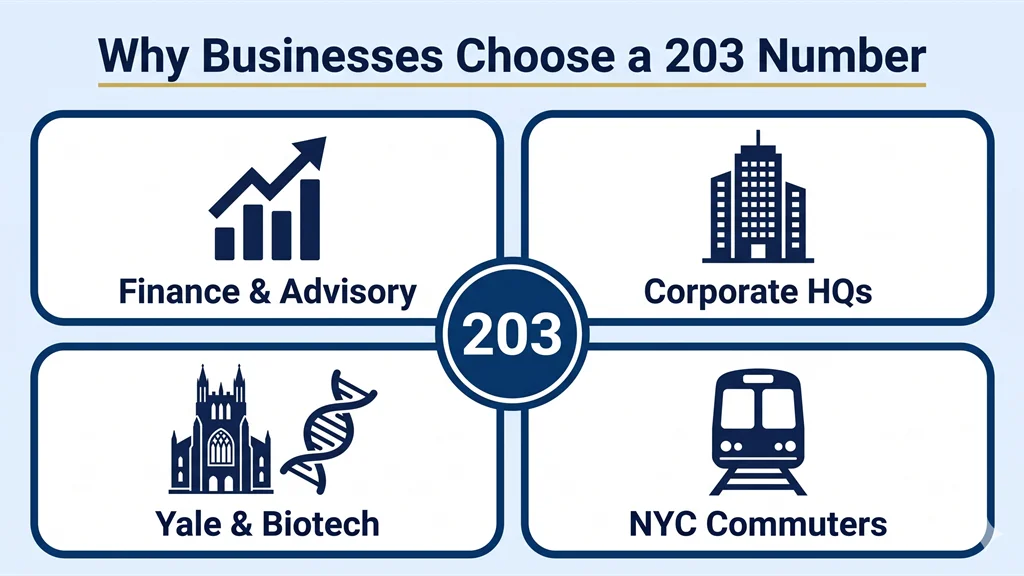
A 203 area code number tells Connecticut customers your business is local to one of the most affluent, business-dense corners of the country — not an out-of-state caller. A virtual 203 number lets you serve the Gold Coast and New Haven markets without leasing a Stamford office.
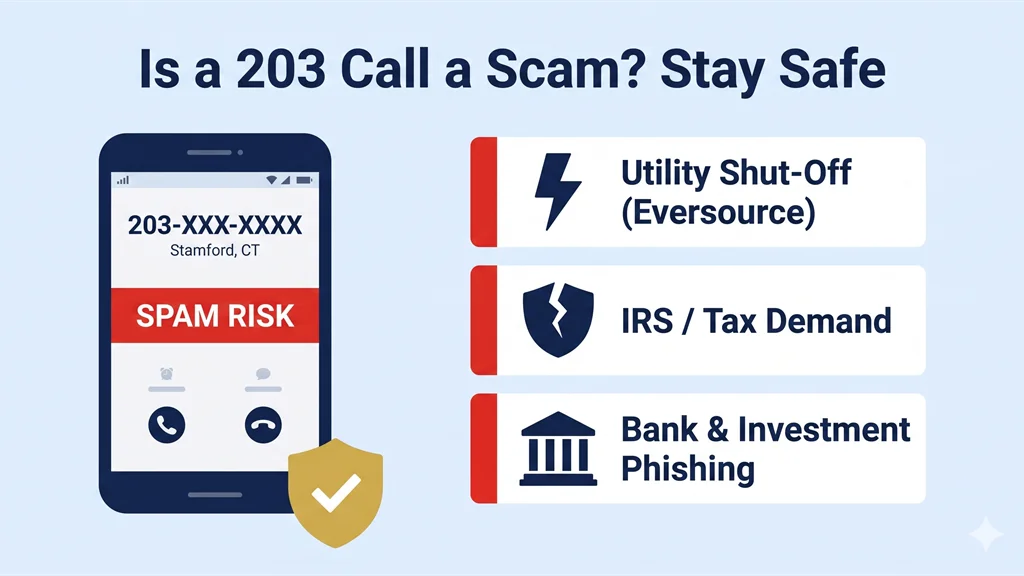
If you keep getting calls from a 203 area code number you do not recognize, the answer to is 203 area code a scam is: the code itself is not. It is almost always "neighbor spoofing," where a scammer fakes a local 203 caller ID so the call looks familiar and you are more likely to pick up.
The vast majority of 203 calls are ordinary Connecticut businesses, residents, and services.
Common 203 scam patterns include fake Eversource utility shut-off threats, phony IRS demands, auto-warranty robocalls, and bank or investment "fraud alert" phishing aimed at the region's finance customers. To stay safe: never share personal or financial details with an unexpected caller, let unknown 203 numbers go to voicemail first, and learn to spot the warning signs through the FTC's guide to phone scams.
Getting a 203 phone number for your business takes three steps:
Most numbers go live within 24 to 48 hours and stay fully portable under FCC rules — so your Connecticut number follows you even if you change providers.
The 203 area code is more than a routing prefix — it is the phone identity of Connecticut's Gold Coast and New Haven. Since 1947 it has represented Greenwich's hedge funds, Stamford's corporate towers, Yale's campus, and Bridgeport's working waterfront, and even with the 475 overlay sharing the same geography, 203 remains the code that says "southwestern Connecticut" most clearly on any caller ID.
For any business whose customers are in Stamford, Greenwich, New Haven, Norwalk, or the wider Fairfield and New Haven county region, a 203 number is the strongest local signal available — and with virtual provisioning, you can carry that presence from anywhere.
The 203 area code covers southwestern Connecticut — Fairfield County and New Haven County along Long Island Sound. Its main cities are Bridgeport, New Haven, Stamford, Norwalk, Danbury, and Waterbury, plus shoreline towns like Greenwich, Westport, and Darien. It runs on Eastern Time and is not in California.
203 is in Connecticut. It is one of the original 1947 area codes and once covered the entire state; today it serves the southwestern corner, sharing that geography with the 475 overlay, while 860 covers the rest of Connecticut.
The 203 code itself is legitimate and used by ordinary Connecticut businesses and residents. Repeated calls from unknown 203 numbers are usually "neighbor spoofing," where a scammer fakes a local caller ID. Let unknown numbers go to voicemail, never share personal or financial details, and report suspicious calls; the FTC publishes guidance on recognizing and avoiding phone scams.
203 (1947) is the original southwestern-Connecticut code and carries the strongest local identity. 475 (2009) is an overlay covering the exact same area — it was added when 203 numbers began running low. Both work identically, but 203 signals a longer-established presence.
The 203 area code observes Eastern Time — EST (UTC−5) in winter and EDT (UTC−4) during daylight saving, the same clock as New York City. It is 3 hours ahead of the US West Coast, and its finance offices track New York Stock Exchange hours.
Choose the number type (local DID, business line, or vanity pattern), reserve an available 203 number from a provider's inventory, and configure SIP routing to your softphone or PBX. Stamford, Greenwich, and New Haven prefixes are in highest demand, but most numbers go live within 24 to 48 hours and are fully portable under FCC rules.
AI receptionists, wholesale routes, virtual numbers — built on one platform with transparent pricing and a 24/7 NOC.