Ajoxi
  • Pillar
    CLOUD PHONE

    Cloud phone, messaging, video, fax, chat — the full UCaaS stack.

    • Business PhoneCalling, SMS, video, one login
    • Customer EngagementEvery channel, one thread
    • Personal AIAI sidekick for every rep
    • SMS & MMSText from the main business line
    • Team ChatInternal chat, tied to customers
    • Video MeetingsRooms with AI notes + recap
    • Online FaxFax without the fax machine
    • Website ChatbotAuto-resolves order status & returns
    • Phone SystemModern PBX with AI built in
    Featured
    Everything included.
    Cloud phone, AI contact center, AI Receptionist, SMS, video, 300+ integrations.
    See plans & pricing
  • Core Capabilities
    • AI Receptionist24/7 first answer · 32 languages
    • AI SentimentRoutes upset callers automatically
    • AI Agent AssistWhisper scripts + next-best-action
    • Conversation IntelligenceTranscripts, sentiment, objections
    • Call RecordingFull fidelity + keyword search
    • Auto-attendantDrag-and-drop visual IVR builder
    • Supervisor ToolsListen · whisper · barge · audit log
    • Toll-free Numbers800, 888, 877 — provisioned fast
    New
    AI Sentiment · live scoring.
    Routes upset customers to senior agents the moment sentiment dips. On every paid plan.
    See AI Sentiment
  • By Industry & Team
    • FinanceSOC 2 · FINRA-ready audit trails
    • RetailOmnichannel + cart-recovery SMS
    • SaaSAPIs + Personal AI on every seat
    • LogisticsMulti-site dispatch routing
    • Sales TeamsPower dialer + live AI coaching
    • Support TeamsShared memory across 8 channels
    • Remote TeamsSame number on every device
    • SMBAI receptionist as your front desk
    • Enterprise ITSSO, SCIM, multi-site governance
    Most adopted
    A calling stack compliance trusts.
    Call recording, STIR/SHAKEN, sentiment routing. SOC 2, PCI, and FINRA-ready audit trails.
    See finance
  • Native Sync
    • HubSpotTwo-way sync · lifecycle triggers
    • ZohoCRM · Desk · Books · Bigin
    Coming soon
    Salesforce. Pipedrive. Freshsales.
    All three native two-way syncs in Q3 2026. Want a heads-up on launch?
    Email me on launch
  • Pricing
  • Learn
    • BlogEngineering & product notes
    • Customer storiesReal outcomes, real numbers
    • GuidesStep-by-step playbooks
    • WebinarsLive every Thursday · on-demand
    • Contact UsTalk to sales or get support
    Build
    • DocsHow everything works
    • API referenceREST + webhooks
    • SDKsNode, Python, Go, Ruby
    • ChangelogEvery ship, in one place
    Trust
    • Status pageLive uptime + incidents
    • Security + complianceSOC 2 · GDPR · PCI
    • PrivacyWhat we collect & why
    • TermsThe contract, in chapters
    Fresh ink
    8,400 calls, measured.
    AI receptionist accuracy by language, accent, and call type — the unedited numbers.
    Read the post
Sign inFree Trial
Cloud Phone
Business PhoneCalling, SMS, video, one loginCustomer EngagementEvery channel, one threadPersonal AIAI sidekick for every repSMS & MMSText from the main business lineTeam ChatInternal chat, tied to customersVideo MeetingsRooms with AI notes + recapOnline FaxFax without the fax machineWebsite ChatbotAuto-resolves order status & returnsPhone SystemModern PBX with AI built in
Contact Center
OmnichannelOne queue for every channelOutbound DialerPredictive, power, previewAgent AssistLive whisper coachingSupervisor AssistSpot bad calls in real timeInteraction AnalyticsAuto-QA, topic trendsEnterprise500+ seat operations
AI Family
Ajoxi VoiceAI Receptionist that books appointmentsAI AssistantDrafts, summaries, follow-upsConversation AIReads every call so you don't miss a thing
AI Receptionist24/7 first answer · 32 languagesAI SentimentRoutes upset callers automaticallyAI Agent AssistWhisper scripts + next-best-actionConversation IntelligenceTranscripts, sentiment, objectionsCall RecordingFull fidelity + keyword searchAuto-attendantDrag-and-drop visual IVR builderSupervisor ToolsListen · whisper · barge · audit logToll-free Numbers800, 888, 877 — provisioned fast
FinanceSOC 2 · FINRA-ready audit trailsRetailOmnichannel + cart-recovery SMSSaaSAPIs + Personal AI on every seatLogisticsMulti-site dispatch routingSales TeamsPower dialer + live AI coachingSupport TeamsShared memory across 8 channelsRemote TeamsSame number on every deviceSMBAI receptionist as your front deskEnterprise ITSSO, SCIM, multi-site governance
HubSpotTwo-way sync · lifecycle triggersZohoCRM · Desk · Books · Bigin
Learn
BlogEngineering & product notesCustomer storiesReal outcomes, real numbersGuidesStep-by-step playbooksWebinarsLive every Thursday · on-demandContact UsTalk to sales or get support
Build
DocsHow everything worksAPI referenceREST + webhooksSDKsNode, Python, Go, RubyChangelogEvery ship, in one place
Trust
Status pageLive uptime + incidentsSecurity + complianceSOC 2 · GDPR · PCIPrivacyWhat we collect & whyTermsThe contract, in chapters
Sign inFree Trial
Ajoxi

Cloud phone and AI contact center on one carrier-grade network.

SOC 2GDPRPCI-DSS

Cloud Phone

  • Business Phone
  • Customer Engagement
  • SMS & MMS
  • Team Chat
  • Video Meetings
  • Phone System

Contact Center

  • Omnichannel
  • Outbound Dialer
  • Agent Assist
  • Interaction Analytics
  • Enterprise CCaaS

Wholesale

  • Wholesale VoIP
  • Wholesale Voice

AI

  • AI Receptionist
  • AI Assistant
  • Conversational AI
  • AI Sentiment
  • Conversation Intelligence

Solutions

  • Finance
  • Retail & eCom
  • SaaS & Tech
  • Sales Teams
  • SMB

Company

  • Pricing
  • About
  • Customers
  • Contact Us
  • Country Codes
  • Area Codes
  • Docs
  • Status
  • Security

© 2026 Ajoxi. All rights reserved.

All systems normal
  • Privacy
  • Terms
  • Security
Map of the United States with area-code regions
← All articlesPillar Guide · Area Codes

Area codes, decoded.

How the North American Numbering Plan actually works, why area codes still matter for business calling, and how to pick the right one for your customers.

Updated May 15, 2026·13 min read·2,200 words
Table of Contents
  • 1.Introduction
  • 2.What is an area code?
  • 3.How area codes are structured
  • 4.Overlay vs geographic codes
  • 5.Toll-free area codes
  • 6.Getting a local number
  • 7.Vanity area codes
  • 8.Keeping your area code when porting
  • 9.Looking up codes & spotting scams
  • 10.10-digit dialing rule
  • 11.Conclusion
  • 12.FAQ

Introduction

Area codes are the most public part of the phone system. They sit on every business card, every billboard, every contact form — and yet most of the rules governing them are buried in FCC filings most callers will never read. The result is a market full of casual confusion: people who think "212" is reserved for Manhattan, people who don't understand why some cities require 10-digit dialing, businesses that assume their toll-free number is portable when it isn't.

This guide unwinds the rules. How the North American Numbering Plan actually works, why overlays force 10-digit dialing, what makes a toll-free code different from a geographic one, how to keep your area code when you port a number, and the scam patterns that exploit the format. Skim a section or read it through — both work.
Map of the United States with state boundaries
The North American Numbering Plan covers the US, Canada, and 23 Caribbean countries — about 350 active area codes today.

What is an area code?

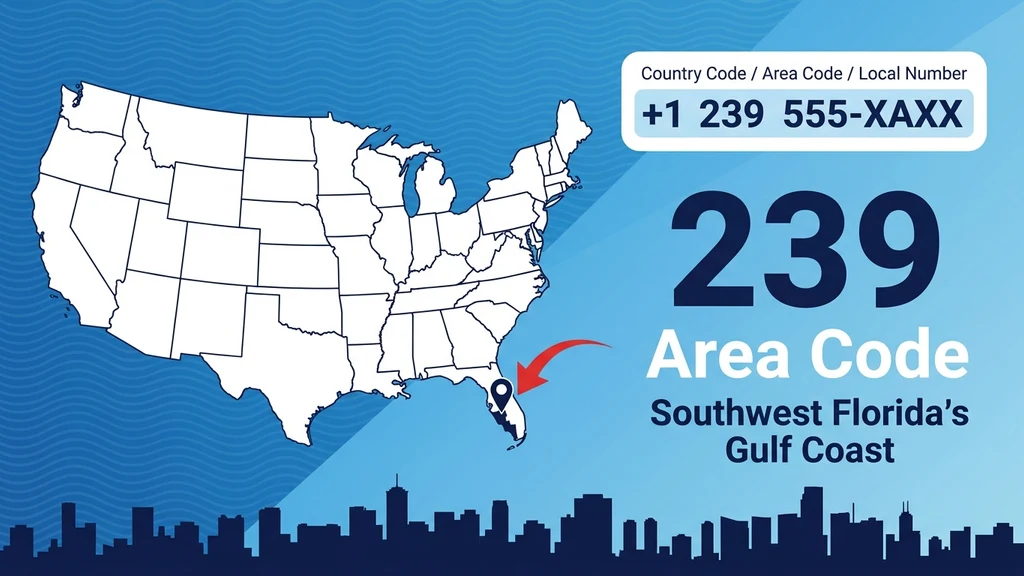
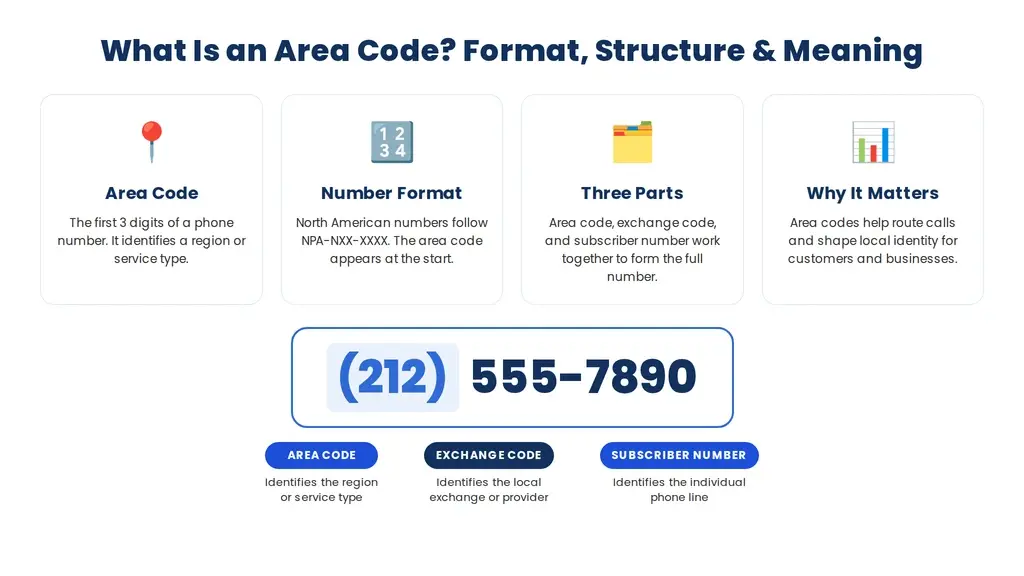
An area code is the three-digit prefix at the start of a North American phone number that identifies a specific geographic region or service type. In a number like (415) 555-2671, the "415" is the area code — assigned to most of San Francisco. In (833) 555-2671, "833" is a toll-free code: not tied to geography at all.

Area codes live inside a framework called the North American Numbering Plan (NANP), which covers the United States, Canada, and 23 Caribbean countries. The plan was created in 1947 by AT&T to standardize how long-distance calls were routed, and it's still administered today by the North American Numbering Plan Administrator (NANPA) under FCC oversight.

For most people, area codes are just a way to tell where a caller is from. For businesses, they're a marketing decision: a New York area code on your sales line tells East Coast prospects you're local, even if your engineers are in Bangalore.
Phone displaying a 10-digit North American phone number with area code
Every NANP phone number is 10 digits — the first three are the area code (NPA), and they tell you who is calling before the line connects.

How area codes are structured

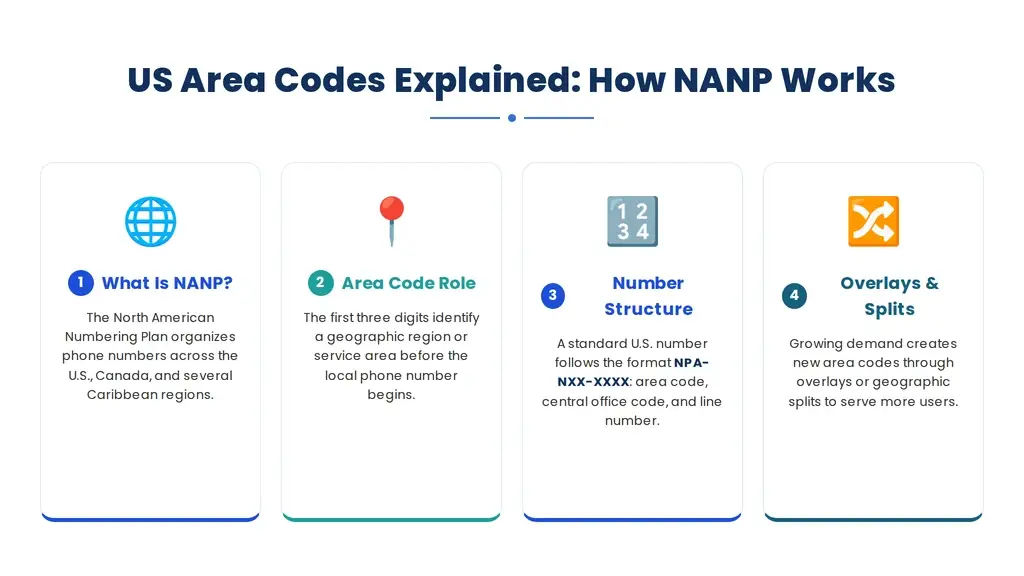
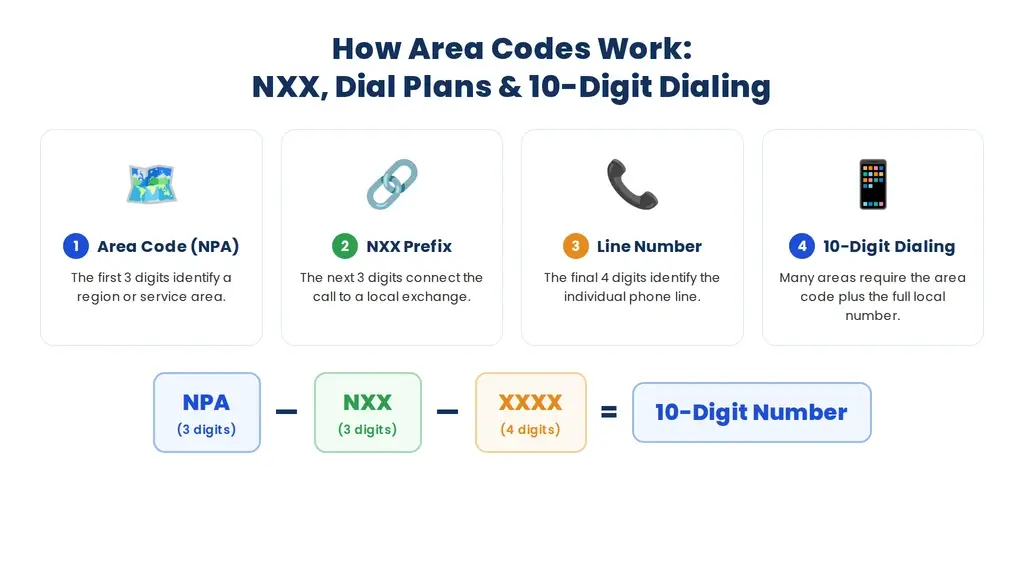
The technical name for an area code is an NPA — Numbering Plan Area. A full North American phone number has three parts:

  • NPA (positions 1–3) — the area code. There are about 350 active NPAs in the NANP.
  • NXX (positions 4–6) — the central office code or exchange. Identifies a smaller switching area within the NPA.
  • Subscriber number (positions 7–10) — the unique identifier for the line within that exchange.

Together they form the NPA-NXX-XXXX format you see on every business card. Originally an NPA covered a contiguous geographic area like all of Manhattan or all of greater Chicago. As demand for phone numbers exploded with mobile, fax, modems, and second lines in the 1990s, the original geographic boundaries had to be subdivided — and that's when overlay area codes started to appear.

One important rule: under NANP regulations, the middle digit of an area code used to be restricted to 0 or 1 (so codes looked like N0X or N1X). That restriction was dropped in 1995 to expand capacity. The middle digit can now be any number 0–9.
Close-up of a phone keypad showing the digit grid used in NPA-NXX-XXXX dialing
NPA + NXX + four-digit subscriber number — the three parts of every North American phone number, dialed on the same keypad since 1947.

Overlay vs geographic area codes

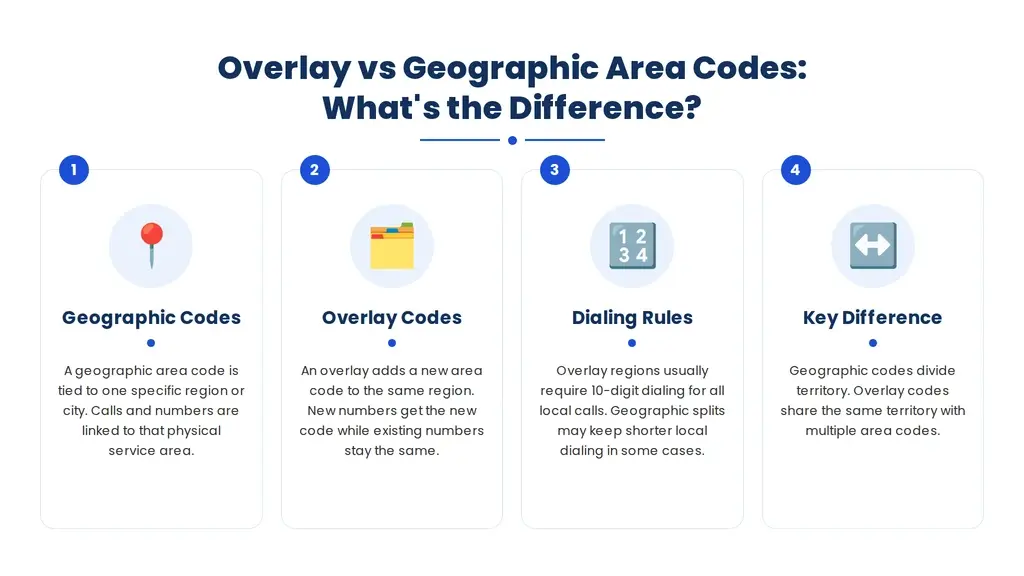
When a metropolitan area runs out of numbers in its original area code, the regulator has two ways to add capacity. Both have major consequences for businesses and consumers.

Geographic split. The existing service area is divided in half. Half keeps the old code, half gets a new one. Customers in the "losing" half have to change their phone numbers — printed business cards, marketing collateral, customer databases all need updating. This is disruptive enough that splits have been rare since 2000.

Overlay. A new area code is added on top of the existing one, covering the same geography. Existing customers keep their old numbers; new lines get the new code. The trade-off: 10-digit dialing becomes mandatory for local calls within the overlay region, because now two different area codes serve the same neighborhood.

Almost every major US metro now runs as an overlay — New York has 212, 332, 646, and 917 layered over Manhattan, and Los Angeles has 213, 310, 323, 424, 818, and others. If you see multiple area codes for the same city, that's an overlay.
Manhattan skyline showing overlay area code territory
Manhattan runs four area codes — 212, 332, 646, 917 — layered over the same neighbourhoods. Overlays are why 10-digit dialing is now mandatory.

Toll-free area codes

Toll-free numbers use a special set of non-geographic area codes that route to whoever has registered the number, with the cost of the call paid by the business receiving it (the "toll-free subscriber") rather than the caller.

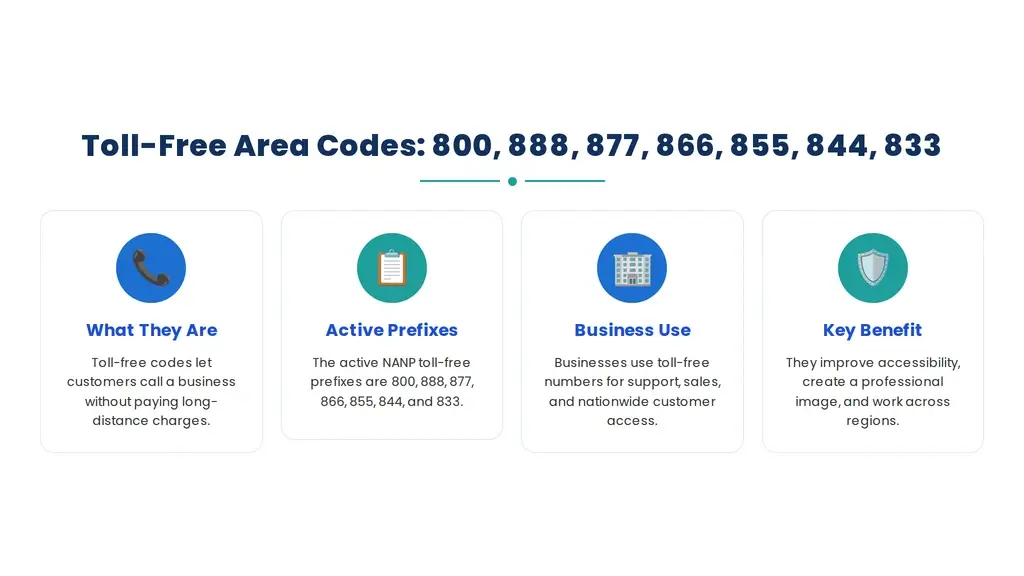
The active toll-free prefixes in NANP, in order of when they were introduced:

  • 800 — original toll-free, launched 1966. Most prestigious, most expensive on the secondary market.
  • 888 — added 1996.
  • 877 — added 1998.
  • 866 — added 2000.
  • 855 — added 2010.
  • 844 — added 2013.
  • 833 — added 2017.
  • 822, 880-887, 889 — reserved for future use.

Toll-free numbers are managed differently than geographic numbers — they're allocated via a competitive auction system called Somos for premium 833 vanity strings, and through "RespOrgs" (Responsible Organizations) for everyday assignments. Any toll-free number is fully portable between providers.
Customer service desk with toll-free inbound call routing
Toll-free codes (800, 888, 877, 866, 855, 844, 833) route to whoever holds the RespOrg record — and the called party pays, not the caller.

Getting a local area code phone number

Provisioning a local number in any US or Canadian area code is fast — usually under five minutes from a modern VoIP provider, sometimes instant. The provider has a pool of available numbers in each NPA-NXX block they hold, and assigns one to your account on demand.

Three things matter when choosing a local number for business use:

  • The area code itself. Pick one that matches the customer base you're targeting. A 212 New York number costs the same as an obscure rural NPA, but the brand signal is wildly different.
  • The exchange (NXX). Within a major area code, exchanges historically map to specific neighborhoods. A 415-986 number originally meant the Financial District; 415-552 meant the Mission. Most providers no longer let you choose the NXX, but premium providers do.
  • The subscriber digits. A "vanity" subscriber portion (-CALL, -8888, -1234) commands a premium. Sometimes worth it for inbound marketing. Usually not for outbound sales.

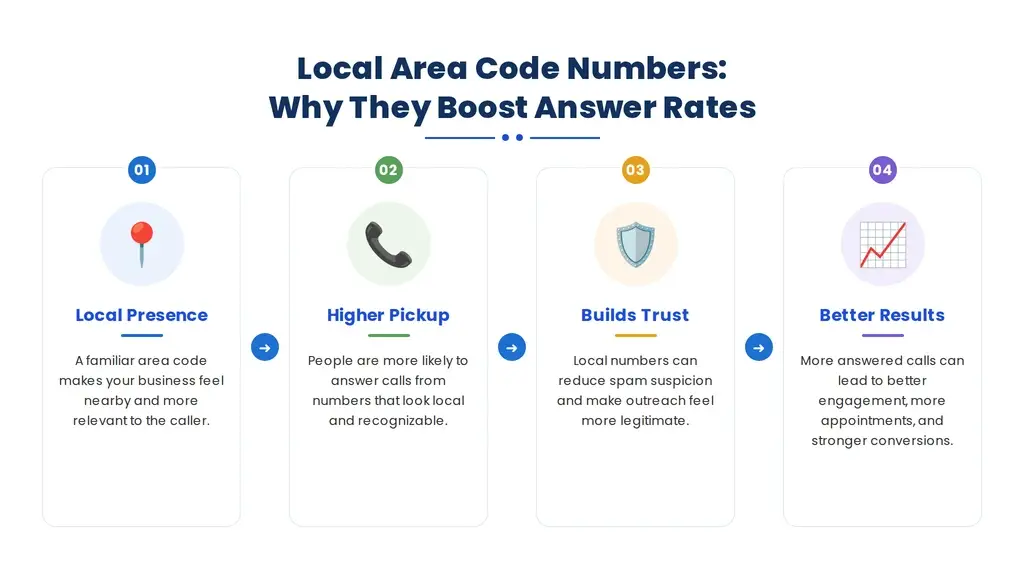
For businesses operating in multiple cities, the right move is usually one local number per metro you serve, plus a single toll-free for general inbound. Local numbers get higher answer rates on outbound dials because they don't trigger spam filters as readily as toll-free.
Smartphone showing a dialed local US phone number
Local presence is a marketing decision — a 212 number on outbound dial gets answered more often than an unknown toll-free in many markets.

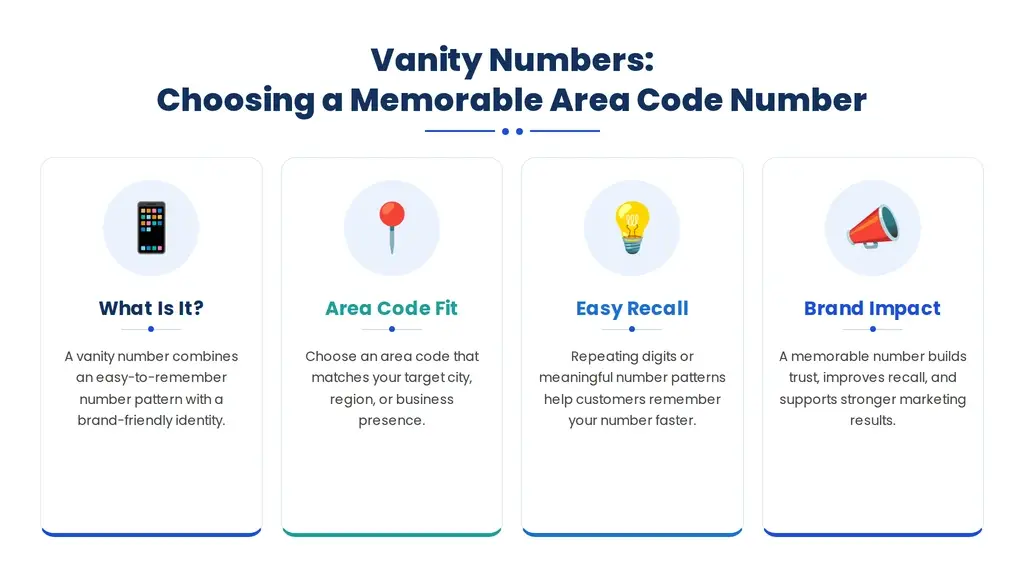
Vanity area codes

Certain area codes carry brand weight that goes beyond geography. A vanity area code is one that businesses pay a premium to acquire because of its association.

The premium NPAs: 212 (Manhattan), 213 (downtown LA), 310 (Beverly Hills / West LA), 415 (San Francisco), 305 (Miami), 202 (DC), 312 (downtown Chicago), 617 (Boston), and 718 (the outer NYC boroughs, oddly prestigious in tech circles). These signal "established big-city business" the moment someone sees the caller ID.

Secondary-market brokers sell 212 numbers for $500–$5,000 each depending on the digits. Compare to a brand-new 332 number (the Manhattan overlay introduced in 2017), which costs nothing — but tells everyone you're new.

For most businesses, vanity codes are not worth the cost. The exception is consumer-facing brands (real estate, hospitality, premium services) where the caller ID is part of the customer experience.
Aerial view of a major metro skyline associated with premium vanity area codes
Premium NPAs — 212 Manhattan, 310 Beverly Hills, 415 San Francisco — carry brand weight that some businesses pay $500–$5,000 per number to acquire.

Keeping your area code when porting

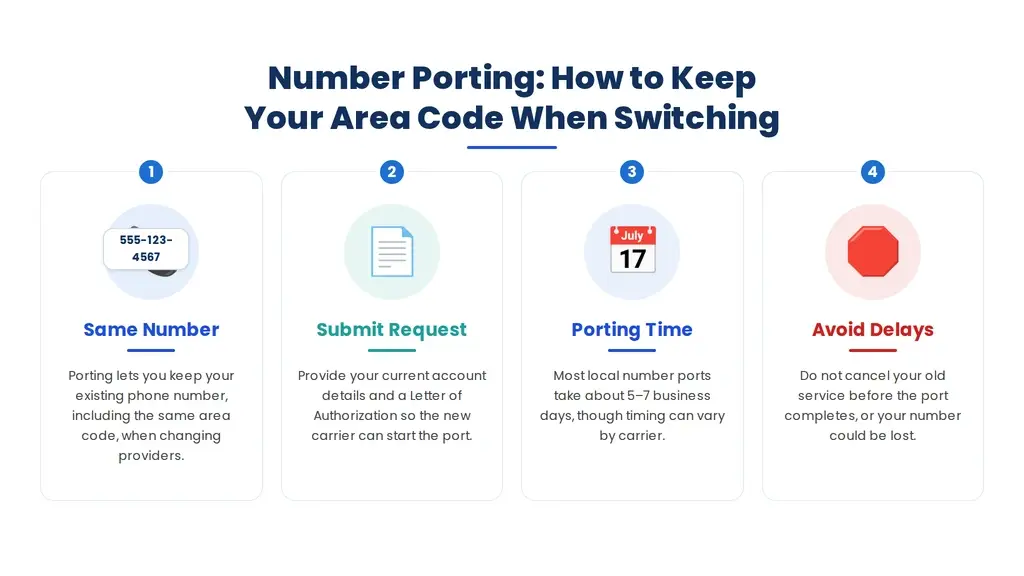
Number portability is the federal right to keep your phone number when you change carriers. It's been guaranteed in the US since 2003 and covers both wireline and wireless. Your area code, exchange, and subscriber digits all stay the same.

The porting process for a local US number typically takes 5–7 business days, sometimes faster with modern carriers. The losing carrier (the one you're leaving) and gaining carrier (the new one) exchange a Letter of Authorization, validate ownership, then schedule a cutover window — usually a 2-hour evening window when call volume is lowest.

One common gotcha: if you've already cancelled service with your old carrier, your number may be considered "released" and can't be ported. Always port first, then cancel. Same rule for toll-free numbers — port before you let the contract lapse.
Contract paperwork for a number portability transfer between carriers
Number portability is a federal right — but the port has to happen before you cancel service, or the number is released back to the pool.

Looking up area codes and spotting scams

The fastest way to look up an area code is a free public registry like the NANPA database. Type the three digits and it returns the state, the time zone, and the cities served.

Area codes also matter for scam detection. Three patterns to watch for:
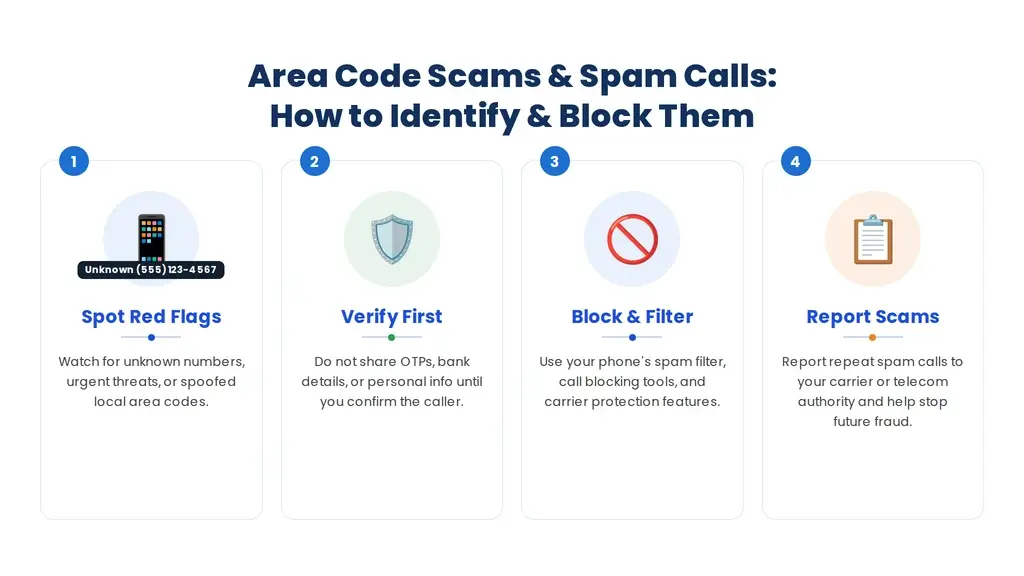
  • Caribbean area codes that look US. 809 (Dominican Republic), 876 (Jamaica), 268 (Antigua), and others use NANP format but are premium international destinations. Calling them back can cost $20+ per minute. The "one-ring" scam exploits this.
  • Spoofed local codes. Telemarketers and scammers routinely spoof a local area code to increase answer rates. The STIR/SHAKEN protocol (mandated for all US carriers) is meant to flag these, but coverage is imperfect.
  • Unfamiliar 800-block codes. Older toll-free codes (800, 888, 877) are well known. Newer ones (855, 833) are increasingly used by scammers because consumers don't recognise them. If you don't recognise the business, don't return the call.
Call-centre agent reviewing caller ID for suspicious area codes
Three patterns to watch: NANP-format Caribbean codes (809, 876, 268), spoofed local NPAs flagged by STIR/SHAKEN, and unfamiliar new toll-free blocks (855, 833).

The 10-digit dialing rule

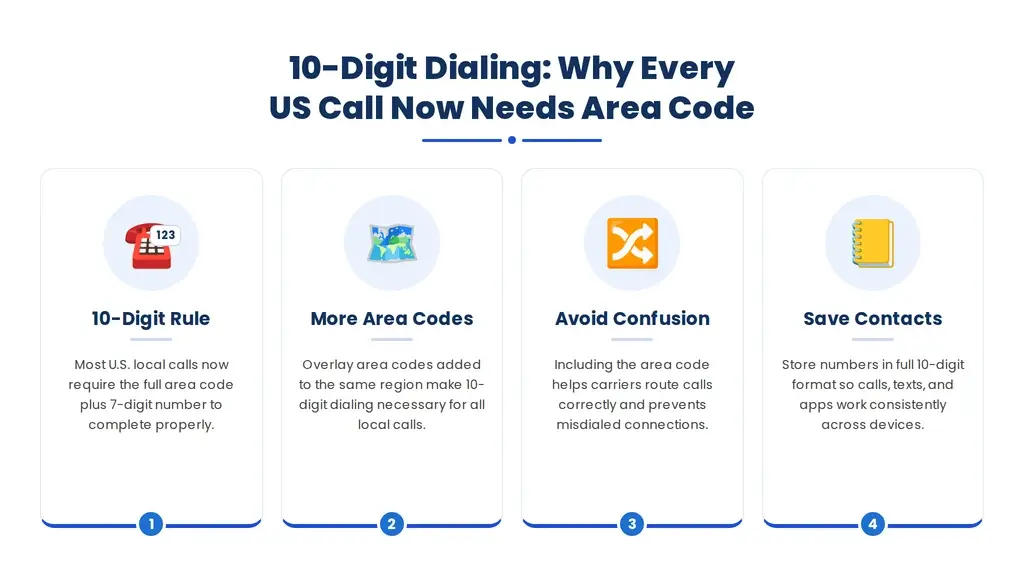
In some US regions you can dial a local call as just seven digits (NXX-XXXX) without the area code. In other regions you have to dial all 10 digits. Why?

The answer is overlay codes. Where one area code covers a region exclusively, seven-digit dialing works because the area code is implied. Where two or more area codes overlay the same region, the carrier needs to know which NPA you mean — so 10-digit dialing becomes mandatory.

This becomes a public safety issue with 988, the suicide and crisis hotline launched in 2022. Because 988 conflicts with some legitimate seven-digit local numbers that start with 988, every region of the country that hasn't already moved to mandatory 10-digit dialing was required to do so. As of October 2021, every US region requires 10-digit dialing for local calls, even where overlays don't yet exist.
Desk phone handset and dial keypad ready for 10-digit local dialing
Since October 2021, every US region requires 10-digit dialing for local calls — partly to free up the 988 prefix for the suicide and crisis lifeline.

Conclusion

The area-code system looks ad-hoc from the outside but is fundamentally a slow-moving regulatory machine — codes get added when capacity runs out, overlays force 10-digit dialing, ports are guaranteed by federal law, and toll-free numbers belong to whoever holds the RespOrg record. Once you understand the framework, the rules stop feeling arbitrary.

For a business choosing a phone number, the practical advice is short: pick a local area code that matches the customers you're trying to reach, port your existing number rather than starting fresh, layer a single toll-free over your inbound funnel, and skip the vanity premium unless your brand is genuinely consumer-facing. The rest is plumbing — handled by your carrier, invisible to your callers.

Local numbers in any US area code, instantly.

Ajoxi provisions a local number in any active NPA in under five minutes — 212, 415, 305, anywhere — with the same per-line price across all of them. Toll-free, vanity, and international available too.
See pricing Start free trial

325 Area Code Texas: Cities, Coverage, and How to Get a 325 Number

The 325 area code covers 36,000 square miles of west-central Texas — Abilene, San Angelo, Brownwood, Sweetwater.

Read the article

Frequently asked questions

What is an area code?

In the North American Numbering Plan, an area code (also called an NPA) is the first three digits of a 10-digit phone number. It identifies a geographic region or, in the case of toll-free codes (800, 888, etc.), a non-geographic service.

What is the difference between an overlay area code and a geographic area code?

A geographic area code covers one region exclusively. An overlay puts two or more area codes on top of the same region, usually because the original code ran out of numbers. Overlays force 10-digit dialing for local calls.

Can I keep my area code when I switch carriers?

Yes. Federal number portability (LNP) has been the law in the US since 2003. Your full 10-digit number, including the area code, comes with you. Start the port before you cancel the old service — once a line is fully released the number may be lost.

What is a toll-free area code?

Toll-free codes (800, 888, 877, 866, 855, 844, 833) are non-geographic prefixes where the called party pays for the call instead of the caller. They are administered by a RespOrg, not a regional carrier.

Why do some places require 10-digit dialing?

Where an area code is overlaid by a second code over the same region, the carrier cannot tell which NPA you meant from a 7-digit number, so 10-digit dialing is mandatory. As of October 2021, all US regions require 10-digit dialing because of the 988 crisis hotline.

How do I get a local number in an area code I am not physically in?

Through a cloud number provider. You buy a virtual local number in any active NPA and route it to your existing phone, voicemail, or call routing rules. No physical move required.

Related Posts

325 Area Code Texas: Cities, Coverage, and How to Get a 325 Number

325 Area Code Texas: Cities, Coverage, and How to Get a 325 Number

The 325 area code covers 36,000 square miles of west-central Texas — Abilene, San Angelo, Brownwood, Sweetwater.

720 Area Code Denver: Denver's Overlay Explained and How to Get a 720 Number

720 Area Code Denver: Denver's Overlay Explained and How to Get a 720 Number

The 720 area code overlays 303 and 983 across the entire Denver metro — Aurora, Lakewood, Thornton, Westminster, Boulder.

805 Area Code California: Central Coast Code Explained and How to Get a Number

805 Area Code California: Central Coast Code Explained and How to Get a Number

California's central-coast 805 covers Santa Barbara, Ventura, Oxnard, Thousand Oaks, SLO, and Paso Robles.