720 Area Code Denver: Denver's Overlay Explained and How to Get a 720 Number
You are probably already using the 720 area code without realizing it. 720, 303, and 983 share the same Denver geography, the same dialing rules, and the same Mountain Time clocks. The differences are administrative, not regional.
Area Codes
720 Area Code Denver: Denver's Overlay Explained and How to Get a 720 Number
Introduction
You're probably already using the 720 area code without realizing it. If you've called any Denver-area number in the last decade, the number on your phone bill was almost certainly a 720, 303, or the newer 983 — three different area codes sharing the exact same geography, the same dialing rules, and the same Mountain Time clocks. The differences between them are administrative, not regional.
A 720 number from a coffee shop in LoDo is no different in coverage from a 303 number across the street.
If you're trying to set up a Denver-area business presence, understand a call you received from a 720 number, or figure out why local calls in Colorado now require 10 digits when they didn't 20 years ago, this guide breaks down how the 720 area code actually works — coverage, the overlay system, dialing rules, history, and how to provision a 720 phone number quickly in 2026.
What Is the 720 Area Code?
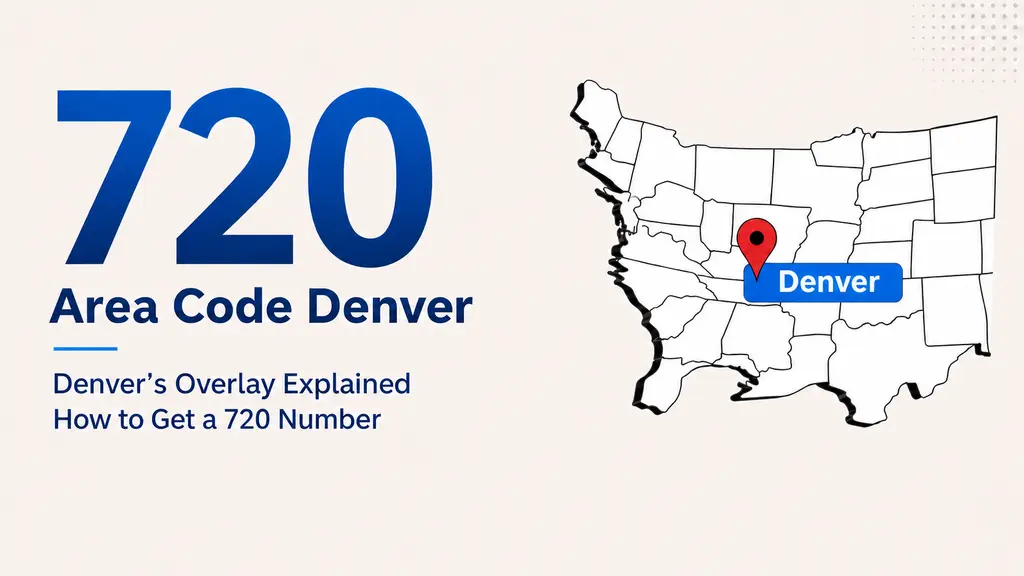
The 720 area code is a North American Numbering Plan area code covering the Denver metropolitan area in Colorado. It was created in 1998 as an overlay of the existing 303 area code rather than as a geographic split — meaning 720 and 303 share the same physical territory. The Denver metro added a third overlay, 983, in 2021.
All three operate under Mountain Time and require 10-digit dialing for local calls.
The 720-303-983 Overlay System Explained
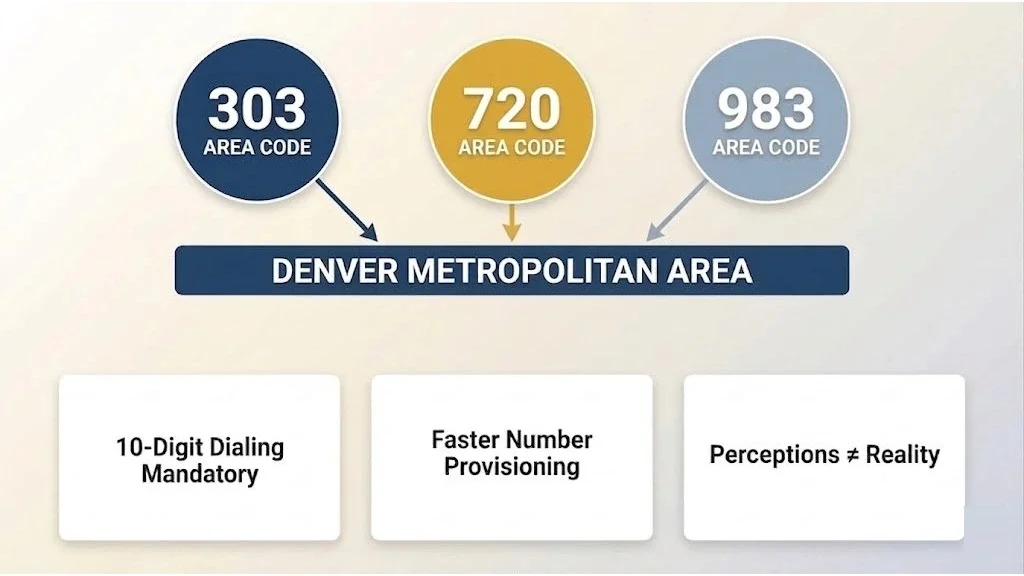
Most US area codes work like Texas or California outside the major cities — one geographic boundary, one area code. The Denver metropolitan area uses an overlay system instead. Three area codes (303, 720, and 983) all serve the same physical region. Every new phone number provisioned in the Denver metro is assigned to whichever code has available inventory, not based on neighborhood or street.
The overlay model has practical consequences:
Ten-digit local dialing is mandatory. Without a unique area code per region, callers must always dial the full area code, even when calling a neighbor.
Number provisioning is faster. New numbers can be issued from whichever code has inventory available, avoiding the regional exhaustion problems that plague single-code metros.
Older perceptions don't match reality. Denver residents still associate 303 with "real local" numbers and 720 with newer mobile lines, but the geography is identical.
Most US metros with population over 1 million have adopted some form of overlay system since the late 1990s for the same reason: pure geographic codes ran out of numbers. The 602 area code (Phoenix) is a notable exception — it still uses geographic splits rather than overlays.
The 720-303-983 overlay — three area codes serve one Denver metro region, forcing 10-digit dialing, enabling faster provisioning, with identical geography despite the perception gap.
Cities and Neighborhoods Covered by 720
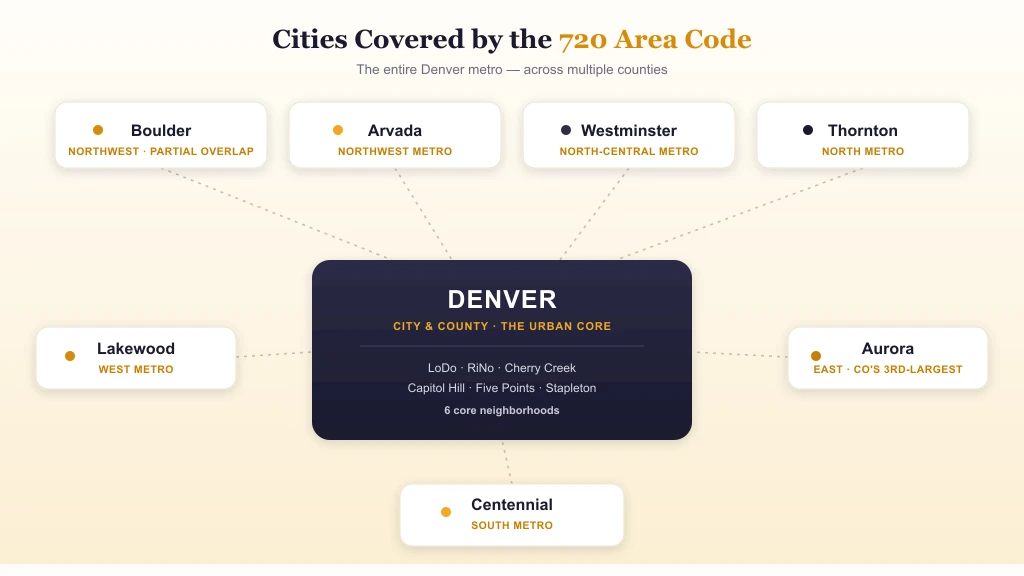
The 720 area code covers the entire Denver metropolitan statistical area across multiple counties. Major cities and neighborhoods using 720 numbers include:
Denver (city and county) — the urban core including LoDo, RiNo, Cherry Creek, Capitol Hill, Five Points, and Stapleton
Aurora — Colorado's third-largest city, east of Denver
Lakewood — west Denver metro
Thornton — north Denver metro
Westminster — north-central Denver metro
Arvada — northwest Denver metro
Centennial — south Denver metro
Boulder — northwest of Denver, partially overlapping
Englewood, Littleton, Wheat Ridge, Brighton, and Commerce City — surrounding Denver suburbs
The same boundary is shared with 303 and 983, so any city or neighborhood that has a 303 number also has 720 and 983 numbers in active use.
Cities and neighborhoods covered by 720 — Denver at the urban core, ringed by Aurora, Lakewood, Thornton, Westminster, Arvada, Centennial, and Boulder across the metro.
Time Zone, Dialing Rules, and 10-Digit Local
The entire 720 area code operates in Mountain Time, switching between Mountain Standard Time (UTC-7) in winter and Mountain Daylight Time (UTC-6) under daylight saving. Because of the 303/720/983 overlay, the Denver metro requires 10-digit local dialing — you cannot call a neighbor with seven digits even within the same neighborhood. Domestic callers from outside the metro dial 1 + 720 + 7-digit local number.
International callers dial their country's international prefix + 1 (US country code) + 720 + 7-digit local number. The North American Numbering Plan Administration (NANPA) manages all area code assignments and 10-digit dialing mandates across the US and Canada.
Denver's Economy and Why Businesses Use 720 Numbers
The Denver metro area is one of the fastest-growing US economies, anchored by technology (Google's Boulder campus, Palantir, SendGrid), aerospace (Lockheed Martin, Ball Aerospace), telecommunications (CenturyLink/Lumen heritage), energy, healthcare, and a sprawling startup ecosystem. The region added population steadily through the 2010s and 2020s, driving the need for that third 983 overlay.
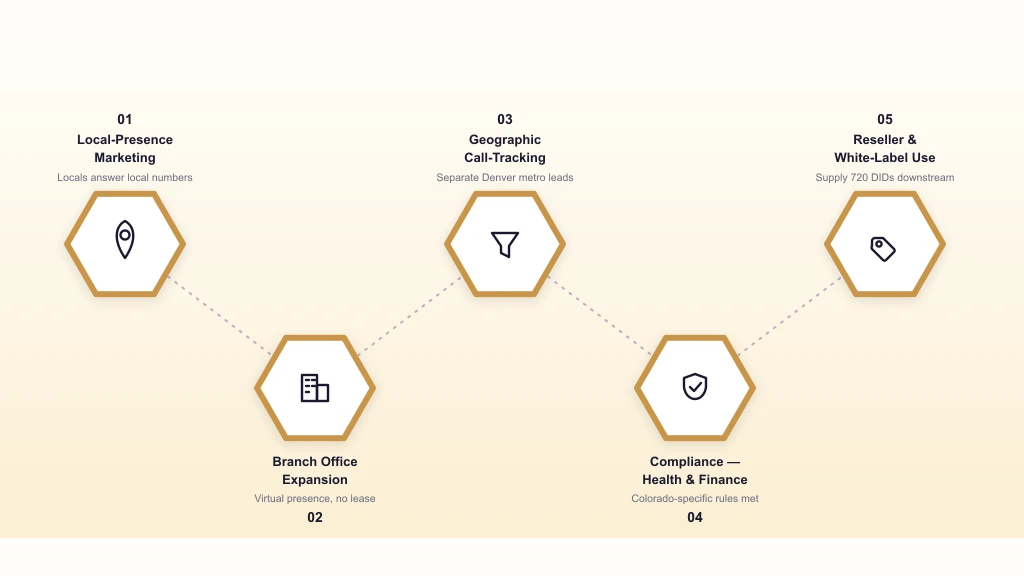
Businesses provision 720 numbers for:
Local-presence marketing — Denver callers answer local 720, 303, and 983 numbers more readily than out-of-area or toll-free numbers
Branch office expansion — virtual Denver presence without physical real estate cost
Call-tracking by geography — separating Denver metro leads in CRM workflows
Healthcare and finance regional compliance — meeting Colorado-specific customer-facing expectations
Reseller and white-label use — DID specialists supplying 720 inventory to downstream customers
Local Denver DIDs include 720 area code numbers alongside 303 and 983 inventory, typically provisioned in 24–48 hours. Businesses expanding across multiple metros can compare the 325 area code or the 805 area code for regional coverage options.
Five common reasons businesses provision 720 numbers — from local-presence marketing to reseller and white-label use.
How 720 Differs From 303 (and Why It Matters Less Than You Think)
The 303 area code was Denver's original code from 1947 — older Denver residents still treat 303 as "the real Denver number." The 720 code was added in 1998 to handle exhausted 303 inventory. Functionally there is no difference between them today. Both serve identical geography, identical dialing rules, identical time zone.
Some Denver natives still prefer 303 for emotional reasons, but call-recipient behavior data shows answer rates are statistically equivalent across all three Denver codes.
How to Get a 720 Area Code Phone Number
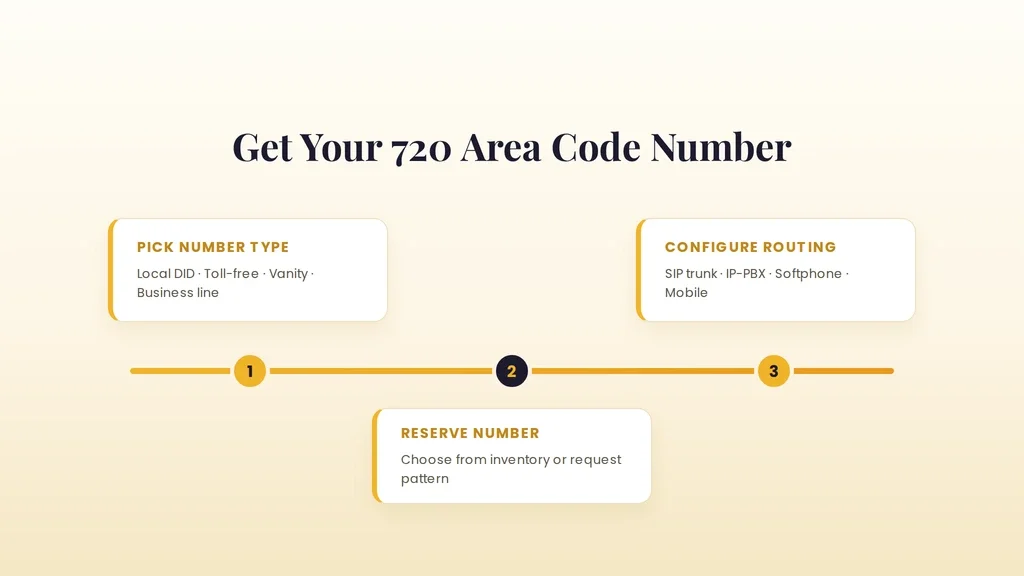
Provisioning a 720 number through a modern DID provider takes three steps:
Pick the number type — local DID, business line, toll-free pair, or vanity. Most buyers want a local 720 DID for Denver presence
Reserve the number — choose from available inventory or request a memorable pattern (rare numbers may carry a setup fee)
Configure routing — point inbound calls to your softphone, IP-PBX, contact-center platform, or mobile device via SIP forwarding or call forwarding rules
The process typically completes in 24–48 hours from order to first inbound call. Numbers stay portable under FCC portability — you can later port your 720 number to a different provider if you switch carriers.
Three steps to a 720 number — pick a number type, reserve it, and configure SIP routing — typically live within 24–48 hours and FCC-portable.
Conclusion
The 720 area code is a textbook case of how modern US metros handle phone-number demand: stack overlays on top of existing geography, force 10-digit dialing for everyone, and stop pretending that area codes correlate with neighborhood. For businesses, the practical implication is freeing — you don't have to chase a scarce 303 number to look "real" in Denver.
A 720 line (or a 983 line) reaches the same customers, in the same neighborhoods, with the same answer rates.
Get a 720 area code phone number — local Denver DIDs across 303, 720, and 983 inventory, business and toll-free pairing, and routing to your softphone or PBX within 24–48 hours. No minimum commits, no setup fees. Businesses also provisioning voice termination alongside their local DIDs can review wholesale VoIP providers and wholesale voice services for carrier-layer context.
Frequently Asked Questions
Where is the 720 area code?
The 720 area code covers the Denver metropolitan area in Colorado, including Denver, Aurora, Lakewood, Thornton, Westminster, Arvada, Centennial, Boulder, Englewood, Littleton, and surrounding suburbs. The region operates in Mountain Time.
The 720 area code was added in 1998 as an overlay of the original 303 code, meaning both codes (plus the newer 983 added in 2021) share the same geographic territory and serve the same cities and neighborhoods.
Is the 720 area code the same as 303?
The 720 area code and 303 area code share the exact same geographic territory in the Denver metropolitan area. Both serve identical cities, neighborhoods, time zone, and dialing rules. The 303 code is older (assigned in 1947) and was Denver's original area code; 720 was added as an overlay in 1998 to handle exhausted 303 inventory.
Functionally they are interchangeable — call-answer rates and local recognition are statistically equivalent.
Why do Denver-area numbers require 10-digit dialing?
Denver-area numbers require 10-digit dialing because the metro operates under an overlay system with three area codes (303, 720, and 983) sharing the same geography. Without a unique area code per neighborhood, the phone network needs the full area code on every call to route correctly. The mandate started when 720 was added in 1998 and was reinforced when 983 was added in 2021.
Most US metros with population over 1 million now require 10-digit local dialing.
When was the 720 area code created?
The 720 area code was created on October 24, 1998, as an overlay of the existing 303 area code in the Denver metropolitan area. The overlay model was chosen over a geographic split to handle exhausted 303 inventory without forcing existing 303 subscribers to change their numbers.
A third overlay code, 983, was added to the same Denver metro region in 2021 to handle continued growth. All three codes operate concurrently with shared geography.
Can I get a 303 area code number instead of 720?
Getting a 303 area code number today is harder than getting a 720 or 983 — most carriers have very limited 303 inventory because the code has been in use since 1947. Some DID providers maintain small 303 inventories from ported-back numbers, but most new Denver-metro provisioning lands on 720 or 983.
For business purposes, the three codes are functionally identical in geography, call routing, and answer rates, so 720 typically substitutes well for any 303 use case.
Run your voice on Ajoxi.
AI receptionists, wholesale routes, virtual numbers — built on one platform with transparent pricing and a 24/7 NOC.