US Toll-Free Number: Complete Business Guide (800/888/877)
A US toll-free number lets customers across the country reach your business without paying for the call — and it signals that you are a national operation worth trusting. This guide explains the prefixes, the caller-pays model, the features that matter, how to get one, and how to stay safe from toll-free fraud.
Area Codes
US Toll-Free Number: Complete Business Guide (800/888/877)
Introduction
When a customer sees a phone number that begins with 1-800 or 1-888, two things happen instantly: they recognize it as toll-free, and they assume the business behind it operates at national scale.
That perception is exactly why a US toll-free number remains one of the most cost-effective branding and customer-service tools a company can own — whether it is a two-person startup or a multi-state enterprise.
Quick definition: A US toll-free number is a telephone number with a special prefix — 800, 888, 877, 866, 855, 844, or 833 — that lets callers reach a business at no charge to them. Instead of the caller paying for the connection, the business that owns the number is billed for the inbound minutes, making it free to dial from anywhere in the United States.
Below we break down what these numbers actually are, why they still matter in an era of mobile phones and free long distance, the exact steps to get one, the features that turn a simple number into a communication system, and the scams you need to recognize.
Whether you are evaluating a virtual phone number setup or a dedicated toll-free line, you will leave with a clear plan.
What Is a US Toll-Free Number?
A US toll-free number is a ten-digit phone number that uses one of seven reserved three-digit prefixes instead of a geographic area code. These prefixes are administered across the North American Numbering Plan, so a single toll-free number works the same whether the caller is in Seattle, Miami, or rural Kansas. The defining feature is the billing arrangement: the called party pays.
The seven active toll-free prefixes are 800, 888, 877, 866, 855, 844, and 833. They were introduced over several decades as each older series ran out of available numbers. The original 800 prefix launched in 1967; 888 followed in 1996, then 877, 866, 855, 844, and most recently 833.
They are functionally identical — none is "better" than another for routing — but the lower prefixes carry more legacy recognition — 800 reads as established, 833 as recently issued. You can check which prefixes still have inventory before committing to one.
The "caller-pays" inversion is the whole point. On a normal call, the person dialing absorbs any charges. With a toll-free number, those inbound charges route back to the business through its toll-free service provider.
In practice this matters less for everyday mobile callers — most US mobile plans bundle unlimited calling — but the psychological signal of "this company will gladly pay for me to reach them" remains powerful.
It would be easy to assume toll-free numbers are a relic, but adoption has actually grown alongside the addition of new prefixes. The reasons are practical and they compound on one another.
National credibility. A toll-free number signals that a business serves customers everywhere, not just one city. It removes any hint of "small local outfit" from your brand.
Customer trust. Buyers are more willing to pick up the phone — or leave a message — when calling costs them nothing and the number looks established.
Free for callers. Even where it is largely symbolic today, the no-charge promise lowers the barrier to contact, which lifts inbound lead volume.
Portability. Toll-free numbers are not tied to a carrier or a location. Under FCC rules you can move yours between providers, so the number you advertise on every brochure stays yours for life.
Vanity options. Toll-free numbers can spell words — 1-800-FLOWERS being the classic — which makes them far easier to remember than a string of digits and turns the number itself into advertising.
For companies expanding past a single market, pairing a toll-free line with local numbers in the markets you serve gives you both national reach and the flexibility to run separate campaigns or departments under distinct numbers.
Toll-free numbers build national credibility and customer trust.
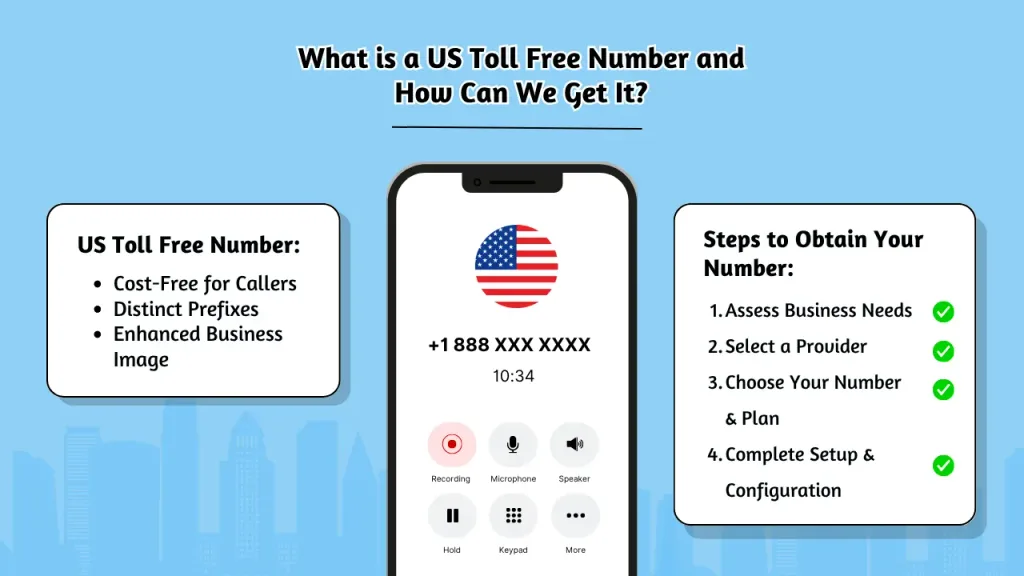
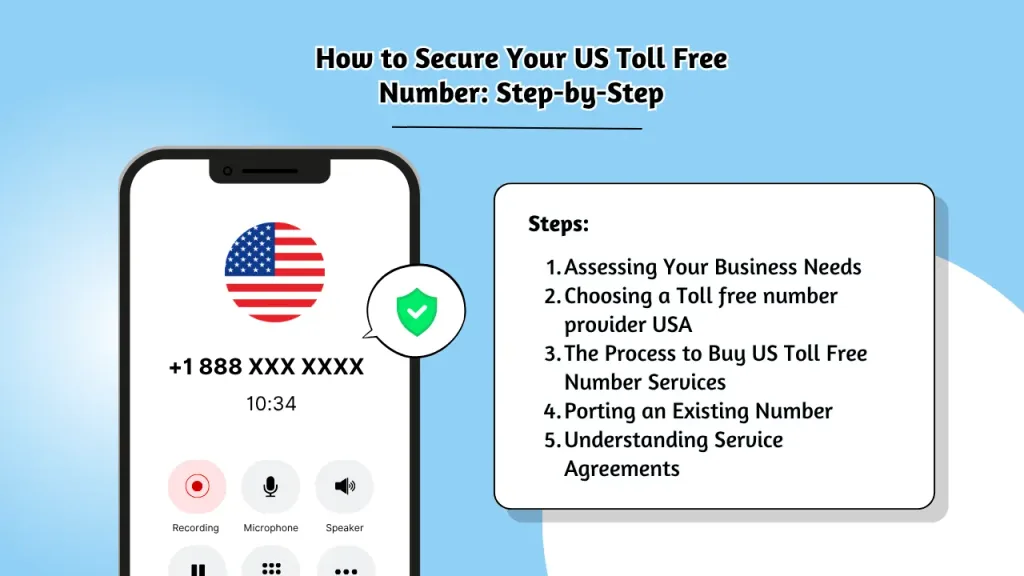
How to Get a US Toll-Free Number
Getting a toll-free number is far faster than most people expect — there is no hardware to install and no waiting weeks for provisioning. The process breaks down into four clear steps.
Choose a provider. Pick a toll-free service provider or cloud phone platform that offers the prefix you want, transparent per-minute or flat-rate pricing, and the routing features your team needs.
Pick a prefix or vanity number. Decide between a standard available number and a memorable vanity pattern. Vanity numbers and premium prefixes may carry a one-time fee, but they pay for themselves in recall value.
Configure routing. Point the number to wherever your team answers — a softphone, an IP-PBX, a mobile device, or a contact-center queue — and set up your IVR menu, hours, and overflow rules.
Go live. Test an inbound call, confirm your greeting and voicemail work, then publish the number across your website, ads, and email signatures.
With a modern cloud setup, the whole sequence can be completed in a single afternoon, and the number is portable from day one. If you want the number to behave like a full business line — with extensions and call handling — provisioning it as a virtual phone number is the simplest route.
Getting a toll-free number — choose, configure, activate.
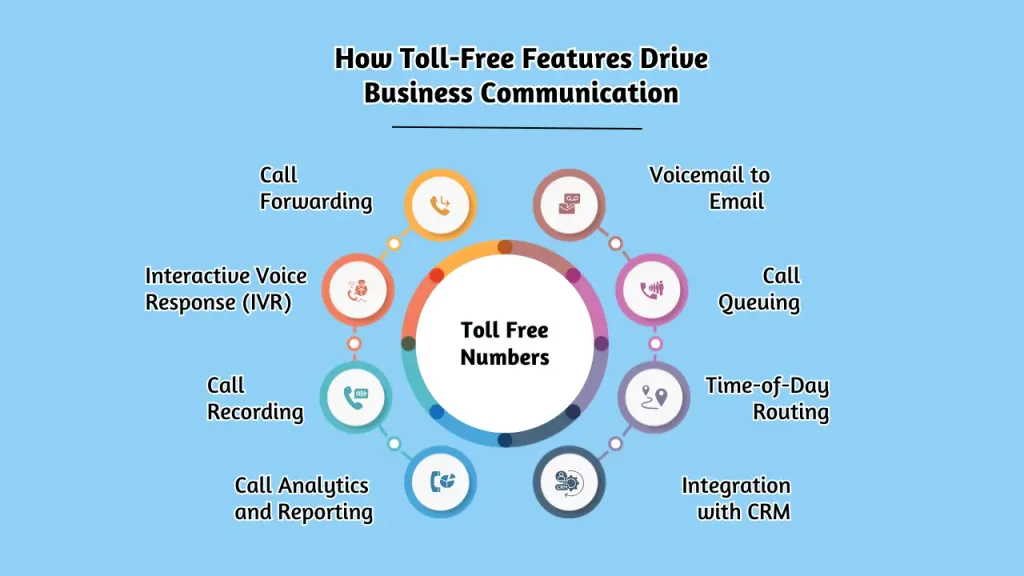
Toll-Free Features That Drive Business Communication
A toll-free number is only the entry point. The real value comes from the communication features layered on top of it, which is where a cloud platform turns a single number into a complete front desk.
Call routing. Send calls to the right person, team, or location based on time of day, caller input, or geography — so no inbound call goes unanswered.
IVR (auto-attendant). A menu greets callers and directs them ("Press 1 for sales, 2 for support"), giving even a small team an enterprise-grade first impression.
Voicemail-to-email. Missed messages arrive as audio files or transcripts in your inbox, so nothing falls through the cracks after hours.
Analytics. Track call volume, peak hours, missed-call rates, and campaign source so you can staff and budget around real data.
Call recording. Capture conversations for training, quality assurance, and dispute resolution, with consent rules handled at the platform level.
Together these features let a toll-free number scale from a one-line startup to a multi-department operation without ever changing the number customers know.
Toll-free features — routing, IVR, analytics, and recording.
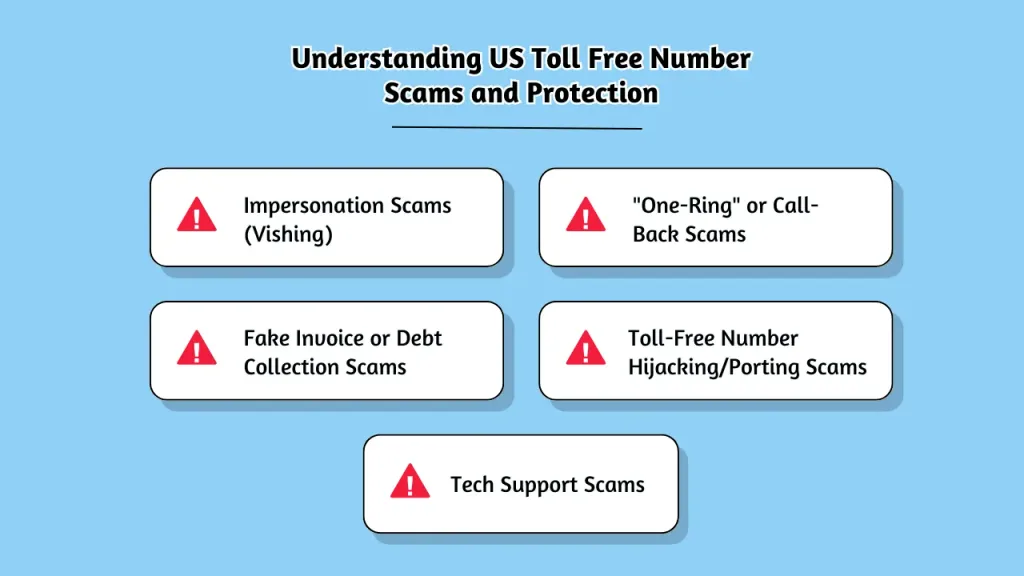
Toll-Free Scams and How to Stay Protected
Because toll-free numbers carry an air of legitimacy, fraudsters sometimes exploit them. Understanding the common tactics is the first line of defense for both businesses and the customers who call them.
Spoofing. Scammers can falsify the number displayed on caller ID to make a call appear to come from a trusted toll-free line, then impersonate a bank or government agency.
Callback fraud. A missed-call or text lures victims into dialing back a premium-rate or overseas number disguised to look toll-free, generating charges or harvesting information.
Impersonation. Bad actors publish fake "support" toll-free numbers that mimic real brands to intercept customers seeking help.
The strongest industry-wide safeguard is STIR/SHAKEN, the caller-ID authentication framework US carriers use to verify that a call genuinely originates from the number it claims. Reputable toll-free providers participate in it, which helps your legitimate calls get delivered and trusted.
To protect yourself, never share sensitive details with an unexpected inbound caller, verify any "support" number against the company's official website, and report suspicious activity to the FTC and your provider. Businesses choosing a partner should confirm STIR/SHAKEN compliance — the same trust signals that protect your customers protect your brand.
Stay protected — recognize toll-free scams and use STIR/SHAKEN.
Conclusion
A US toll-free number is one of the few business tools that delivers on credibility, accessibility, and brand recall all at once. The prefix you choose — 800, 888, 877, 866, 855, 844, or 833 — matters less than how you put the number to work with smart routing, an IVR, analytics, and authenticated caller ID.
Pair that with a memorable vanity pattern and you have a marketing asset that works on every channel for the life of your business.
Frequently Asked Questions
What is a US toll-free number?
A US toll-free number is a ten-digit phone number that uses a reserved prefix — 800, 888, 877, 866, 855, 844, or 833 — instead of a geographic area code. It works nationwide, and the business that owns the number pays for inbound calls rather than the caller.
This caller-pays model makes the number free to dial and signals that the company serves customers across the country.
Which toll-free prefix is best for my business?
All seven prefixes — 800, 888, 877, 866, 855, 844, and 833 — route calls identically, so none is functionally better. The original 800 series carries the most legacy recognition but has very limited availability. Newer prefixes like 855, 844, and 833 offer far more open inventory, including vanity numbers.
Choose based on the specific number or word you can secure rather than the prefix alone.
How much does a US toll-free number cost?
Pricing varies by provider but typically combines a low monthly fee with either a flat rate or a per-minute charge for inbound calls. Standard available numbers are inexpensive, while premium vanity numbers may carry a one-time setup fee. Because you only pay for the inbound minutes you receive, costs scale with your actual call volume rather than a fixed large commitment.
Can I keep my toll-free number if I switch providers?
Yes. Under FCC rules, toll-free numbers are portable and belong to your business, not to a single carrier. You can move your number between providers without losing it, which means the number you advertise on your website, packaging, and ads stays the same for the life of your company even if you change platforms or grow into a larger system.
How do I protect against toll-free number scams?
Choose a provider that participates in STIR/SHAKEN caller-ID authentication, which verifies that calls genuinely originate from the number shown. Never share sensitive information with an unexpected inbound caller, and always verify any support number against a company official website before dialing back. For your own business, authenticated delivery helps your legitimate calls reach customers and protects your brand from impersonation.
Run your voice on Ajoxi.
AI receptionists, wholesale routes, virtual numbers — built on one platform with transparent pricing and a 24/7 NOC.