805 Area Code California: Central Coast Code Explained and How to Get a Number
If you are trying to get a phone number on California's central coast — Santa Barbara, Ventura, San Luis Obispo, or the wine country between them — the 805 area code is the only meaningful choice. Demand exceeds supply, and that has shaped the entire history of the code.
Area Codes
805 Area Code California: Central Coast Code Explained and How to Get a Number
Introduction
If you're trying to get a phone number on California's central coast — Santa Barbara, Ventura, San Luis Obispo, or the wine country and beach towns between them — the 805 area code is the only meaningful choice. There's also an 820 overlay added in 2017, but the available 820 inventory remains small.
Most central-coast numbers still come from 805, and demand exceeds supply because the region's population and small-business density have grown faster than North American Numbering Plan administrators forecast a decade ago.
Whether you received a call from an 805 number, want a central-coast business presence, or are researching the area code as you plan a regional expansion, this guide breaks down what makes the 805 area code distinctive — coverage, its history of multiple splits, dialing rules, and how to provision an 805 phone number quickly in 2026.
What Is the 805 Area Code?
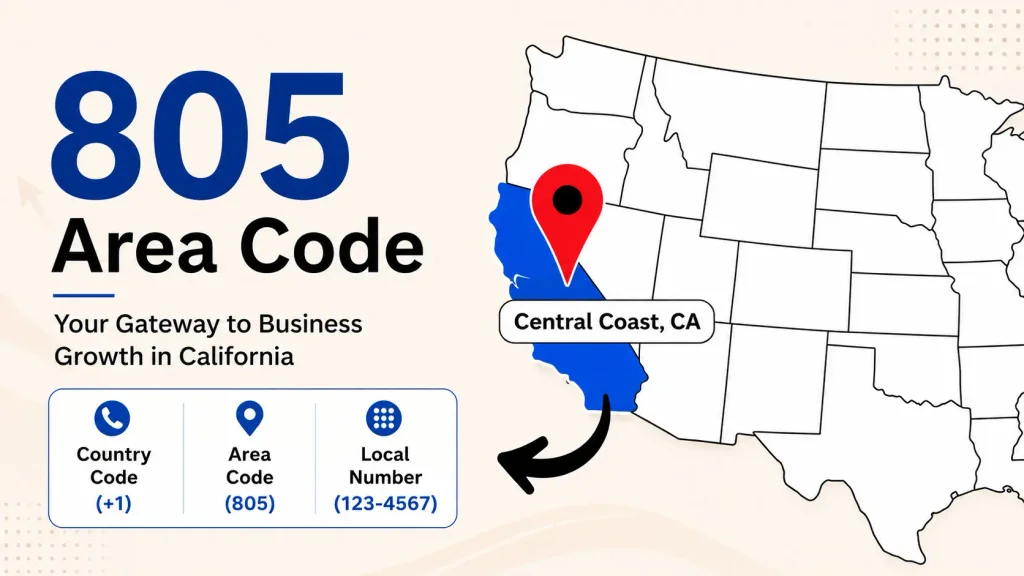
The 805 area code is a North American Numbering Plan code covering California's south-central coast region. It serves Santa Barbara County, Ventura County, San Luis Obispo County, and small portions of northern Los Angeles County. Created in 1957, the 805 area code has been split multiple times to create newer codes; an overlay code, 820, was added in 2017 to handle continued growth.
The region operates in Pacific Time.
A History of Splits: How 805 Shrank Into Its Current Boundary
The 805 area code is one of the most-split area codes in NANP history. When it was created in 1957, the original 805 covered a much larger swath of central California — most of the territory from the Bay Area suburbs down to Ventura County. Over the next several decades, growth and number-exhaustion forecasts forced the original 805 to give up territory repeatedly.
Major splits over the years removed regions to create 408 (San Jose and Silicon Valley, 1959), 209 (Central Valley), 818 (San Fernando Valley, 1984), 661 (Bakersfield and Antelope Valley, 1999), and 559 (Fresno). By the time those splits were complete, 805 had shrunk to its current central-coast boundary — Santa Barbara, Ventura, and San Luis Obispo counties.
The takeaway: the 805 you see today is geographically smaller than the 805 your parents may remember. The number itself is the same; the territory shrunk around it.
Cities Covered by the 805 Area Code
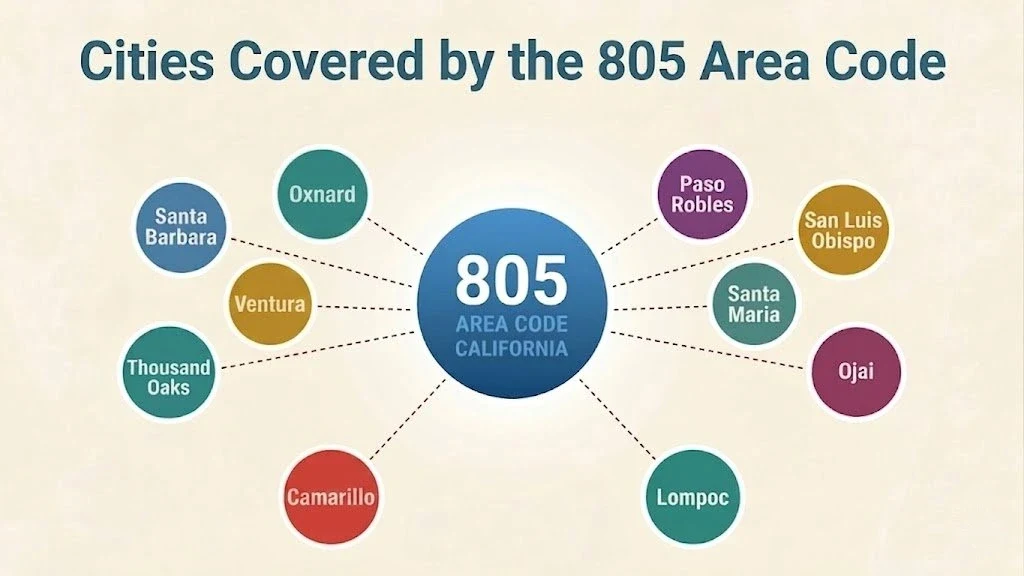
The 805 area code spans California's south-central coast with a mix of mid-size cities, agricultural towns, and tourism destinations. Major cities served include:
Santa Barbara — coastal cultural and tourism anchor
Ventura (officially San Buenaventura) — Ventura County seat
Oxnard — the largest city in Ventura County by population
Thousand Oaks and Simi Valley — east Ventura County tech and biotech corridor
Camarillo — central Ventura County
San Luis Obispo — SLO County seat, home to Cal Poly
Paso Robles — northern wine country anchor
Lompoc and Santa Maria — northern Santa Barbara County
Ojai, Carpinteria, Goleta, Buellton, Solvang, Atascadero, and Pismo Beach — smaller communities each with strong regional identity
Three counties share the 805 area code — Ventura, Santa Barbara, and San Luis Obispo — spanning California's south-central coast.
The 820 Overlay and 10-Digit Dialing
The 820 area code was added in 2017 as an overlay of 805, meaning both codes now share the same physical territory. As soon as 820 launched, the entire region was required to switch to 10-digit local dialing — callers within 805 territory dial the full 805 + 7-digit number even when calling a neighbor across the street.
International callers dial their country's international prefix + 1 (US country code) + 805 + the 7-digit local number. The region operates in Pacific Time, observing Pacific Standard Time (UTC-8) in winter and Pacific Daylight Time (UTC-7) during daylight saving.
Central Coast Economy and Why Businesses Use 805 Numbers
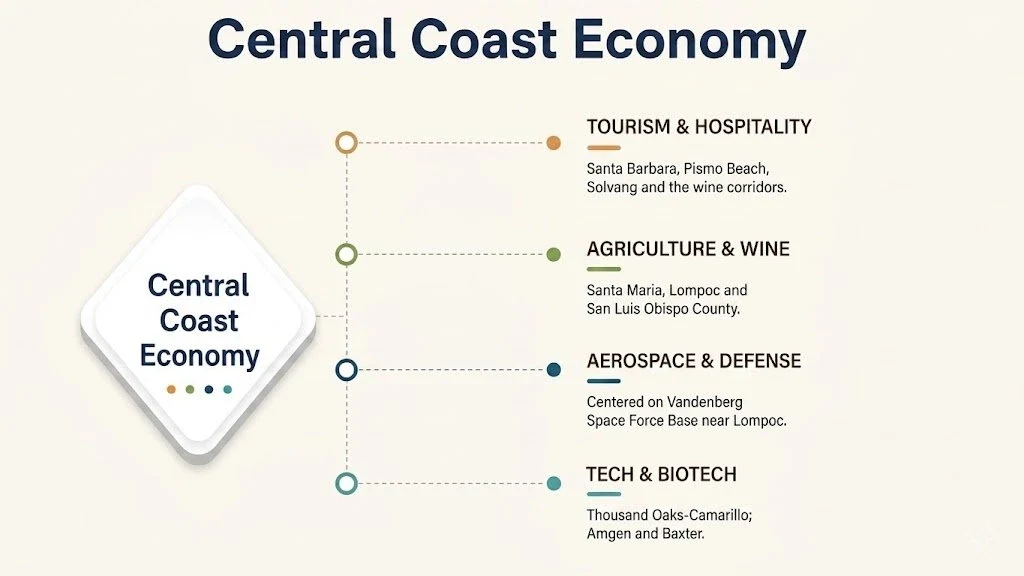
The 805 region anchors several distinct industries that drive demand for local phone numbers. Tourism and hospitality dominate Santa Barbara, Pismo Beach, Solvang, and the wine corridors of Paso Robles and Santa Ynez Valley. Agriculture and viticulture run through Santa Maria, Lompoc, and SLO County. Aerospace and defense concentrate around Vandenberg Space Force Base near Lompoc.
Technology, biotech, and pharma cluster in the Thousand Oaks-Camarillo corridor, with anchor employers including Amgen and Baxter. Higher education adds Cal Poly San Luis Obispo, UC Santa Barbara, and California Lutheran University.
Businesses provision 805 numbers for local-presence marketing (central-coast callers answer 805 numbers more readily than out-of-area codes), branch-office expansion without physical real estate cost, call-tracking by region, and DID reseller programs supplying central-coast inventory to downstream customers. Resellers building a regional DID business can explore wholesale voice services to understand the infrastructure layer behind local number provisioning.
Four industries drive the 805 economy — tourism, agriculture & wine, aerospace, and tech & biotech.
Why 805 Numbers Carry Regional Brand Value
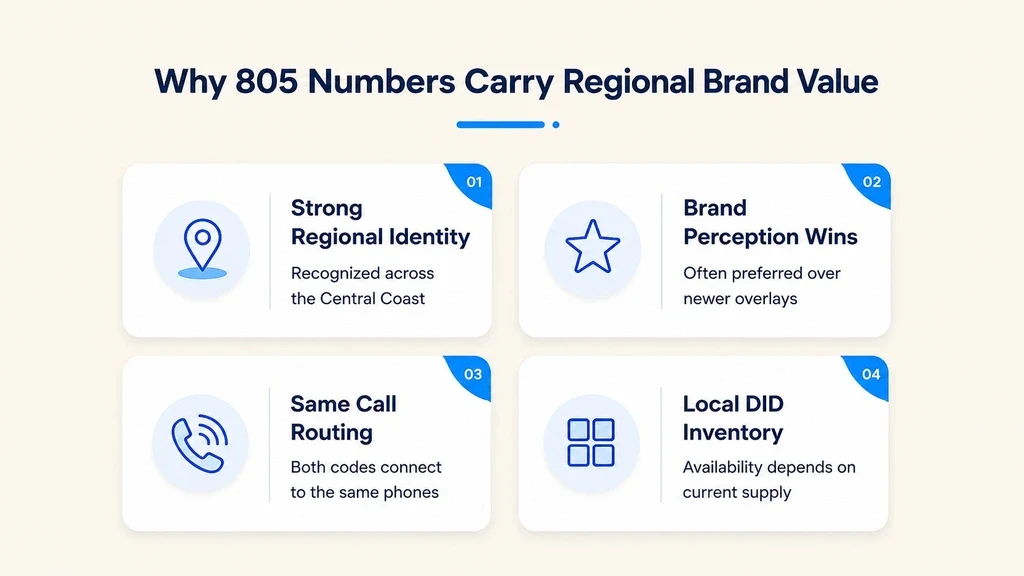
Not every area code has cultural pull. The 805 does. The region has a strong regional identity — "the 805" gets used as shorthand for the central coast lifestyle the way "the Bay" means San Francisco or "SoCal" means greater Los Angeles. Local businesses, lifestyle brands, and remote workers often prefer 805 numbers over 820 overlay numbers because the older code carries more regional recognition.
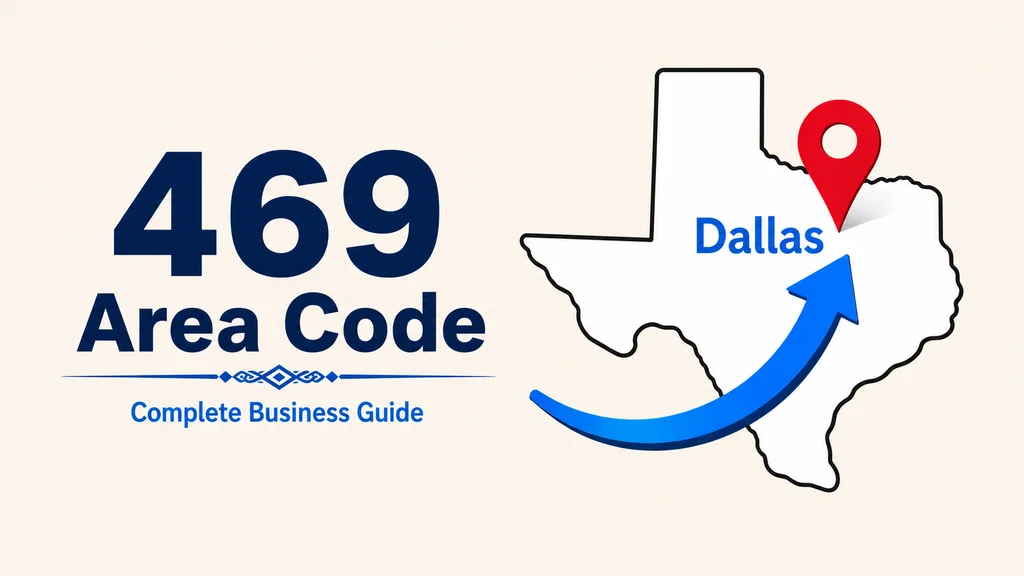
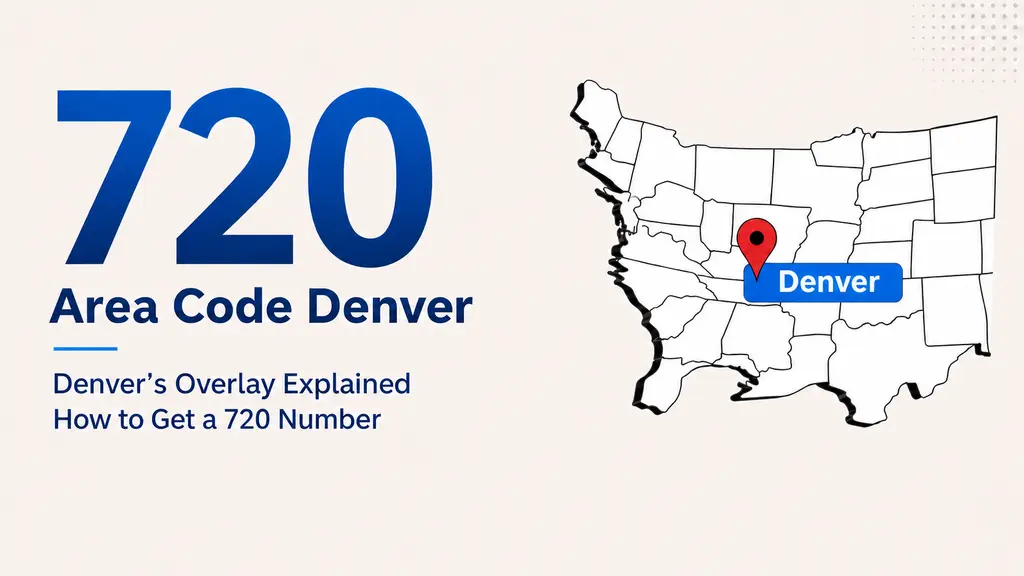
Both codes route the same calls to the same phones, but 805 still wins on brand perception. Central-coast local DIDs include 805 inventory subject to availability. Businesses curious how codes get structured can compare the overlay-based 720 area code versus the geographic-split model used in the 469 area code.
Why 805 wins on brand — strong regional identity, brand perception over 820, same routing, and available local DID inventory.
How to Get an 805 Area Code Phone Number
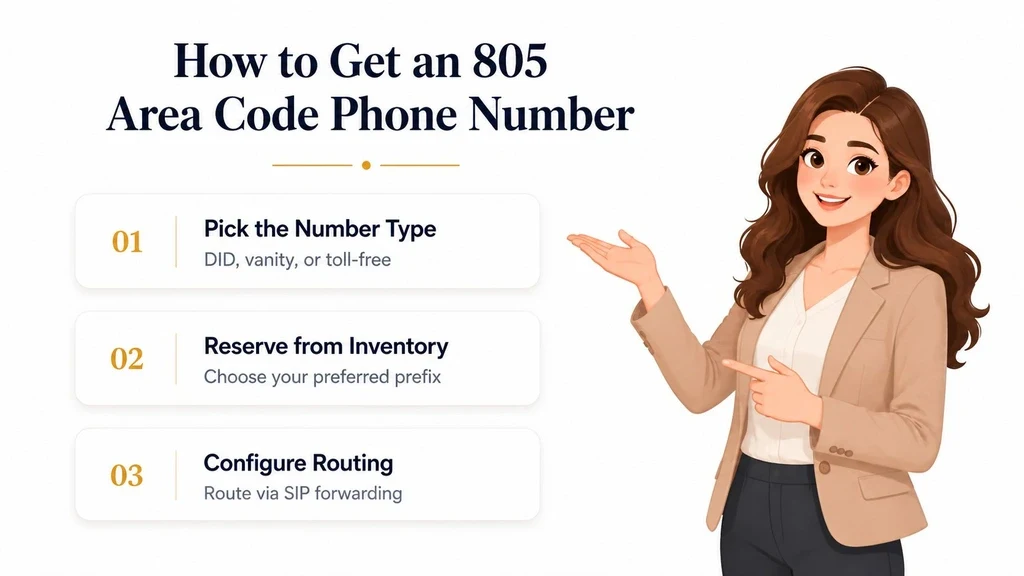
Provisioning an 805 number through a modern DID provider takes three steps:
Pick the number type — local DID, business line, vanity, or toll-free pairing. Most buyers want a local 805 for central-coast presence
Reserve from available inventory — 805 inventory is tighter than newer codes; specific prefixes or memorable patterns may require a one-time fee
Configure routing — point inbound calls to your softphone, IP-PBX, contact-center platform, or mobile device via SIP forwarding or call-forward rules
The process typically takes 24–48 hours from order to first inbound call. Numbers stay portable under FCC rules.
Three steps to an 805 number — pick your number type, reserve from available inventory, and configure call routing.
Conclusion
The 805 is one of the few US area codes that operates as a brand as much as it does a phone-routing prefix. It has been split five times, overlaid once, and now anchors a central-coast region that takes its area code seriously enough that lifestyle brands and remote workers go out of their way to acquire one.
For businesses, the practical implication is straightforward — if your customers are in Santa Barbara, Ventura, Oxnard, Thousand Oaks, SLO, or Paso Robles, an 805 number is worth the slightly tighter inventory.
Provision an 805 central-coast DID — local Santa Barbara, Ventura, and SLO numbers, business and toll-free pairing, and routing to your softphone or PBX typically live within 24–48 hours. No minimum commits, no setup fees. Businesses running multi-location calling operations can review wholesale VoIP termination providers for the carrier infrastructure powering these DIDs, and the 325 area code guide for another mid-size regional market comparison.
Frequently Asked Questions
Where is the 805 area code?
The 805 area code covers California's south-central coast, including Santa Barbara, Ventura, and San Luis Obispo counties plus small portions of northern Los Angeles County. Major cities include Santa Barbara, Ventura, Oxnard, Thousand Oaks, Simi Valley, Camarillo, San Luis Obispo, Paso Robles, Lompoc, and Santa Maria. The region operates in Pacific Time.
An overlay code, 820, was added to the same geography in 2017 to handle continued population and small-business growth.
What cities are in the 805 area code?
Cities in the 805 area code span California's central coast: Santa Barbara, Ventura, Oxnard (Ventura County's largest), Thousand Oaks, Simi Valley, Camarillo, San Luis Obispo, Paso Robles, Lompoc, Santa Maria, Ojai, Carpinteria, Goleta, Buellton, Solvang, Atascadero, and Pismo Beach.
The region includes major anchor institutions like UC Santa Barbara, Cal Poly San Luis Obispo, California Lutheran University, Vandenberg Space Force Base, and the Amgen-Baxter biotech corridor in Thousand Oaks-Camarillo.
When was the 805 area code created and how often has it been split?
The 805 area code was created in 1957 from California's earlier 213 region. It has been split multiple times since then to create newer area codes, including 408 (San Jose and Silicon Valley, 1959), 209 (Central Valley), 818 (San Fernando Valley, 1984), 661 (Bakersfield and Antelope Valley, 1999), and 559 (Fresno).
Each split shrank the 805 territory until it settled at its current central-coast boundary covering Santa Barbara, Ventura, and San Luis Obispo counties.
What is the 820 area code overlay?
The 820 area code is a 2017 overlay of the 805 area code, meaning 820 covers the exact same central-coast California geography as 805. Both codes serve the same cities, neighborhoods, and counties. When 820 launched, the entire 805 region switched to mandatory 10-digit dialing for all local calls.
New numbers in the central coast can be issued from either code depending on inventory availability, though 805 remains the older and more widely recognized.
Why are 805 numbers harder to get than other California codes?
805 numbers are harder to get than newer California codes because the 805 area code has been in continuous use since 1957 and serves a region with strong demand for local-presence numbers. Tourism, biotech, agriculture, and higher education all drive ongoing 805 number consumption. The 820 overlay added in 2017 helped, but most buyers still prefer 805 for regional brand recognition.
Specific prefixes or vanity patterns may need provider-side reservations.
Run your voice on Ajoxi.
AI receptionists, wholesale routes, virtual numbers — built on one platform with transparent pricing and a 24/7 NOC.