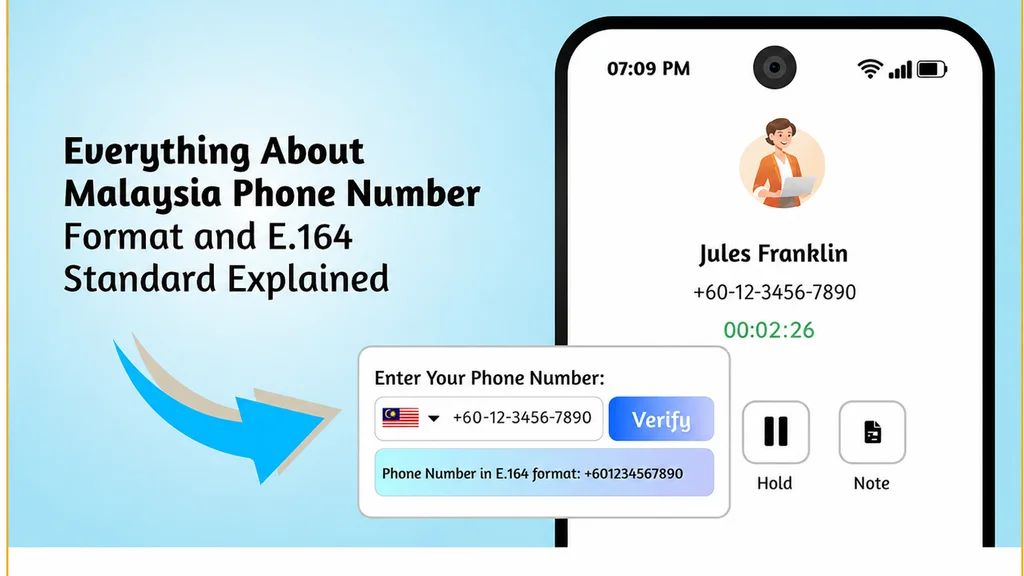
Everything About Malaysia Phone Number Format and E.164 Standard Explained
Connecting with Malaysia, a key hub in Southeast Asia, is essential for global business and personal ties. This ultimate guide breaks down the Malaysia phone number format — the +60 country code, area codes, mobile prefixes, and the E.164 standard for flawless communication.
Phone Number Format
Everything About Malaysia Phone Number Format and E.164 Standard Explained
Introduction
Connecting with Malaysia, a key hub in Southeast Asia, is essential for global business and personal ties. However, the nuances of the Malaysia phone number format can be a common source of frustration, leading to failed calls and missed opportunities. Getting the format right is the critical first step to any successful interaction, but it's easy to make mistakes.
This ultimate guide is designed to eliminate all confusion about the Malaysia phone number format. We will break down every component, from the crucial +60 country code to area codes and mobile prefixes, and help you master the universally required E.164 standard for flawless communication.
Core Components of a Malaysian Phone Number Format
The Malaysia number format is the structured system revealing its origin and type. Understanding each component is vital for ensuring your calls and messages connect.
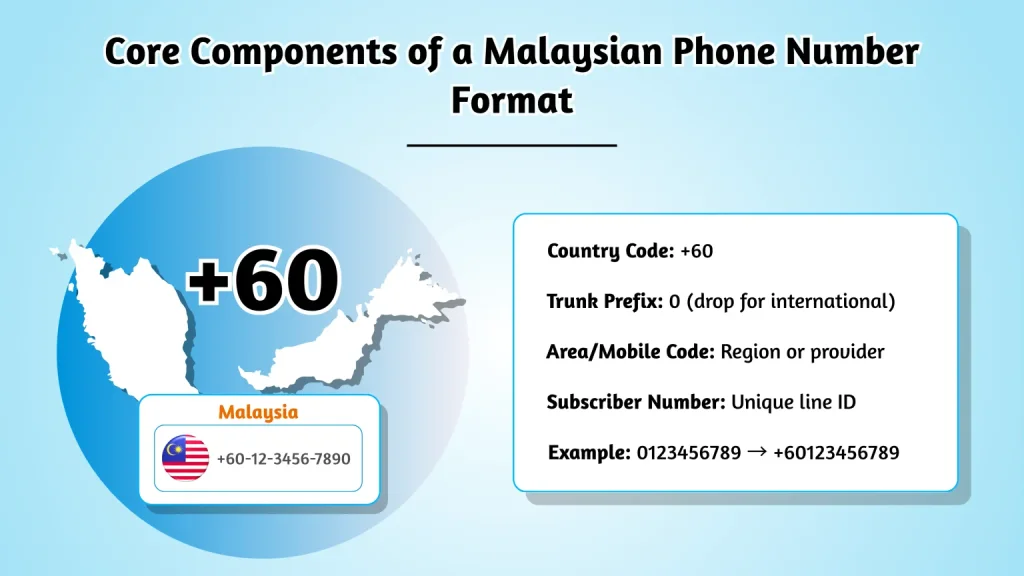
The four components of every Malaysian phone number — country code, trunk prefix, area or mobile code, and subscriber number.
Country code: The Malaysian country code is +60. This prefix is essential for all international calls to Malaysia. When dialing from outside the country, you must add "+60" before the rest of the number.
Trunk prefix: For domestic calls within Malaysia, a trunk prefix of "0" is used. This "0" is always omitted when dialing from another country.
Area code / mobile prefix: Following the trunk prefix is an area code for landline numbers or a mobile prefix for mobile numbers. These codes are crucial for identifying the geographical region or the mobile network provider.
Subscriber number: The final component is the subscriber number, the unique identifier for a specific phone line. The length of the subscriber number can vary depending on whether it's a landline or a mobile number.
Example in action: A domestic mobile number like 012-3456789 becomes +60 12 345 6789 internationally, combining the country code, mobile prefix and subscriber number while dropping the trunk prefix "0".
The formatting golden rule: Always remember to drop the leading "0" (trunk prefix) when you add the "+60" country code for international calls, texts, or saving contacts.
A Guide to Malaysian Landline Number Structure
Malaysian landline numbers, also known as fixed-line numbers, are geographically assigned and are a key part of the overall Malaysia phone number format. The structure of a landline number is a good indicator of its location, which is useful for businesses targeting specific regions.
A social-media phone number, on the other hand, is a unique contact number associated with social-media accounts, allowing businesses to streamline communication with customers across different platforms.
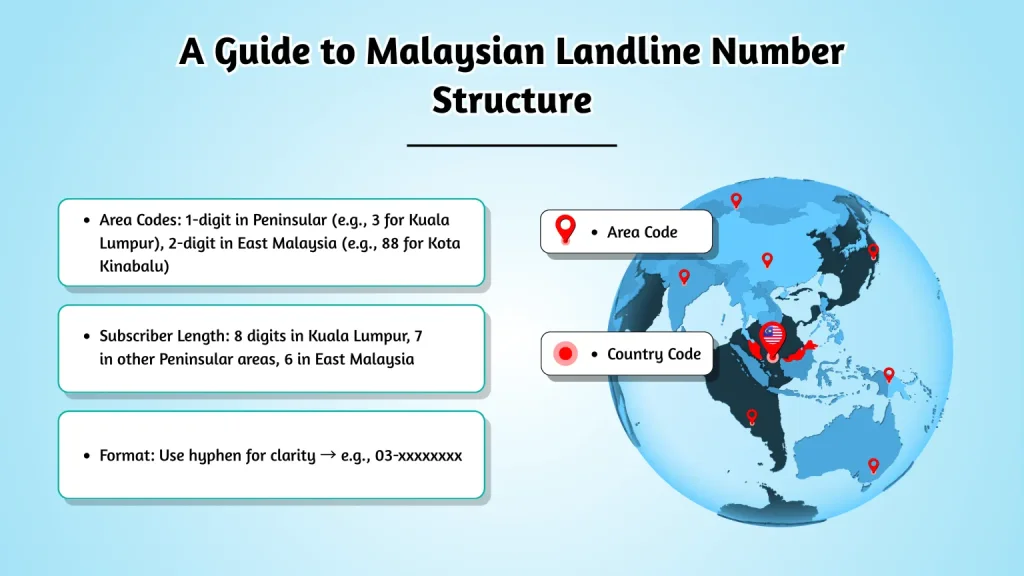
Malaysian landline structure — one-digit area codes across Peninsular Malaysia, two-digit codes in East Malaysia (Sabah & Sarawak).
Area codes: Area codes in Peninsular Malaysia are typically one-digit (e.g., 3 for Kuala Lumpur), while in East Malaysia (Sabah and Sarawak) they are two-digit (e.g., 88 for Kota Kinabalu).
Subscriber number length: The length of the subscriber number for landlines varies. In the populous region of Kuala Lumpur (area code 3), subscriber numbers are eight digits long. In other parts of Peninsular Malaysia they are typically seven digits, and in East Malaysia they are six digits long.
Formatting: When writing a Malaysian landline number, it's common practice to include a hyphen between the area code and the subscriber number for clarity (e.g., 03-xxxxxxxx for a number in Kuala Lumpur).
You may also know: get a 202 area code — your local line to Washington D.C.
How Do Malaysian Mobile Numbers Work?
The mobile phone landscape in Malaysia is diverse, with several network operators, each with its own set of prefixes. Unlike landlines, mobile numbers are not tied to a specific geographical location, offering greater flexibility. However, understanding the complete Malaysia phone number format is just as important for ensuring your calls and texts go through without a hitch.
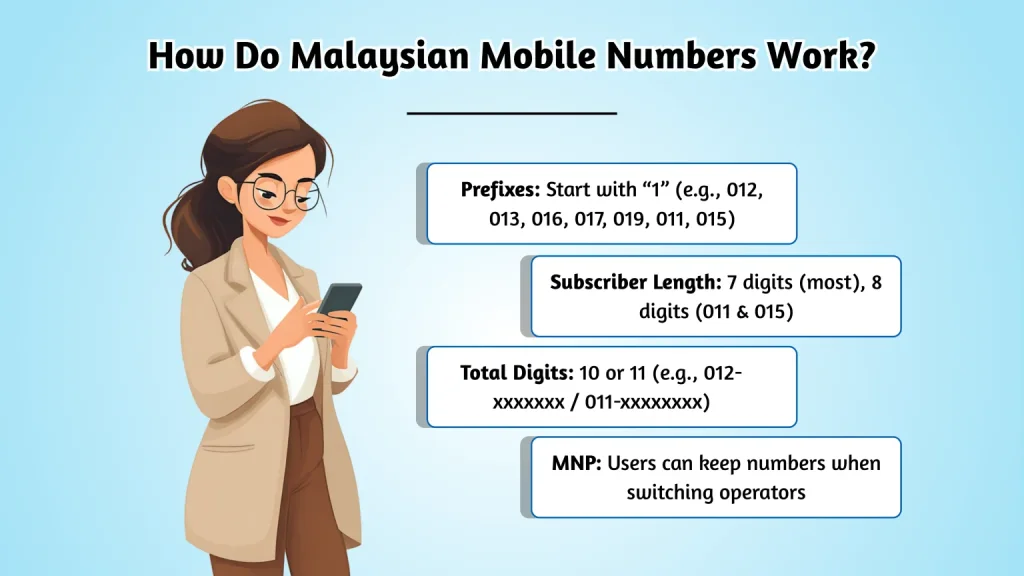
Malaysian mobile prefixes (012, 013, 016, 017, 019, 011, 015) and the 7- vs 8-digit subscriber rule.
Mobile prefixes: Malaysian mobile numbers are identified by a two-digit prefix that always begins with "1". Common prefixes include 012, 013, 016, 017, and 019. Newer prefixes like 011 and 015 have also been introduced to accommodate the growing number of mobile users.
Subscriber number length: The length of the subscriber number for mobile phones can be either seven or eight digits. Numbers with the prefixes 011 and 015 have eight-digit subscriber numbers, while all other mobile prefixes have seven-digit subscriber numbers.
Total length: When written locally, a complete Malaysian mobile number will have either 10 digits (e.g., 012-xxxxxxx) or 11 digits (e.g., 011-xxxxxxxx). This is a quick way to check if a number looks correct.
Mobile number portability (MNP): Due to MNP, the prefix of a mobile number no longer definitively identifies the current mobile network operator. MNP allows users to switch providers while keeping their existing mobile number.
What is E.164 and Why Does it Matter?
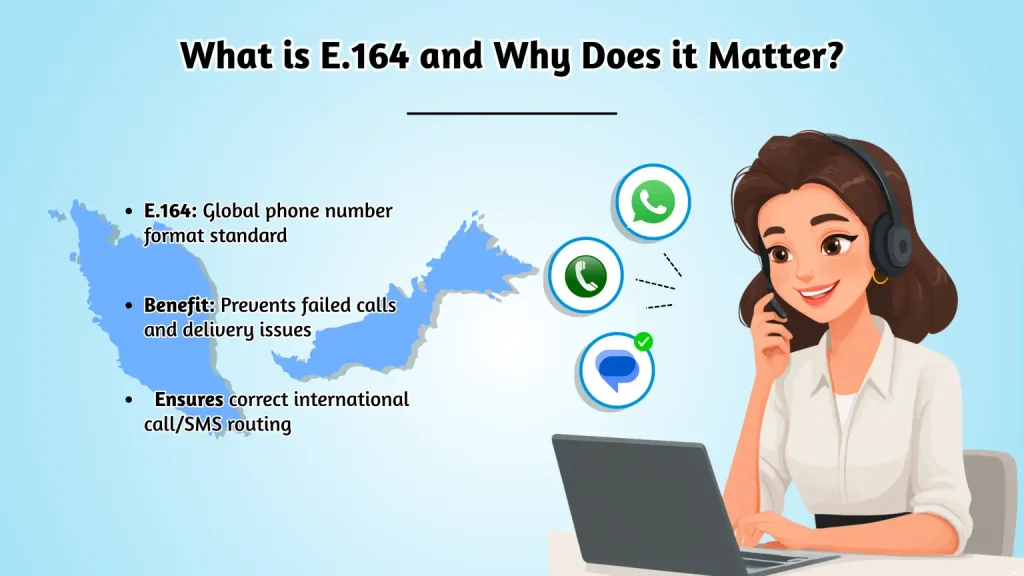
For all international communication (calls, SMS, WhatsApp), E.164 is the universal standard. It ensures correct routing and prevents failed calls or undelivered messages.
E.164 — the internationally recognized standard that makes every Malaysian number globally unique and routable.
What exactly is the E.164 format?
It is the internationally recognized standard numbering plan for all phone numbers.
Its primary goal is to create a globally unique number for every device on a public network.
This ensures that calls and messages can be routed correctly across different countries without errors.
How to convert a Malaysian number to E.164
This conversion follows a simple four-step process:
Always begin with a plus sign (+).
Add Malaysia's country code, which is 60.
Remove the leading trunk prefix "0" from the local number.
Combine the remaining area / mobile code and subscriber number without any spaces or hyphens.
E.164 examples: A local landline 03-12345678 becomes +60312345678. A local mobile number 012-3456789 becomes +60123456789.
How to Validate Malaysian Phone Numbers
Validating the correct Malaysia phone number format at entry is crucial for businesses. It ensures data quality, prevents failed marketing campaigns, and maintains reliable communication. Technical validation solutions are readily available to handle this important process.
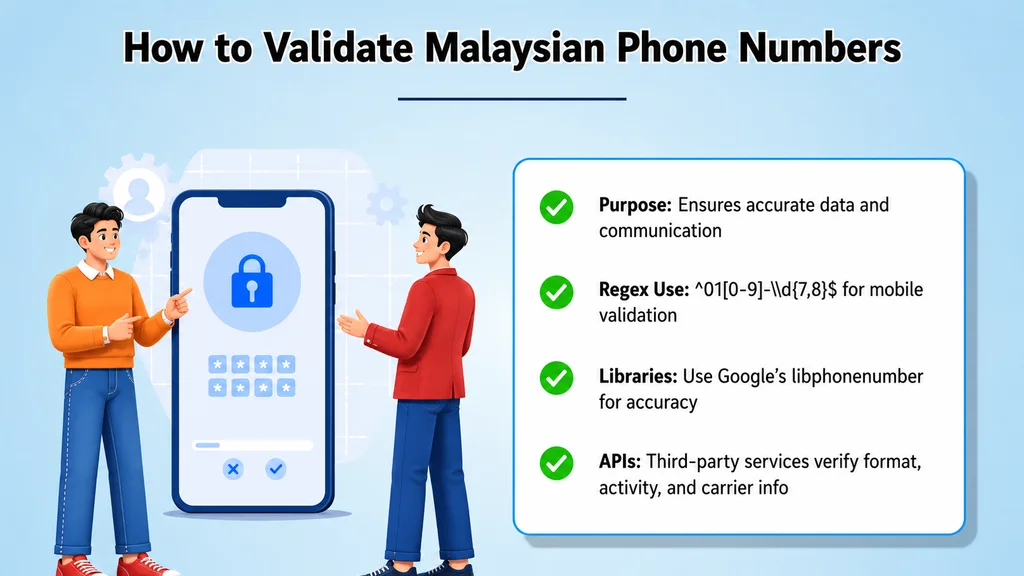
Three ways to validate Malaysian numbers — regex patterns, libphonenumber, or third-party validation APIs.
Using regular expressions (regex): Regular expressions are powerful tools for pattern matching and can be used to create rules for validating the format of Malaysian phone numbers. A robust regex can account for the different prefixes and subscriber-number lengths of both landline and mobile numbers.
Example regex for Malaysian mobile numbers: A regex like ^01[0-9]-\d{7,8}$ can be used to validate Malaysian mobile numbers, accounting for the "01" prefix and the seven- or eight-digit subscriber number.
Using phone-number libraries: For a more robust solution, developers can use dedicated open-source libraries like Google's libphonenumber. These libraries are regularly updated with the latest formatting and validation rules from countries worldwide, handling the complex logic for you.
Third-party validation services: For a more comprehensive validation solution, you can use third-party phone-number validation APIs. These services can not only check the format of a number but also verify if the number is active and provide additional information, such as the carrier and line type.
Advanced Call Management Features Explained
Beyond understanding basic standards like the Malaysia phone number format, the communication infrastructure of smart cities relies on advanced call-management tools to enhance efficiency and security. Features like call barring are essential for city services and businesses to gain greater control over both their high-volume incoming and crucial outgoing calls, supporting everything from emergency response systems to streamlined municipal hotlines.
What is call barring? Call barring is a feature that allows you to block certain types of incoming and outgoing calls on your phone. This can be useful for preventing unauthorized international calls, blocking spam calls, or restricting calls while roaming to avoid high charges.
Outgoing call barring: Block all outgoing calls or specific types of calls, such as international calls or calls to premium-rate numbers.
Incoming call barring: Block all incoming calls or calls from specific numbers.
How to activate call barring: Call barring is typically a network-level service that can be activated through your phone's settings or by contacting your mobile service provider.
How 5G is Shaping the Future of Malaysian Telecom
As 5G revolutionizes Malaysian telecom, new opportunities emerge for businesses. To connect with local audiences, understanding the correct Malaysia phone number format remains essential for seamless communication in this advanced new era.
The impact of 5G: 5G will significantly impact mobile broadband, IoT, and smart cities, enabling new business applications and services that were impossible with older mobile-technology generations.
Digital Nasional Berhad (DNB): The Malaysian government created DNB as the single wholesale 5G provider to accelerate deployment and ensure high-quality, affordable access for all citizens.
New business capabilities: Businesses can use 5G for advancements in smart manufacturing (Industry 4.0), real-time supply-chain tracking, enhanced contact center operations, and immersive augmented reality for retail and remote customer support.
Enhanced consumer experience: Individuals will see tangible benefits like ultra-high-definition video streaming, lag-free online gaming, and more reliable telehealth and remote education services. Report telecom fraud to the FTC.
Conclusion
The Malaysia phone number format is a structured system vital for clear communication. By understanding the roles of the +60 country code, area prefixes, and the critical E.164 standard, you can eliminate dialing errors. Whether for business or personal use, applying these formatting rules ensures your calls and messages reach their destination in Malaysia without issue, making every connection a successful one.
Manage your Malaysian contacts the smart way with Ajoxi — never worry about a failed call or undelivered message again.
Frequently Asked Questions
What's the country code I should use for Malaysia?
For any international calls to Malaysia, you'll need to use the country code +60. This prefix replaces the leading zero you would see in a locally written number — for example, the domestic landline 03-12345678 becomes +60 3 1234 5678 in international format.
How do I correctly format a Malaysian mobile number for an international call?
Start with the plus sign (+), add the Malaysian country code 60, drop the leading 0 from the local mobile prefix, then add the subscriber number. A local mobile number written as 012-3456789 becomes +60123456789 in international E.164 format. The same conversion works for SMS, WhatsApp, and contact-list storage.
I've seen some Malaysian mobile numbers that look longer than others. Is this normal?
Yes — Malaysian mobile numbers come in two lengths. Numbers with the 011 or 015 prefixes have eight-digit subscriber numbers (11 digits total when written locally with the leading 0). All other mobile prefixes (012, 013, 016, 017, 019) have seven-digit subscriber numbers, giving 10 digits total. Both lengths are valid; the prefix tells you which to expect.
Why is the E.164 format so important for Malaysian numbers?
E.164 is the universal numbering standard that every international carrier, SMS gateway, and messaging app (including WhatsApp) uses to route calls and messages. Saving Malaysian numbers in E.164 format (+60 followed by the number with the leading 0 dropped) guarantees that calls and texts work correctly regardless of where you are dialing from, and that contact lists sync cleanly across devices.
When should I use the "0" at the start of a number versus the "+60"?
Use the leading 0 only when dialing domestically within Malaysia — for example, an Malaysian caller dialing 03-12345678 from inside Kuala Lumpur. When dialing from outside Malaysia, when saving the number internationally, or when using messaging apps like WhatsApp, drop the 0 and use +60 instead. The two prefixes are mutually exclusive — never use both together.
Run your voice on Ajoxi.
AI receptionists, wholesale routes, virtual numbers — built on one platform with transparent pricing and a 24/7 NOC.