Wholesale Voice Services: The Infrastructure Layer Powering Global Calls
Wholesale voice services power global call networks — but not all services are equal. A 2026 walkthrough of the five service types, the call-flow mechanics, white vs grey routes, and which service profile fits which business.
Wholesale Voice
Wholesale Voice Services: The Infrastructure Layer Powering Global Calls
Introduction
Most businesses that rely on phone calls have no idea what's actually carrying them. A call placed from a contact center in Manila to a customer in Frankfurt doesn't travel on a single network.
It crosses three or four carrier systems, passes through at least one wholesale interchange, and reaches the destination through a local operator that the originating carrier has never directly contracted with. That entire invisible layer is wholesale voice services. The wholesale voice carrier business guide goes deeper into how those carrier systems actually operate day-to-day.
Wholesale voice services are the bulk voice communication infrastructure that carriers, resellers, enterprises, and platforms purchase from specialist providers to originate, transit, and terminate calls at scale.
Unlike retail voice, which sells to individual end users, wholesale voice operates business-to-business — trading voice traffic in millions of minutes, enabling any organization to reach phone networks worldwide without building that infrastructure themselves.
What Wholesale Voice Services Actually Cover
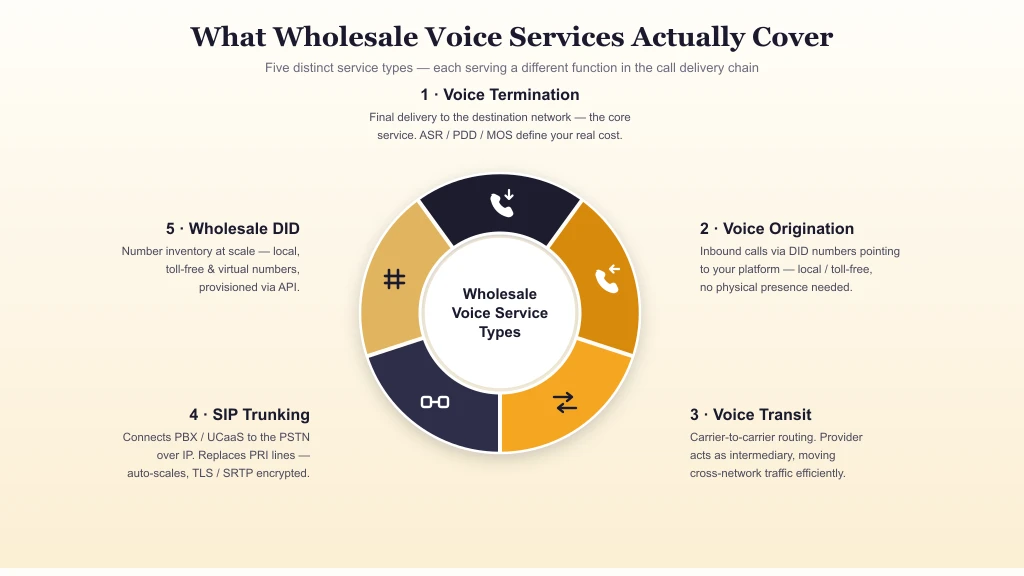
Wholesale voice isn't a single product. It's a category covering several distinct service types, each serving a different function in the call delivery chain.
Voice Termination is the final delivery of a call to its destination network — the handoff from the wholesale carrier's IP infrastructure to the recipient's mobile or PSTN endpoint. This is the core service for resellers and call centers. The per-minute rate applies here, and route quality (ASR, PDD, MOS) determines whether the nominal rate reflects your real cost.
Voice Origination is the inbound counterpart — receiving calls through DID numbers that point to your platform or PBX. A business buying wholesale origination gets local or toll-free numbers in target markets, tied to an IP endpoint, without operating a physical presence. Ajoxi provides DID numbers across 120+ countries with instant activation and full porting support.
Voice Transit moves calls between networks where the wholesale provider acts as an intermediary carrier — neither originating nor terminating the call, but routing it efficiently through their infrastructure. Transit services matter for carriers and large aggregators managing cross-network traffic volumes.
SIP Trunking connects a business's PBX or UCaaS platform directly to the PSTN through an IP-based trunk. It replaces physical PRI lines with virtual capacity that scales instantly and supports voice, video, and data sessions over the same connection. Ajoxi's SIP trunking supports auto-scaling with TLS/SRTP encryption, compatible with Asterisk, FreePBX, and 3CX without requiring custom development.
Wholesale DID (Direct Inward Dial) provides geographic and non-geographic number inventory for resellers and platforms needing to provision numbers at scale. The DID infrastructure covers local numbers, toll-free numbers, and virtual numbers across markets — accessible via API for programmatic provisioning.
Five distinct wholesale voice service types — termination, origination, transit, SIP trunking, and wholesale DID — each serving a different function in the call delivery chain.
How a Call Moves Through a Wholesale Voice Network
Understanding the mechanics removes a lot of confusion about why route quality varies and why the cheapest provider often delivers the worst effective cost.
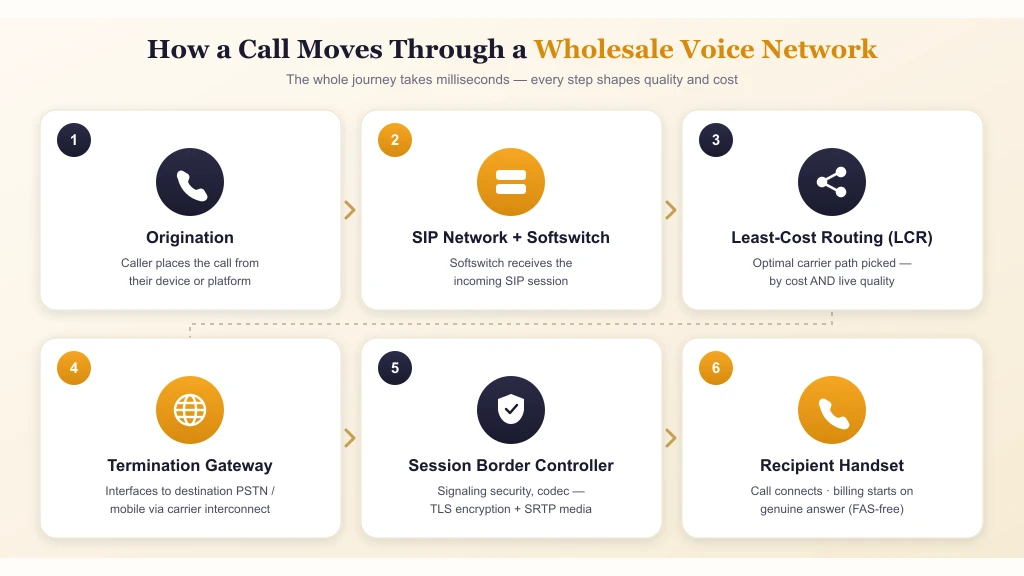
A call starts at origination — the calling party places a call from their device or platform. That call enters the SIP network and the wholesale provider's softswitch receives the session.
The softswitch runs least-cost routing (LCR) — selecting the optimal carrier path to the destination based on per-minute rates, live quality metrics (ASR, PDD), network congestion, and compliance requirements.
Quality-focused providers weight quality metrics alongside cost in the routing algorithm. Cost-only LCR selects the cheapest available path regardless of ASR — the primary cause of poor effective cost on gray-market routes.
The call reaches the termination gateway, which interfaces between the provider's IP network and the destination PSTN or mobile network through a carrier interconnect. Tier-1 carriers own these interconnects directly. Tier-2 aggregators route through intermediaries, which introduces latency and quality variability.
Session Border Controllers (SBCs) sit at the network edge managing signaling security, codec negotiation, and interoperability between networks. SBCs handle TLS encryption for SIP signaling and SRTP for media — the security layer that separates enterprise-grade wholesale voice from unprotected commodity routing.
The call terminates at the recipient's handset. Billing starts on genuine answer (FAS-free) — or on the carrier's signal of answer, which may precede actual human pickup if FAS protection isn't in place.
This entire sequence takes milliseconds. The quality of each step — interconnect directness, LCR weighting, SBC configuration, and FAS-free billing — determines whether the call is clear and the invoice accurate.
How a call moves through a wholesale voice network — origination, SIP/softswitch, least-cost routing, termination gateway, session border controller, and recipient handset, all in milliseconds.
White Routes, Grey Routes, and Why the Difference Costs You
Every wholesale voice buyer hears about "white routes" and "grey routes." The distinction is worth understanding precisely because grey-route providers compete almost entirely on headline per-minute rates. Our voice termination uses only CLI-compliant white routes.
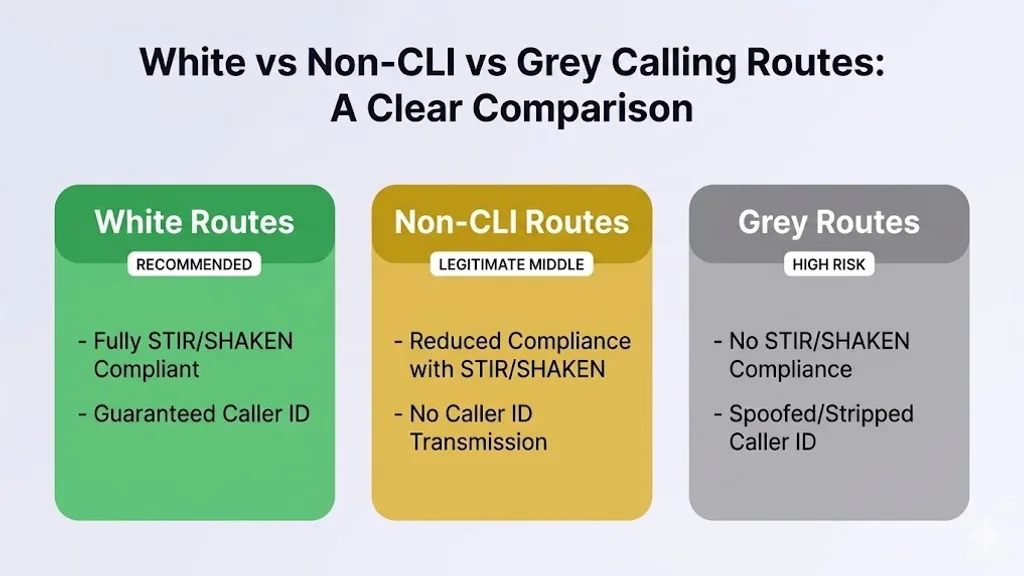
White routes (CLI routes) pass full caller identification through the network. The receiving party sees an accurate caller ID. The route complies with destination-country regulations including STIR/SHAKEN for US traffic and CLI authentication rules for EU member states.
Call completion rates are higher because CLI delivery correlates with answer rates — most people answer calls from identified numbers and screen unknown ones.
Grey routes bypass official interconnects to reduce cost. CLI may be spoofed or stripped. STIR/SHAKEN attestation is absent. In markets with anti-spoofing regulations — Belgium, France, Germany, Brazil post-Resolution 777 — grey-route calls are increasingly blocked at the destination carrier level. A route that successfully terminates today may be blocked next month when regulation tightens.
Non-CLI routes are a legitimate middle category — lower cost, no caller ID, suitable for bulk outbound where call completion rate matters more than display name. Non-CLI is not grey routing. The distinction is disclosure: a reputable provider is explicit about route type; a grey-route provider often isn't.
Ajoxi provides white CLI routes, Non-CLI routes, and CC routes under one account through its CLI and CC route infrastructure — explicitly labeled and separately priced, so buyers can match route type to traffic profile without ambiguity.
White CLI vs Non-CLI vs grey routes compared on caller ID, compliance, answer rate, and regulatory risk — route type, not headline rate, is what you are actually buying.
The Five Business Types That Use Wholesale Voice Services — and What Each Needs
Wholesale voice isn't one-size-fits-all. The service configuration that works for a BPO call center is different from what an OTT calling app or a UCaaS reseller requires.
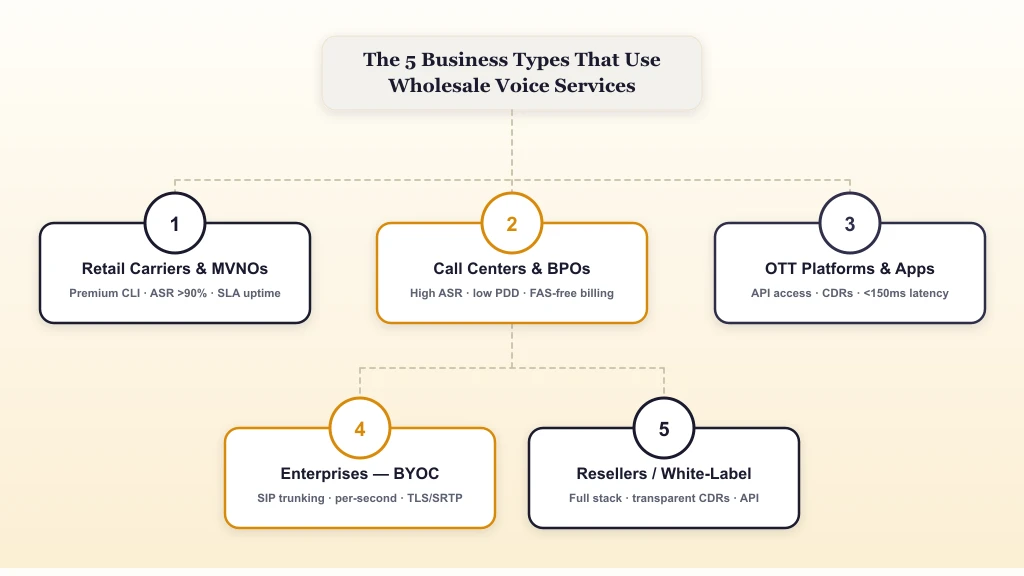
Retail carriers and MVNOs need high-volume premium CLI termination with guaranteed ASR above 90% and SLA-backed uptime. Their end customers experience the quality directly, making route consistency non-negotiable. These buyers prioritize tier-1 interconnects and real-time QoS data over per-minute rate.
Call centers and BPOs handle thousands of concurrent calls requiring high ASR, low PDD, and flexible CLI/Non-CLI routing depending on campaign type. FAS-free billing is critical at this volume — even a small FAS inflation multiplied across millions of monthly minutes materially impacts cost.
OTT platforms and calling apps need termination for app-to-phone calls — typically Non-CLI or CLI depending on market and use case — with strong API access for programmatic route management, real-time CDR retrieval, and number provisioning. Latency below 150ms round-trip is the practical threshold for acceptable voice quality in app-to-phone calling.
Enterprises using BYOC (Bring Your Own Carrier) connect their UCaaS or CPaaS platform directly to a wholesale voice provider via SIP trunking. They want per-second billing to minimize costs on short-duration calls, codec flexibility (G.711 and G.729 support), and TLS/SRTP encryption that satisfies security policy. Ajoxi's SIP trunking handles auto-scaling without downtime, with IP authentication and TLS/SRTP included.
VoIP resellers and white-label providers need the full stack: termination, DIDs, SIP trunking, and transparent CDRs for retail invoice reconciliation — all under one account, ideally with API access for programmatic management. The margin between wholesale cost and retail pricing is their revenue model. Route quality protects that margin; poor ASR and customer churn erode it.
The five business types that buy wholesale voice — retail carriers/MVNOs, call centers/BPOs, OTT platforms, BYOC enterprises, and resellers/white-label — each with different needs.
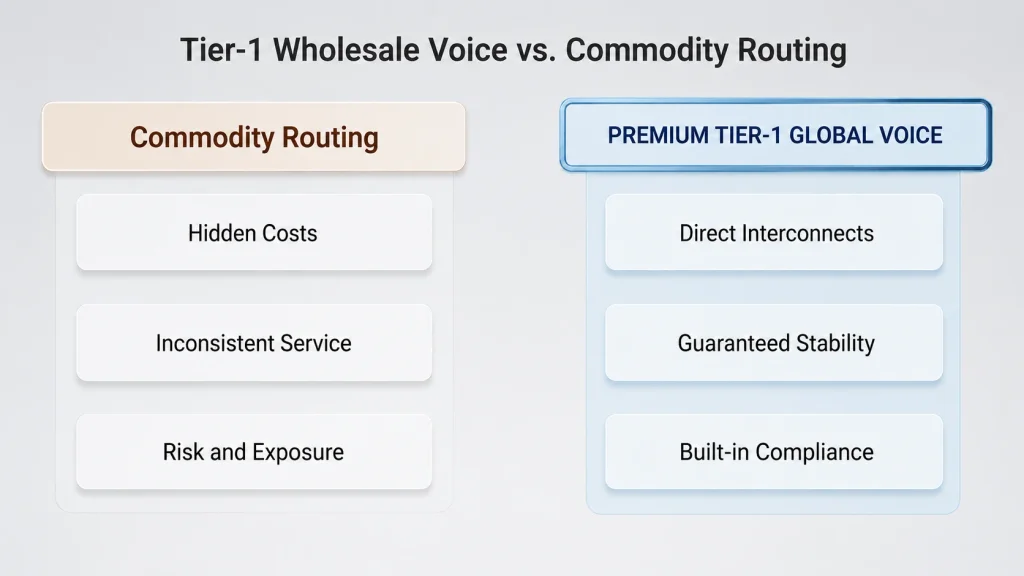
What Differentiates Tier-1 Wholesale Voice from Commodity Routing
The wholesale voice market has providers at every price point. Choosing based on rate alone is how businesses end up with high effective costs, compliance exposure, and customer churn from poor call quality.
Tier-1 providers own the carrier interconnects. No intermediary means no quality variance introduced by a middleman's sourcing decisions. Direct interconnects produce lower PDD, more stable ASR, and faster incident resolution when issues arise — because the provider owns the network layer where the problem lives.
Ajoxi's wholesale voice network operates across 243 territories with direct tier-1 interconnects, backed by 99.99% uptime and a 50+ year team expertise. The infrastructure includes AI-driven route optimization that adjusts paths in real time based on live quality data — not static rate tables — and proactive fraud monitoring covering IRSF, Wangiri, and SIM-box patterns before they generate billing incidents.
For businesses in regulated sectors — finance, healthcare, insurance — the compliance layer matters as much as the technical one. Ajoxi's platform covers GDPR and FCC STIR/SHAKEN requirements across regulated industry verticals — meaning buyers don't need to source separate compliance attestation from a carrier that wasn't built for regulated industries.
Explore voice termination setup choices or review wholesale VoIP termination providers compared side by side — no credit card required to start a trial, live in under an hour. Report voice fraud to the FTC.
Tier-1 wholesale voice vs commodity routing — the real split on interconnects, PDD/ASR stability, incident resolution, route optimization, fraud monitoring, and compliance.
Conclusion
Wholesale voice services are the invisible infrastructure layer that decides whether a business call gets through, gets billed correctly, and complies with the destination market's regulations.
Termination, origination, transit, SIP trunking, and wholesale DID each serve a different function in the call delivery chain — and matching the service type to your business profile is what separates a margin-positive voice operation from one that bleeds cost.
Tier-1 carriers earn the premium they charge through direct interconnects, FAS-free billing, AI-driven LCR weighted on quality, and compliance posture built in from day one. The cheapest column on the rate deck rarely produces the lowest invoice once ASR, PDD, MOS, and STIR/SHAKEN attestation are accounted for.
The buyers who treat wholesale voice as infrastructure — not a commodity — keep the margin that makes voice a viable revenue engine in 2026. For a practical buying guide, see the breakdown of wholesale VoIP minutes TCO and the comparison of wholesale VoIP providers.
FAQ: Wholesale Voice Services
What are wholesale voice services?
Wholesale voice services are bulk voice communication infrastructure sold business-to-business by carrier-grade providers. They cover voice termination, voice origination, voice transit, and SIP trunking. Buyers — carriers, resellers, enterprises, and platforms — access global call delivery without building their own network infrastructure.
What is the difference between wholesale voice and retail voice services?
Retail voice sells calling plans directly to end users at per-minute or monthly rates that include a service margin.
Wholesale voice operates at the B2B infrastructure layer — providers sell bulk minutes, routes, and trunking capacity to carriers, resellers, and enterprises who then deliver services to end users. Wholesale pricing is significantly lower because it trades margin for volume and removes the end-user relationship management layer.
What is the difference between white routes and grey routes in wholesale voice?
White routes (CLI routes) pass full caller identification, comply with destination-country regulations, and use legitimate carrier interconnects. Grey routes bypass official interconnects to reduce cost — often stripping or spoofing CLI, lacking STIR/SHAKEN attestation, and risking regulatory blocking as anti-spoofing rules tighten globally.
Non-CLI routes are a legitimate third category — lower cost, no CLI passed — distinct from grey routing in that the route type is disclosed and the interconnect is official.
What quality metrics determine if wholesale voice services are reliable?
Four metrics define usable route quality: ASR (Answer-Seizure Ratio) — target above 90% for CLI routes; PDD (Post-Dial Delay) — target under 3 seconds; MOS (Mean Opinion Score) — target above 4.0; and NER (Network Effectiveness Ratio) — target above 95%. Request per-destination data, not network averages.
What is FAS billing and why does it matter in wholesale voice?
FAS (False Answer Supervision) occurs when a carrier's switch signals a call as answered before a human picks up, triggering billing for ring time.
At scale, FAS inflates wholesale cost 15–30% above the nominal per-minute rate. FAS-free billing — where charges start only on genuine human answer — is the standard among tier-1 providers and should be confirmed in writing before committing traffic volume.
Run your voice on Ajoxi.
AI receptionists, wholesale routes, virtual numbers — built on one platform with transparent pricing and a 24/7 NOC.