Everything You Must Know About the Korean Phone Number Format
Calling South Korea is easier than you think once you understand the simple rules. The Korean phone number format follows a logical, three-part structure: the country code (+82), the city or mobile codes, and the subscriber number — with one rule that trips up nearly every international caller.
Phone Number Format
Everything You Must Know About the Korean Phone Number Format
Introduction
Calling South Korea is easier than you think once you understand the simple rules. The Korean phone number format follows a logical, three-part structure, and this guide breaks it down for you.
We'll cover the essential components: the country code (+82), the city or mobile codes, and the subscriber number — to ensure you can successfully navigate the Korean Phone Number Format for any personal or professional reason.
Getting Started: South Korea's Country Code (+82)
The foundation of the Korean phone number format for international calls is South Korea's country code +82, the prefix that routes calls correctly. A social-media phone number can also support customer contact across messaging platforms, but for voice the country code is the critical first step. For more details on global dialing, you can refer to this international call guide.
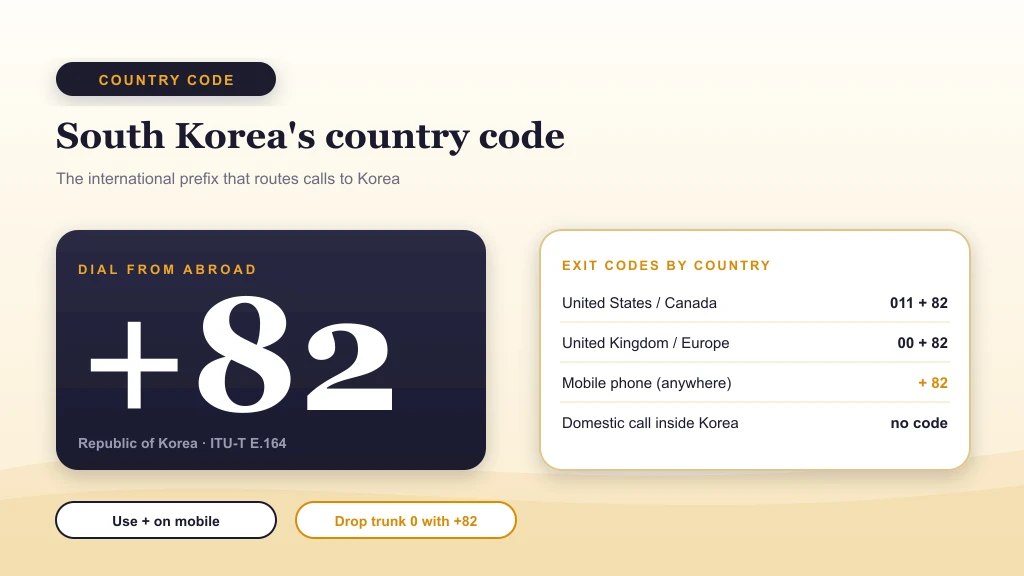
South Korea's country code is +82 — the prefix that routes international calls into the country.
Key aspects of the country code
The "Plus" sign (+): When dialing from a mobile phone, the plus symbol (+) is a universal replacement for your local country's exit code (such as 011 from the USA or 00 from the UK). It simplifies the dialing process, automatically telling your network to connect internationally.
Dialing from a landline: If you are calling from a landline, you must manually dial your country's specific exit code first, followed by 82. For example, a caller from the United States would dial 011, then 82, and then the rest of the Korean phone number.
When not to use it: You do not need to use the country code if you are already within South Korea and making a domestic call to another Korean number. In this case, you would simply dial the area / mobile code followed by the subscriber number.
Korean Phone Number Structure Explained
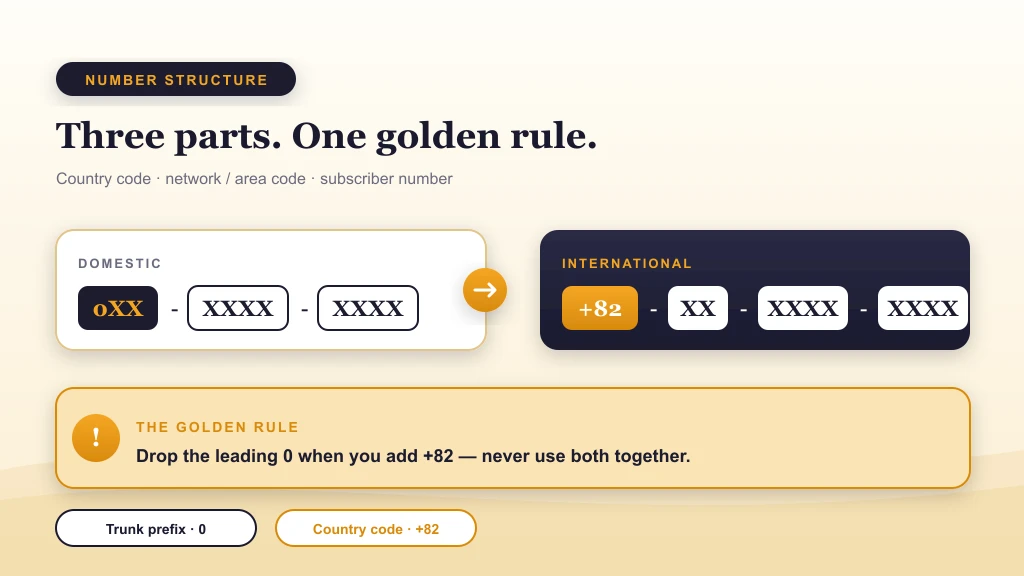
A complete South Korean telephone number consists of three parts: the country code, a network / area code, and the subscriber number. The most critical rule to remember when calling from abroad is to drop the leading zero from the network or area code.
The three parts of every Korean phone number — country code, network / area code, and subscriber number.
Breakdown of the format
Full domestic format: 0XX-XXXX-XXXX
International calling format: +82-XX-XXXX-XXXX
Let's look at the components of the Korean Phone Number Format in detail:
Network / area code (XX): A 2 or 3-digit code that identifies the mobile carrier or the geographic region (city / province) of the number. For example, Seoul's area code is 2, while major mobile carriers use codes like 10.
Subscriber number (XXXX-XXXX): The unique 7 or 8-digit number assigned to the individual phone line. It is typically split into two groups of three or four digits for readability.
The "dropped zero" rule: The leading "0" in the domestic format is a trunk prefix used only for calls within South Korea. When dialing from another country, this "0" must be removed. Forgetting this step is the most common reason international calls to Korea fail to connect.
South Korea Area Codes for Major Cities
For landline numbers, the area codes are a crucial part of the Korean Phone Number Format for connecting to the correct geographic region. These codes vary in length from two to three digits. Knowing these codes is essential for businesses trying to establish a local presence or for travelers needing to contact local services, especially when paired with wholesale bandwidth for efficient communication.
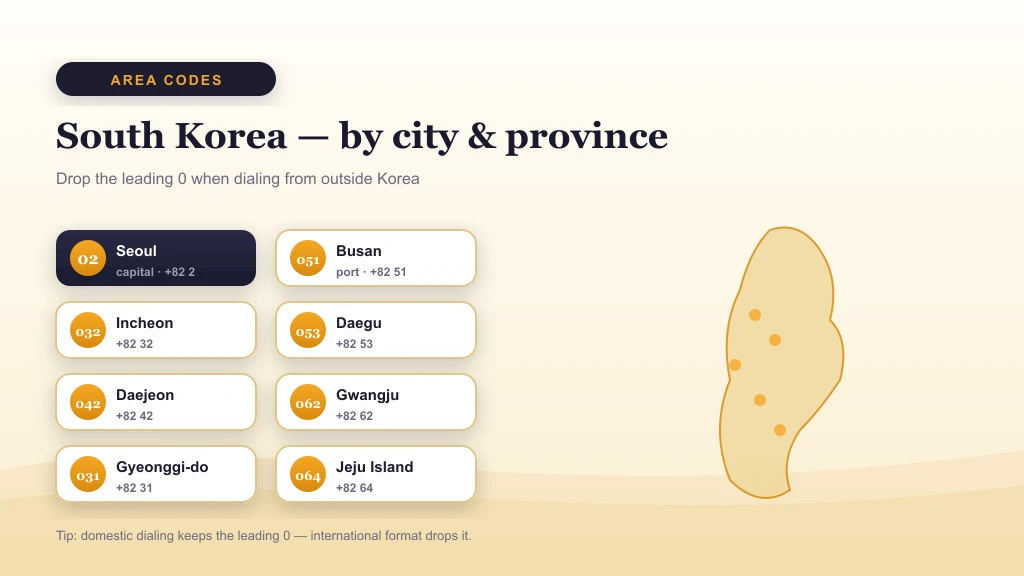
South Korea area codes for major cities — Seoul, Busan, Incheon, Daegu, Daejeon, Gwangju and more.
Quick-reference table of area codes
Below are the area codes for some of South Korea's most significant cities and provinces. Remember to drop the initial "0" from these codes when dialing from outside Korea.
City / Province
Domestic area code
International dialing code
Seoul
02
2
Busan
051
51
Incheon
032
32
Daegu
053
53
Daejeon
042
42
Gwangju
062
62
Gyeonggi-do
031
31
Jeju Island
064
64
How to Call a South Korean Mobile Number from Abroad
Calling a South Korean mobile phone uses a specific structure within the overall Korean Phone Number Format. The process is very similar to calling a landline, but instead of an area code you will use a mobile carrier identification number. The most common mobile identifier in South Korea is 10.
For businesses managing high-volume traffic, connecting through wholesale voice providers can ensure these international connections remain stable and cost-effective.
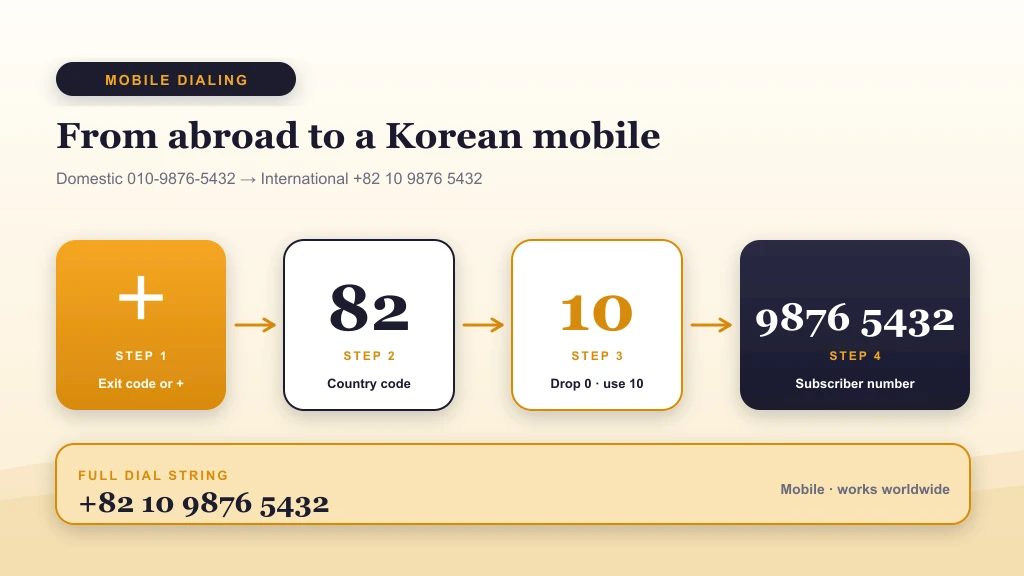
Calling a Korean mobile from abroad — exit code or +, country code 82, mobile identifier 10, then the subscriber number.
Step-by-step mobile dialing
Let's say you want to call a mobile number in South Korea, which is written domestically as 010-9876-5432.
Start with the exit code or plus sign (+): From a mobile, simply start with +. From a US landline, dial 011.
Add the South Korean country code: 82.
Add the mobile identifier: Use 10 (after dropping the leading "0").
Dial the subscriber number: Finish with 9876-5432.
The complete number you would dial from a mobile phone is: +82-10-9876-5432.
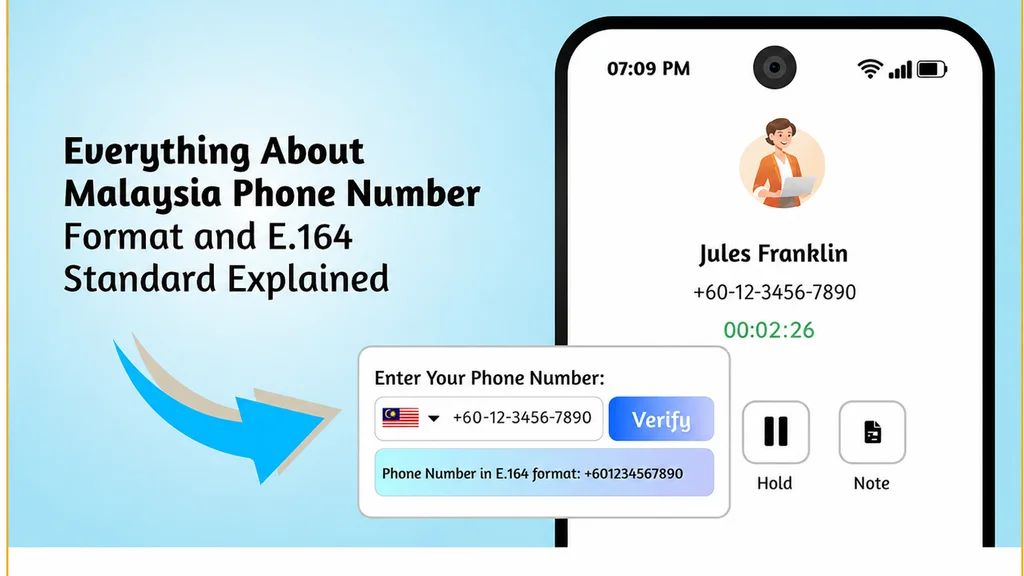
You may also know: Everything About Malaysia Phone Number Format.
Tips for Formatting and Saving Korean Numbers
Correctly formatting and saving Korean numbers in your contacts list can save you future confusion, dialing errors, and undelivered text messages. Adopting the standard international format ensures that your calls and texts will work whether you are at home or traveling in South Korea. For international dialing standards, consult the ITU.
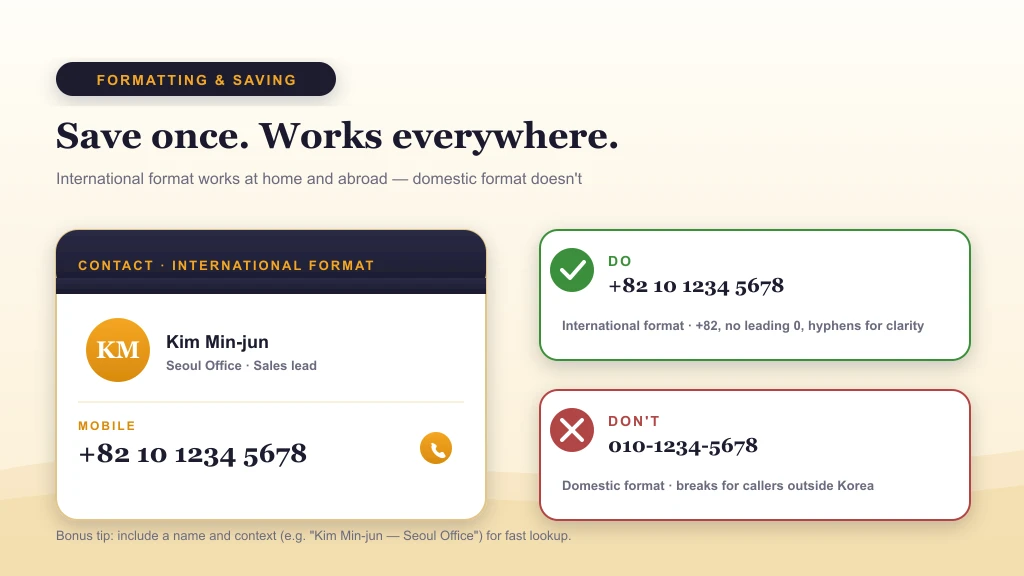
Save Korean contacts in international +82 format so calls and texts work whether you're inside or outside Korea.
Best practices for your contacts list
Always use the international format: Save all Korean numbers with the country code +82 and without the leading zero of the area / mobile code. For example, save 010-1234-5678 as +82-10-1234-5678. This format works both internationally and domestically when using a mobile phone.
Use hyphens for readability: While not strictly necessary for dialing, using hyphens to separate the number segments (+82-10-XXXX-XXXX) makes the number much easier to read and verify.
Include a name and context: When saving a contact, add a clear name and a note (e.g., "Kim Min-jun — Seoul Office" or "Busan Hotel Front Desk"). This is especially helpful when dealing with multiple contacts from the same organization.
Common Errors When Dialing a Korean Number
A single misplaced digit can prevent your call from connecting. Being aware of the most frequent dialing mistakes is the first step to avoiding them. From forgetting to drop the zero to dialing at an inappropriate time, these small errors can cause big frustrations.
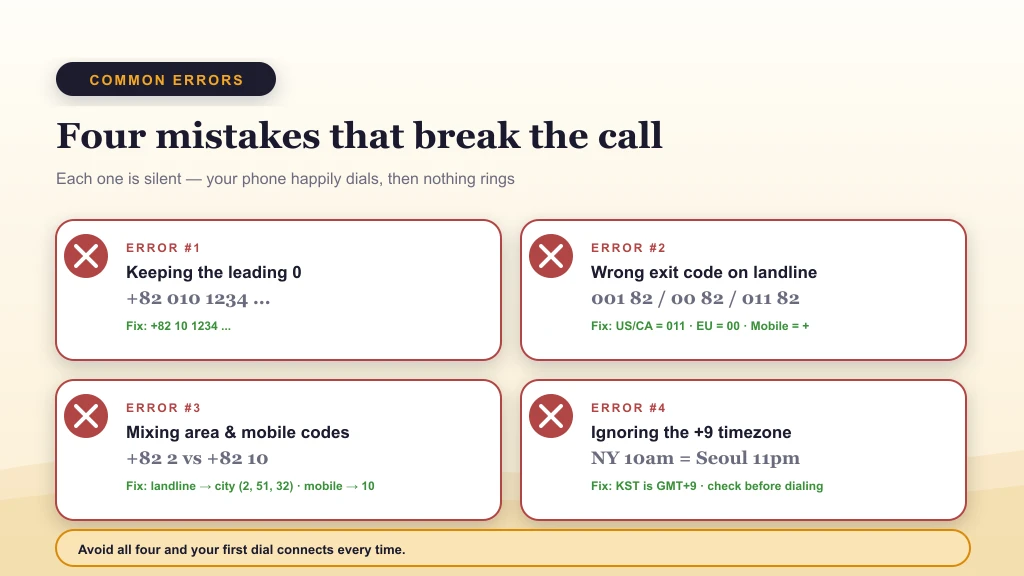
The four most common Korean-dialing mistakes — forgetting the dropped 0, wrong exit code, mixing area / mobile codes, and ignoring the +9 time-zone gap.
Checklist for a successful call
Forgetting to drop the leading "0": This is the number-one mistake when people use the Korean Phone Number Format for the first time. The "0" on a domestic number (e.g., 010 or 02) must be removed when you add the +82 country code.
Using an incorrect exit code: While + on a mobile solves this, landline users must know their specific country's exit code. For the US and Canada it's 011; for most of Europe it's 00.
Mixing up area and mobile codes: Ensure you know whether you are calling a landline (which requires a city area code like 2 for Seoul) or a mobile phone (which almost always uses 10).
Ignoring time-zone differences: South Korea operates on Korea Standard Time (KST), which is GMT+9. Before calling, check the local time to avoid calling in the middle of the night. A call from New York at 10 AM is 11 PM in Seoul.
Conclusion
Navigating the Korean phone number format is simple once you understand its key components. Always remember to start with the +82 country code and apply the critical "dropped zero" rule.
By distinguishing between the primary mobile identifier (10) and specific city area codes, you can prevent the most common dialing mistakes. This guide has equipped you with the confidence to format any Korean number correctly. You are now ready to connect with anyone in South Korea without hassle or confusion.
Get started with your South Korean number through Ajoxi — connect with South Korean partners effortlessly. Our reliable virtual numbers help you build trust and manage calls like a local.
Frequently Asked Questions
What does a typical number look like using the Korean Phone Number Format?
A typical mobile number is formatted as 010-XXXX-XXXX, while a landline uses a city code such as 02-XXX-XXXX for Seoul. For international calls, the leading 0 is replaced with the country code +82 — for example, the domestic mobile number 010-1234-5678 becomes +82-10-1234-5678 in international format.
How do I write my Korean phone number for international contacts?
Use the full international format with the +82 country code, drop the leading 0 from the area or mobile code, and separate the segments with hyphens for readability. Example: a domestic number written as 010-1234-5678 should be stored as +82-10-1234-5678. This format works whether the contact is calling you from inside or outside South Korea.
Is it free to receive texts in South Korea with a foreign SIM?
Receiving SMS messages while roaming in South Korea is usually free with most major mobile carriers, but it depends on your home carrier's roaming plan. Some carriers include free incoming SMS while roaming, while others charge a per-message fee. Always check your roaming policy before traveling. Receiving messages on a Korean SIM card or eSIM is free regardless of origin.
Can I use WhatsApp with a Korean phone number?
Yes. WhatsApp works with any valid phone number that can receive an SMS or voice call for verification, including South Korean numbers. After verifying with your +82 number, WhatsApp messaging and calls work over the internet — so a foreign WhatsApp contact does not need to dial a Korean number, only message you through the app.
What is the mobile phone code for South Korea?
The mobile phone code (carrier identifier) most commonly used in South Korea is 10, written domestically as 010. In international format the leading 0 is dropped, so a Korean mobile number begins with +82 10. All three major South Korean mobile carriers — SK Telecom, KT, and LG U+ — use the 010 mobile prefix.
Run your voice on Ajoxi.
AI receptionists, wholesale routes, virtual numbers — built on one platform with transparent pricing and a 24/7 NOC.