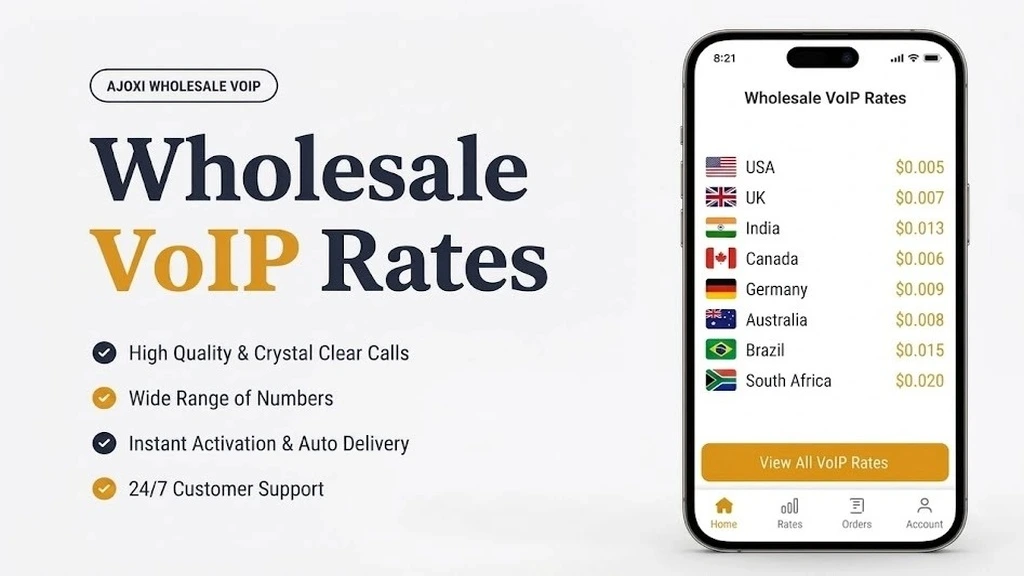
VoIP Wholesale Rates: What Businesses Pay in 2026
How wholesale VoIP rates are structured, what drives effective per-minute cost above the nominal rate, and how to evaluate a rate card.
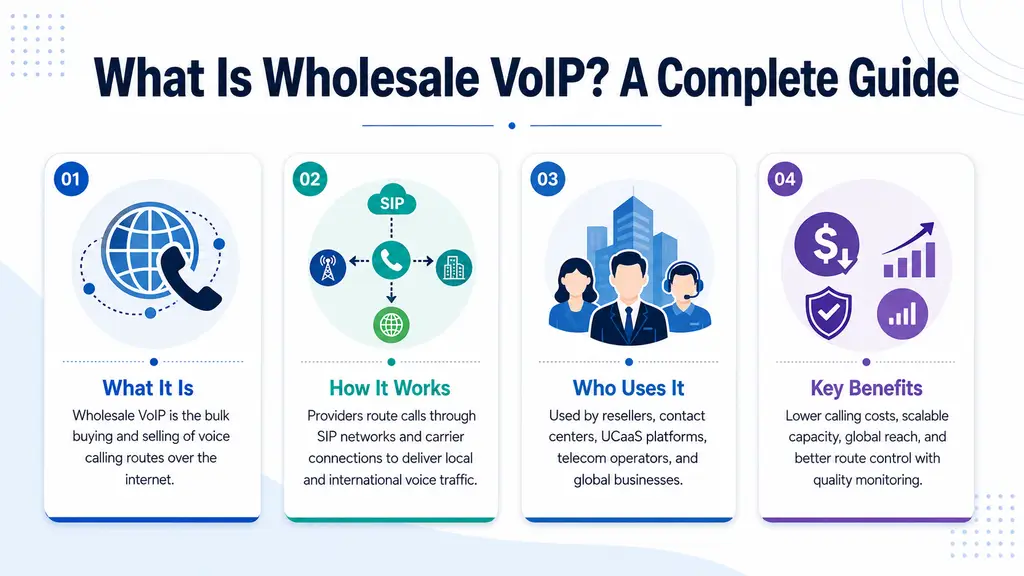
How A-Z termination, origination, SIP trunking, and rate cards actually work — written for carriers, resellers, BPOs, and platforms buying voice minutes at scale.
Most people who buy voice minutes for a living have never used the word "wholesale" with a stranger. The business of wholesale VoIP sits two layers beneath the consumer experience — carriers buy minutes from carriers, who buy from carriers, who eventually terminate calls onto the public network. The contracts are quiet, the pricing changes weekly, and the engineering decisions ripple into every business call that crosses a country border.
This guide is for the people sitting on the buy side of those contracts. It covers what wholesale VoIP actually is, how rates are structured, the difference between a CLI route and a non-CLI route, the three quality metrics that matter, the toll-fraud patterns that wipe out margins, and the practical checklist for choosing a provider that will still be operating six months from now. Read it end-to-end, or skim the section you need.
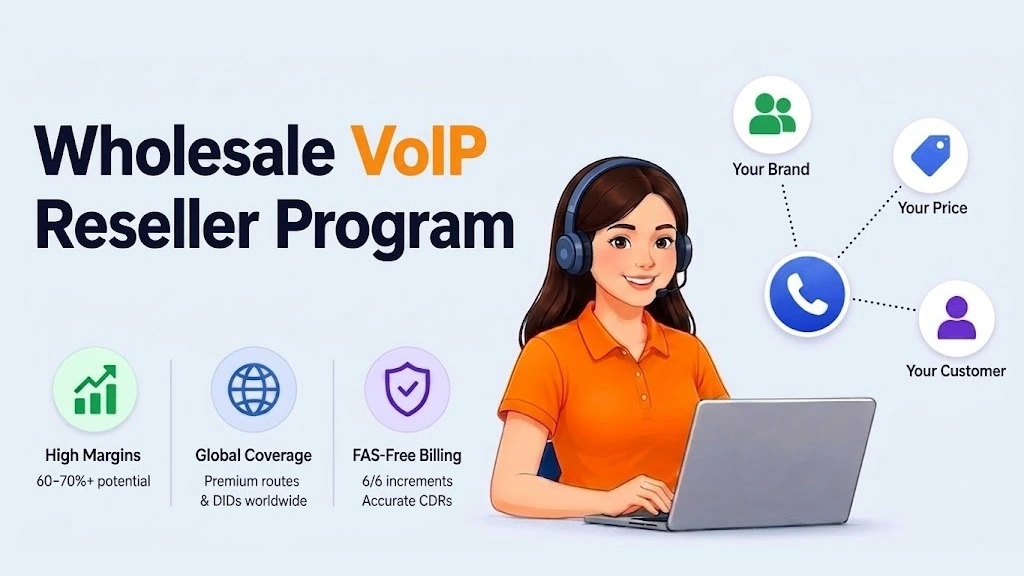
Wholesale VoIP is the business of selling voice minutes in bulk between carriers, rather than to end users. A wholesale provider sits on Tier-1 SIP interconnects with telcos around the world, buys massive volumes of termination capacity at deeply discounted rates, and then resells that capacity to other businesses — resellers, BPOs, contact centres, ITSPs, and platforms — at a margin.
The product is invisible to a consumer. Nobody buys "wholesale VoIP" the way they buy a mobile plan. But behind the scenes, almost every business voice call that crosses a country border has traversed at least one wholesale carrier route. If your company sends or receives more than a few thousand minutes per month, you are very likely already paying for wholesale termination — directly or indirectly.
The technical mechanism is SIP (Session Initiation Protocol) over IP transport. Two carriers establish a SIP trunk — a logical voice connection — agree on a per-minute rate by destination, and route traffic. The connection is monitored continuously for quality (drops, latency, jitter) and renegotiated when rates or routes change.
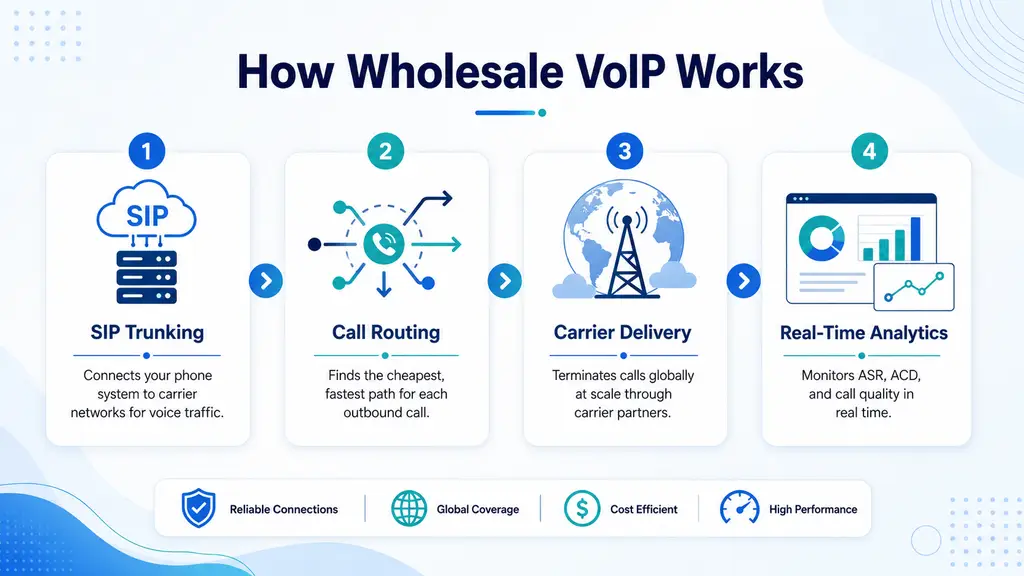
Four buyer profiles dominate the wholesale market, and each has very different priorities.
Resellers and ITSPs buy minutes wholesale and repackage them as retail VoIP plans for SMBs. Margin is everything. They negotiate aggressive per-minute pricing, often with monthly volume commitments, and watch ASR (Answer-Seizure Ratio) like a hawk.
Contact centres and BPOs buy origination (inbound DIDs) and termination (outbound dialing) in roughly equal volume. They care about predictable latency and a single throat-to-choke for support, because every dropped call costs them an SLA penalty with their own enterprise customers.
Communications platforms — companies that embed voice into their own product (CPaaS providers, dialer software, call recording tools) — buy at the highest volume and care most about API maturity, programmatic provisioning, and global coverage in a single contract.
Enterprises with international footprints sometimes buy wholesale directly to bypass their retail telco markup. A pharma company with offices in 14 countries can save 40–60% by signing a single wholesale contract instead of paying 14 separate retail telcos.
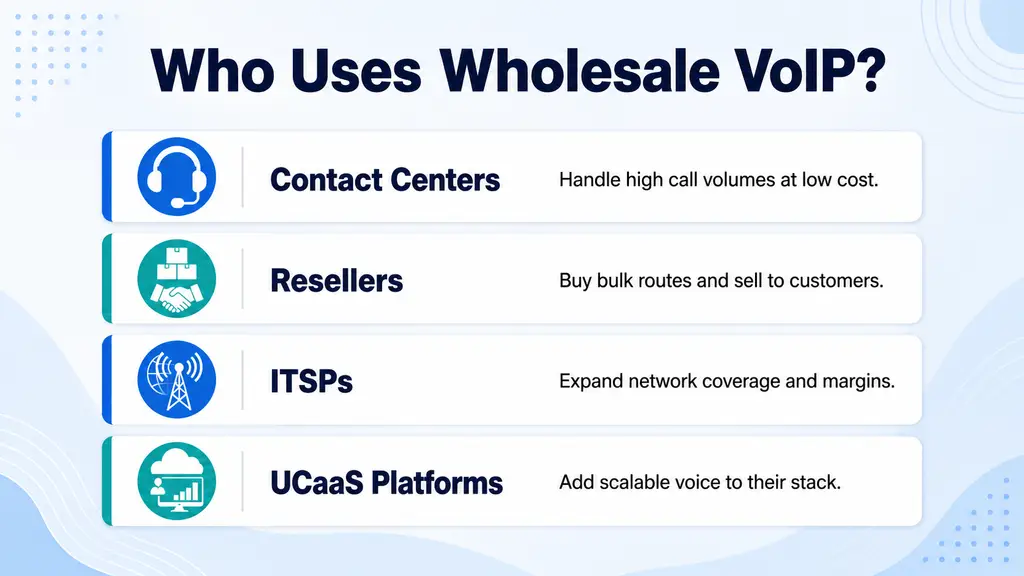
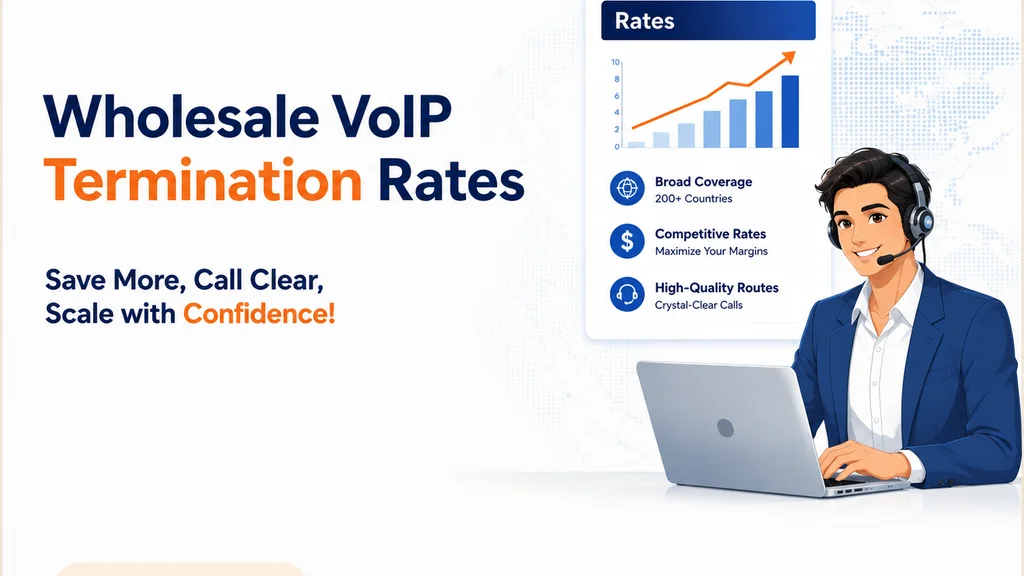
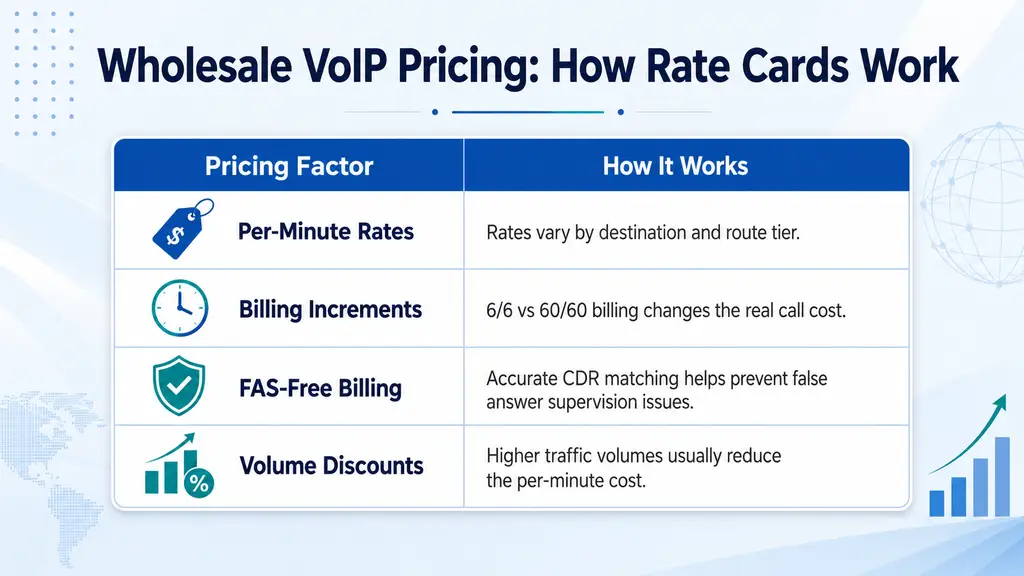
Wholesale VoIP rates are quoted per minute, per destination, with billing in 6-second or 1-second increments. A typical rate card has thousands of rows — one per country prefix or sometimes one per area code within a country. Rates change weekly. Some change daily.
Pricing depends on three variables: destination country, the type of route (CLI vs non-CLI, more on that below), and your monthly committed volume. The same call to Germany can cost €0.0085/min on a Tier-1 CLI route or €0.0028/min on a non-CLI grey route, and the difference is not always obvious until you look at the call completion data a month later.
There are two pricing structures you will see most often:
Volume commits get you 15–35% better rates. So do termination-only commits (no origination DIDs). Negotiation matters; published rate cards are usually the starting point, not the finishing point.
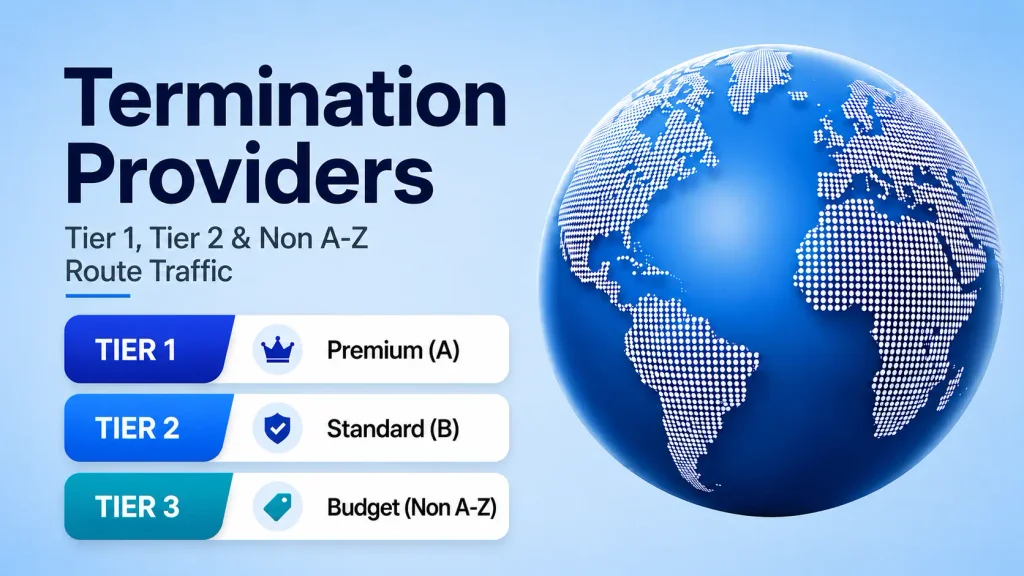
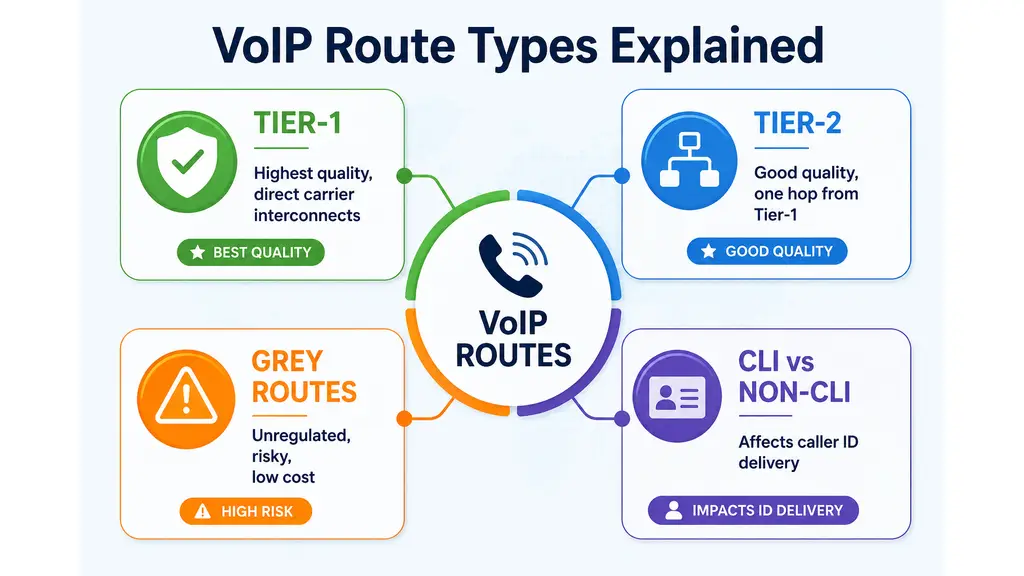
"A-Z termination" is industry jargon for a route that can terminate calls to every country on Earth — Andorra to Zimbabwe. The premium A-Z routes are CLI-guaranteed: the called party sees the original calling number on their handset, the call signaling preserves caller ID end-to-end, and the route is direct Tier-1 with no grey-market hops.
Non-CLI routes strip or replace the caller ID. They are cheaper — sometimes 60% cheaper — because they exit through carriers that don't pay the full settlement rate to the destination operator. The trade-off: spam-flagging is more likely, completion rates are lower, and the destination operator can blackhole the entire prefix without warning if abuse complaints spike.
Most reputable wholesale buyers operate a mixed strategy: CLI routes for premium business traffic (where the called party expects to know who's calling) and non-CLI for marketing dialers and high-volume robocalling where margin is paramount. Mixing is fine. Pretending a non-CLI route is CLI to a customer is fraud — and detectable.
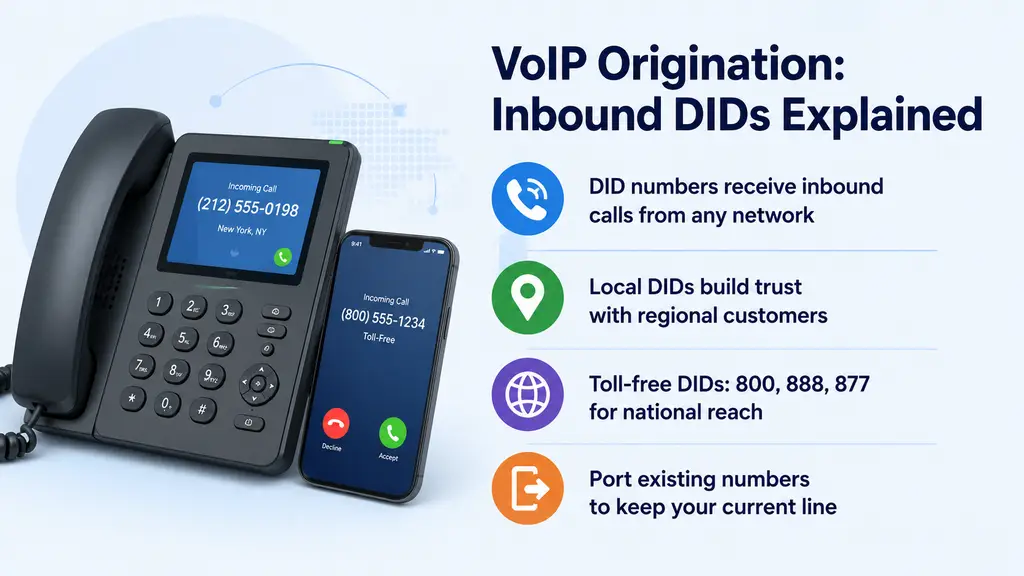
The two halves of a wholesale VoIP contract. Termination = your outbound calls leaving your platform and reaching the destination handset. Origination = inbound calls coming in on a DID (Direct Inward Dial number) and arriving at your platform.
Termination is priced per minute. Origination is priced per DID per month plus a per-minute charge for incoming calls. A US local DID typically rents for $0.50–$2 per month with $0.005–$0.01 inbound per minute. Toll-free DIDs are more expensive ($1–$5/mo) but the inbound is paid by the called party — which is you — so the math is different.
Most wholesale buyers need both. A contact centre dialing out needs termination. A SaaS company giving every customer a unique support line needs origination. A CPaaS provider needs both at massive scale across 100+ countries.
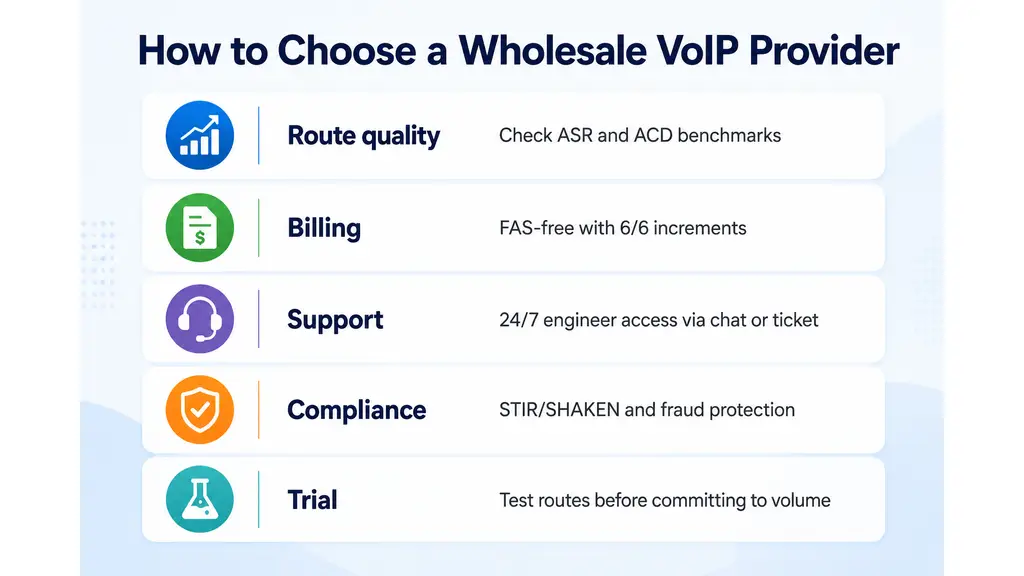
The right provider depends on what you're optimising for. Five questions cut through marketing copy faster than anything else.
1. Where are their Tier-1 interconnects? Ask for a list of direct telco settlement agreements. If a provider says "Tier-1 routes" but routes traffic through three intermediate carriers to reach Vodafone, that's not Tier-1; that's marketing.
2. What's the failover behavior? If their primary route to Germany goes down at 3am, how fast does traffic re-route, and to what fallback? Ask for incident postmortems from the last six months.
3. How do they bill? 1-second increments save 5–8% compared to 60-second billing on a million-minute month. Most reputable wholesale providers bill in 1-second after the first minute.
4. What's the dispute resolution path? When a customer claims they were billed for a call they didn't make, what's the SLA on resolution? Reputable carriers have CDR (Call Detail Record) audit tools you can self-serve.
5. Who answers when you call NOC at 3am? Wholesale voice has no "support hours". The NOC is staffed 24/7 or it isn't a real wholesale operation. Test their response time before you sign.
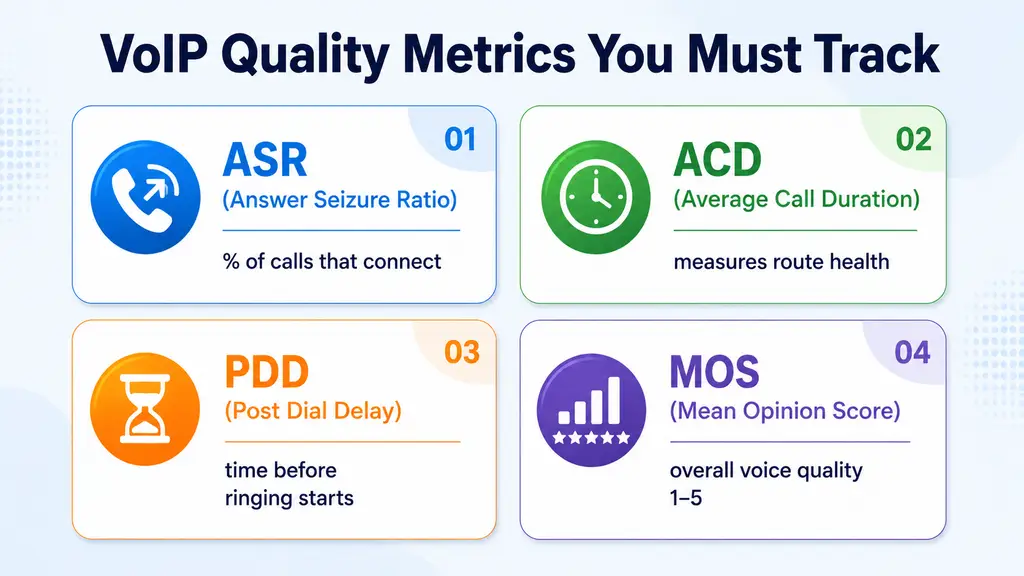
Three numbers tell you whether a wholesale route is good or bad.
ASR (Answer-Seizure Ratio) is the percentage of calls that are answered out of the total seized. A healthy ASR for outbound business traffic is 45–65%. An ASR below 30% on a CLI route usually means your traffic is being filtered as spam at the destination operator.
ACD (Average Call Duration) is how long answered calls last. A drop in ACD without a drop in ASR is a tell-tale sign the destination network is connecting calls and then dropping them. Some grey routes do this deliberately to claim a billable connection.
PDD (Post-Dial Delay) is the time between you finishing dialing and the destination handset starting to ring. Under 4 seconds is excellent. Over 8 seconds and your customers will think the network is broken. PDD is the canary in the coal mine for routing problems upstream.
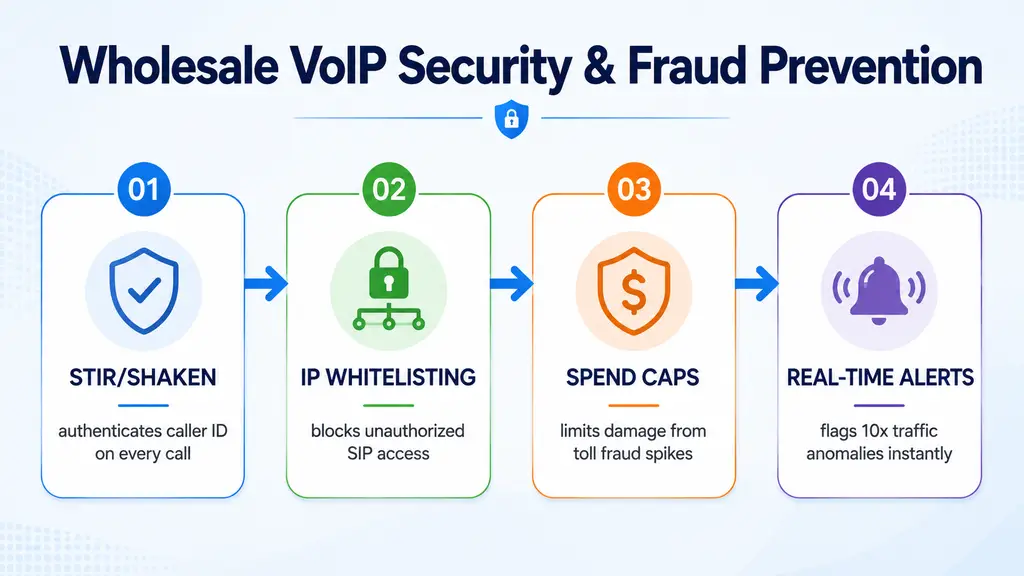
Toll fraud is the single largest financial risk in wholesale VoIP. The pattern is well-known: attackers compromise a PBX or a weakly-secured SIP trunk, then place tens of thousands of expensive international calls — usually to premium-rate numbers in obscure countries — over a long weekend. By Monday morning, the bill is $40,000.
Three controls reduce fraud risk to near-zero without slowing legitimate traffic:
Any reputable wholesale provider offers all three as built-in controls, not paid add-ons. If they charge for fraud protection, they are not a serious wholesale provider.
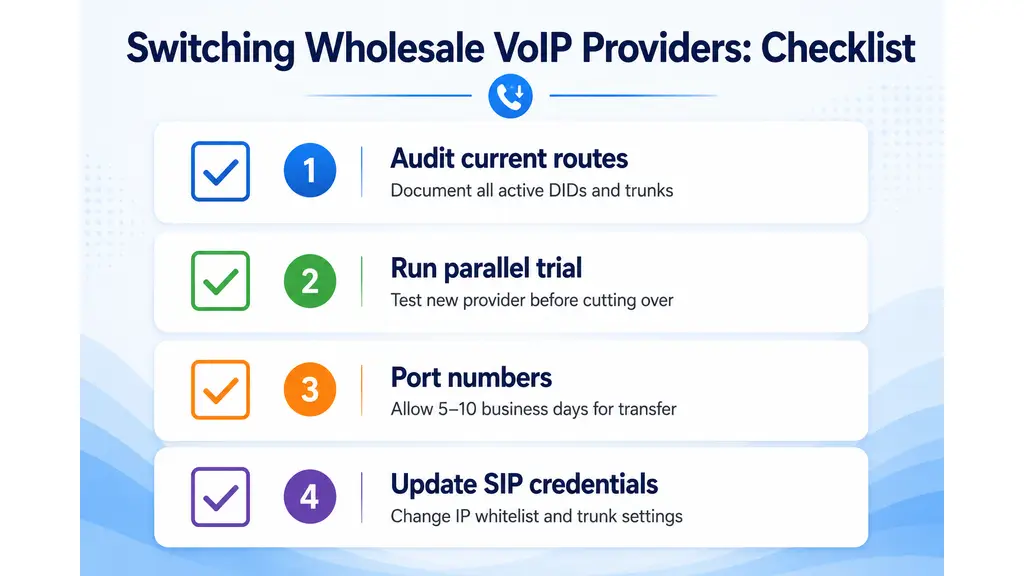
Switching is the moment most wholesale buyers fear. It doesn't have to be painful if you sequence it properly.
The right sequence: provision SIP trunks with the new provider first, run 5–10% of test traffic for two weeks, validate ASR/ACD/PDD on the new routes match or beat the incumbent, then move traffic in 25% increments over four weeks. Keep the old contract active until the new one is fully proven. Number porting (LNP) for origination DIDs is a separate workstream — start it on day one, expect 7–10 business days for US locals and longer for international.
Never cut over 100% on day one, even if the new provider's pre-sales engineer swears it'll be fine. Voice infrastructure is full of edge cases that only show up under real traffic.
Wholesale VoIP looks intimidating from the outside because the language is operator language — rate cards, settlement, A-Z routes, CLI integrity — but the underlying decisions are not that different from any other commercial supply contract. You are buying a commodity that varies in quality from one supplier to the next, paying a per-unit price that depends on volume and route quality, and you live or die by how carefully you measure what you actually got.
The buyers who do well share three habits. They measure ASR, ACD, PDD, and MOS continuously, not just at procurement time. They keep at least two carriers warm for every major destination, so a route degradation never becomes an outage. And they treat fraud controls as a non-negotiable default, not an add-on. Get those three right and wholesale VoIP becomes one of the most predictable cost lines on the budget.
Retail VoIP sells voice service to end users (a person, a business) bundled with apps, devices, and support. Wholesale VoIP sells raw voice minutes between carriers and businesses operating their own platform — no UI, no consumer support, much lower per-minute pricing, and a volume commit usually attached.
On a CLI route, the called party sees the original caller ID and the call signaling is preserved end-to-end. On a non-CLI route, the caller ID is stripped or replaced. Non-CLI is cheaper but completion rates are lower and spam-flagging is more likely.
A-Z is industry shorthand for a route that can terminate voice traffic to every country in the world — Andorra to Zimbabwe. A "Tier-1 A-Z" provider has direct settlement agreements with major telcos in each destination region.
Per minute, by destination prefix, usually in 1-second increments after a 1-minute floor. Some providers bill in 6-second blocks. The shorter the increment, the more money you save on short calls — typically 5–8% on a million-minute month.
For outbound business voice traffic on CLI routes, 45–65% is healthy. Below 30% usually means traffic is being filtered as spam at the destination operator, or you are on a degraded route.
Three controls reduce toll-fraud risk to near zero: per-destination daily spend caps on high-risk prefixes, IP whitelisting so the trunk only accepts traffic from your own server IPs, and real-time anomaly detection that alerts on 10x spikes in volume to a single destination.
Tier-1 A-Z termination, origination DIDs in 120+ countries, transparent rate cards, 1-second billing, and a 24/7 NOC that picks up in under 90 seconds.