Wholesale VoIP Termination Providers: How to Choose the Right Partner
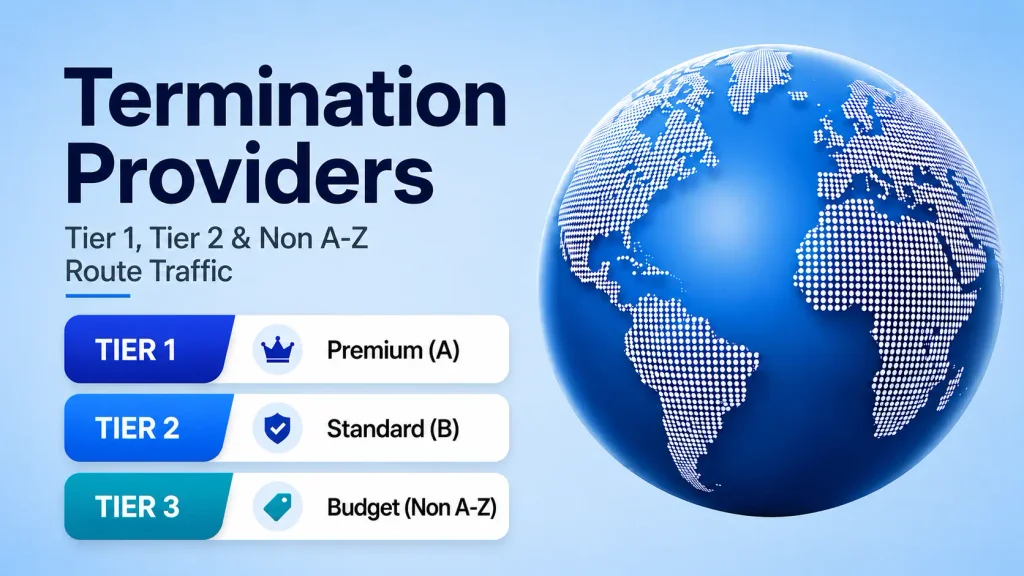
Tier-1 vs Tier-2 vs gray-market providers, the six evaluation criteria that matter, and a practical sequence for trial routing before you commit volume.
Compare the 7 best wholesale VoIP providers in 2026. Side-by-side breakdown of routes, pricing models, global coverage, uptime, and honest strengths and trade-offs — written for resellers, carriers, MVNOs, and BPOs running real traffic.

Global wholesale voice traffic crossed 700 billion minutes last year, and less than 10% of it actually rode tier-1 routes end-to-end. The rest got squeezed through gray paths, transcoded twice, and arrived at the destination with false answer supervision or 400ms of post-dial delay. That's the wholesale VoIP market most providers don't talk about.
If you're a reseller, MVNO, BPO, or carrier hunting for a better termination partner, the choice goes far beyond per-minute pricing. ASR, ACD, PDD, route stability, billing transparency, and global reach all decide whether your end customers stay or churn. This guide compares the seven wholesale VoIP providers worth a serious look in 2026 — what they're built for, where they shine, and where they fall short.
A wholesale VoIP provider is a carrier-grade voice operator that sells bulk SIP termination, origination, and DID services to other businesses — not end users. They aggregate routes from tier-1 carriers, move calls through SBCs and softswitches, and bill on rate decks. Resellers, CPaaS platforms, and contact centers use them to power their own voice products.
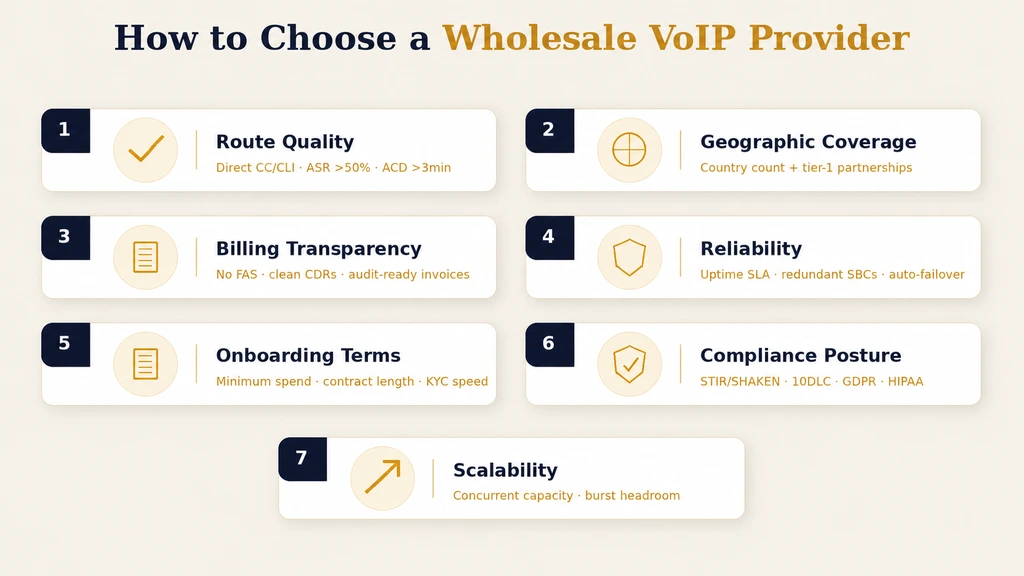
Before lining providers up against each other, decide what actually moves the needle for your business. Most buyers obsess over the rate deck. Smarter ones evaluate the full stack.
The seven criteria that matter most:
A cheap rate deck buys you nothing if 30% of your minutes are FAS or support disappears the moment a route degrades.
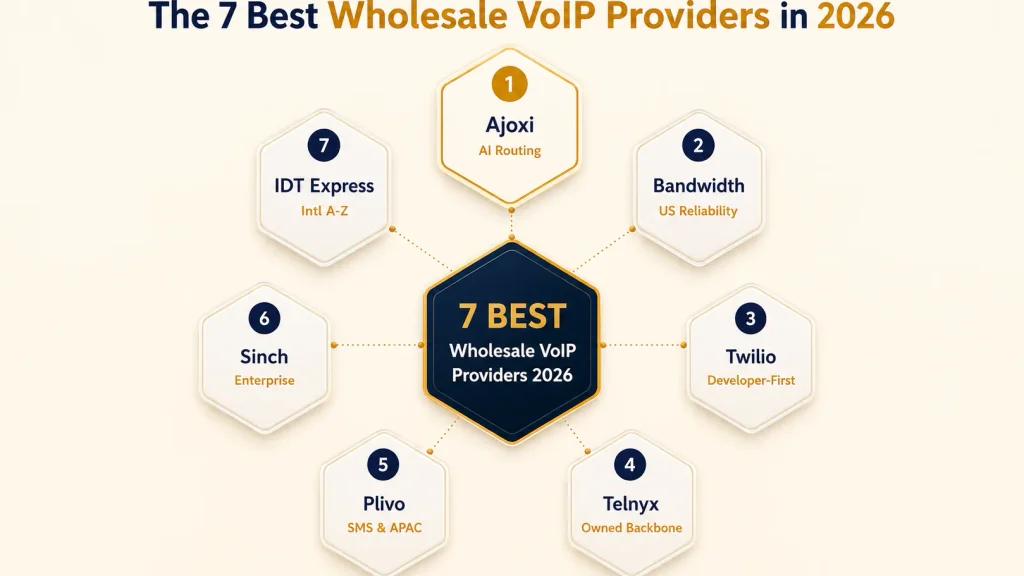
Ajoxi runs an AI-driven wholesale voice network with tier-1 carrier partnerships across 243 territories. The platform layers real-time route optimization on top of carrier-grade SBCs, so calls automatically shift away from degrading paths within seconds. There are no setup fees, no minimum contracts, and pricing is quote-by-route rather than a generic rate deck.
Best for: resellers, MVNOs, BPOs, and UCaaS platforms that need both global termination and a pay-as-you-go model.
Where it shines: AI routing, 99.99% uptime SLA, and a cross-channel stack — voice, SMS, UCaaS, and contact-center tools — sitting on one platform. The team brings 50+ years of combined telecom expertise, which shows up in how routes are vetted before they're sold.
Where it doesn't compete: if you're chasing rock-bottom rates on gray routes, the platform isn't built for that by design.
Bandwidth is a tier-1 with strong direct interconnects to major North American carriers. Great for domestic termination, 911-class reliability, and 10DLC compliance for messaging. International coverage is thinner than its peers, and contracts trend toward enterprise commitments. Best fit: US-heavy SaaS, contact centers, and enterprise voice buyers who need regulatory depth at home.
Twilio is a developer-first CPaaS with a wholesale voice arm. Excellent APIs, deep documentation, and broad coverage through resold tier-1 partners. Costs run higher than pure wholesalers, and FAS-style discrepancies have surfaced in audits of long-tail destinations. Best for developers who want one API stack across voice, SMS, and email — and don't mind paying a markup for the convenience.
Telnyx owns more of its IP backbone than most CPaaS peers, which keeps PDD low and gives the network engineering team direct control. The self-serve portal is excellent. Caveats: account approval can be slow for new resellers, and some destinations still route through partners rather than direct interconnects. Strong choice for technical teams who want tighter control without negotiating an enterprise contract.
Plivo offers competitive SMS pricing and decent voice rates, with particular strength in India and emerging APAC markets. Voice quality on long-haul international destinations has been called inconsistent by reseller communities, so traffic mix matters. Best for SMS-heavy senders or platforms with APAC-skewed user bases.
Sinch delivers tier-1 carrier-grade voice and A2P SMS at scale, particularly strong on the messaging side. Sales motion is enterprise-style, onboarding cycles run long, and pricing is usually negotiated against volume commits. Best for global enterprises that prefer one vendor across voice and messaging and have the procurement muscle to handle a complex contract.
IDT is a veteran international wholesaler with deep direct routes into Africa, the Middle East, and Latin America. The self-serve portal is straightforward. International A-Z is the strength; SMS and UCaaS overlays are weaker compared to AI-native platforms. A solid pick for traditional resellers focused on long-haul international voice.
| Provider | Best For | Coverage | Pricing Model | Standout Feature |
|---|---|---|---|---|
| Our Platform | Global resellers & carriers | 243 territories | Pay-as-you-go, no minimums | AI routing + 99.99% SLA |
| Bandwidth | US enterprise | US-focused | Enterprise commits | 10DLC + 911 reliability |
| Twilio | Developers | Global (resold) | API metered | Best-in-class APIs |
| Telnyx | Technical resellers | Global (owned IP) | Self-serve | Owned backbone |
| Plivo | SMS + APAC | Global, APAC strong | Per-message / per-min | India SMS rates |
| Sinch | Global enterprise | Global tier-1 | Volume commits | A2P SMS at scale |
| IDT Express | Long-haul international | International A-Z | Rate deck | Direct LatAm/Africa routes |
Use this quick decision frame:
The honest take: no provider wins every category. Run a 30-day parallel test with two shortlisted providers on your top five destinations before committing serious volume. ASR and ACD will tell you more than any sales deck. For buyers focused on per-minute economics, see the breakdown of termination rates and wholesale VoIP minutes pricing models.
Explore wholesale voice services in depth — tier-1 carrier-grade voice, AI-driven routing, and pay-as-you-go billing built for resellers and carriers. The guide to wholesale VoIP termination providers breaks down exactly what separates tier-1 route quality from gray-market risk.
No wholesale VoIP provider wins every category — and that's fine, because no real voice business has only one need. The right shortlist depends on whether you're terminating US enterprise traffic, exposing voice APIs to developers, sending SMS-heavy APAC volume, or routing long-haul international A-Z.
Across all seven providers compared here, the same evaluation discipline applies: run a 30-day parallel test on real traffic, demand destination-specific ASR data, confirm FAS-free billing in writing, and time the support response before you need it during an actual incident.
The winning partnership is built on the boring fundamentals — routing transparency, billing precision, compliance posture, and SLAs that pay out — not the homepage copy. For a deeper look at how these networks operate, the wholesale voice carrier business guide breaks down what happens inside the carrier layer.
A wholesale VoIP provider sells bulk SIP termination, origination, and DID services to other businesses — resellers, carriers, BPOs, and platform companies — not retail end users. They aggregate routes from tier-1 carriers, run the SBCs and softswitches that move calls, and bill on per-minute rate decks or custom route-by-route quotes negotiated with each buyer.
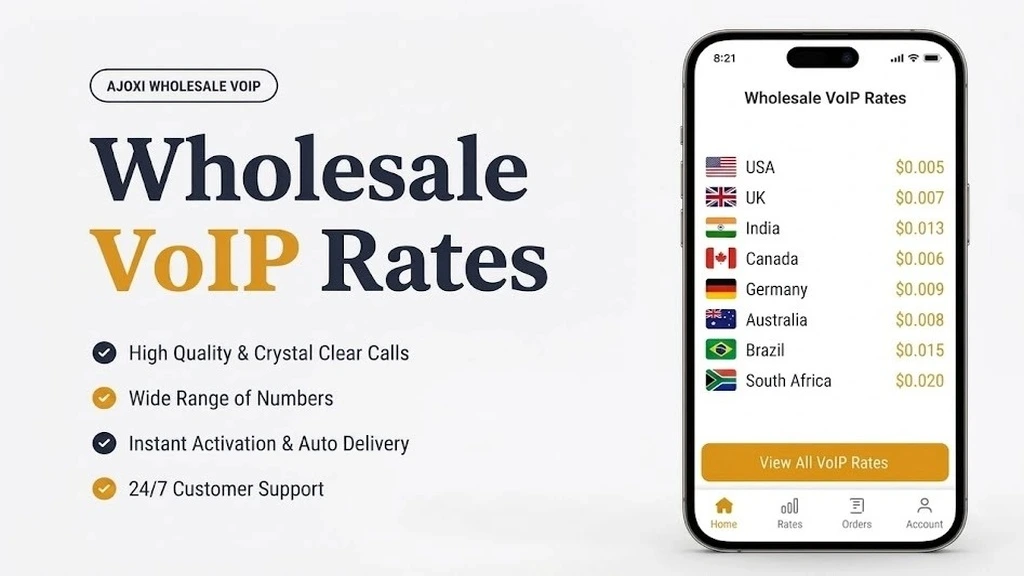
Wholesale VoIP rates vary by destination, route type, and volume. US termination typically lands between $0.0025 and $0.008 per minute on tier-1 routes. International rates depend on country and quality tier. Direct CLI routes cost more than non-CLI but deliver better ASR and ACD. Most providers quote custom rate decks per buyer rather than publishing public prices.
Not exactly. Wholesale VoIP is the upstream layer — the bulk voice carriers that sell minutes and routes in volume. SIP trunking is one product you can build on wholesale VoIP. A SIP trunk provider may itself be a wholesale VoIP buyer, repackaging minutes for end customers. Many Ajoxi resellers buy both wholesale termination and white-label SIP trunking.
CLI routes preserve the original calling line identification end-to-end, which is what destination networks expect. CC (call center) routes often strip or replace CLI to optimize cost. CLI routes deliver better ASR and stronger compliance under STIR/SHAKEN enforcement. CC routes are cheaper but increasingly blocked or flagged by destination carriers, especially on US-bound traffic.
STIR/SHAKEN is the FCC-mandated framework for attesting that a calling number is authorized to originate the call. Wholesale providers must sign and pass attestation across the network. Without proper STIR/SHAKEN handling, calls increasingly get marked Spam Likely or blocked outright at the destination, especially on US-bound traffic. It is now a baseline requirement, not a nice-to-have.
AI receptionists, wholesale routes, virtual numbers — built on one platform with transparent pricing and a 24/7 NOC.