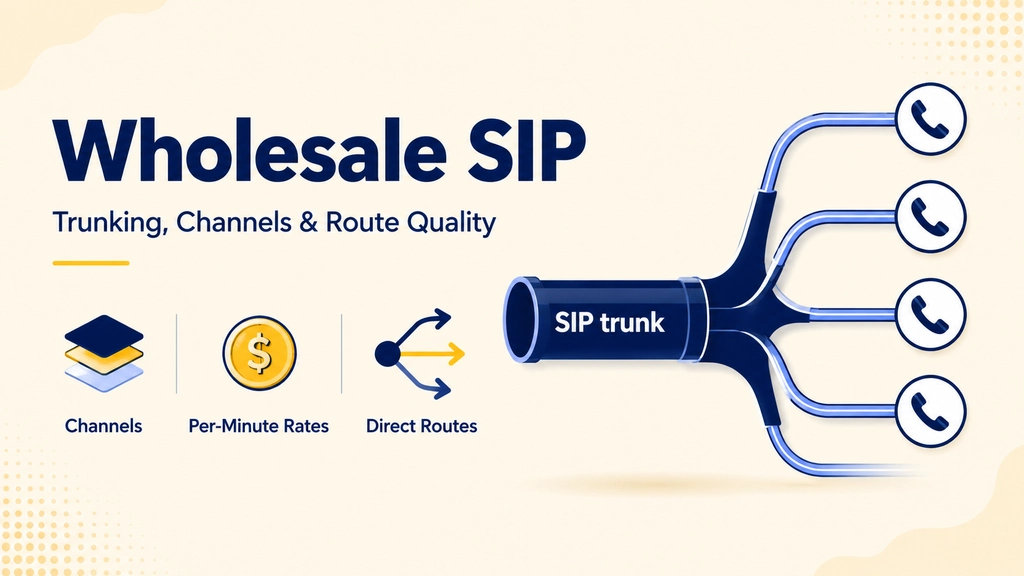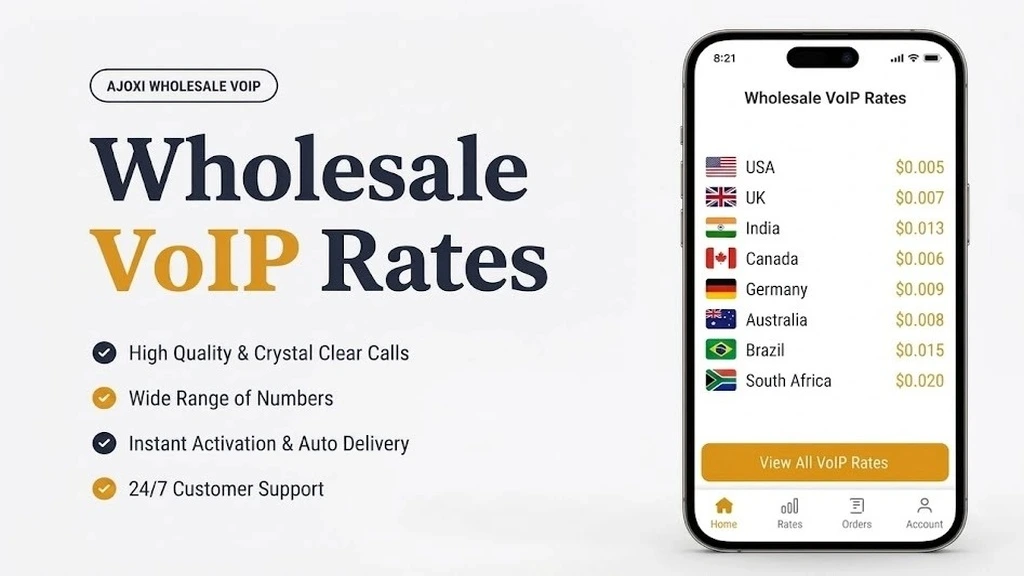
VoIP Wholesale Rates 2026: Complete Per-Minute Pricing Guide for US Businesses
How wholesale VoIP rates are structured, what drives effective per-minute cost above the nominal rate, and how to evaluate a rate card against ASR, PDD, MOS, and FAS.
A wholesale VoIP reseller program lets MSPs, telecom resellers, BPOs, and VARs sell carrier-grade voice under their own brand — no infrastructure needed. The 2026 walkthrough of margin stacks, who should join, and how to start in under an hour.
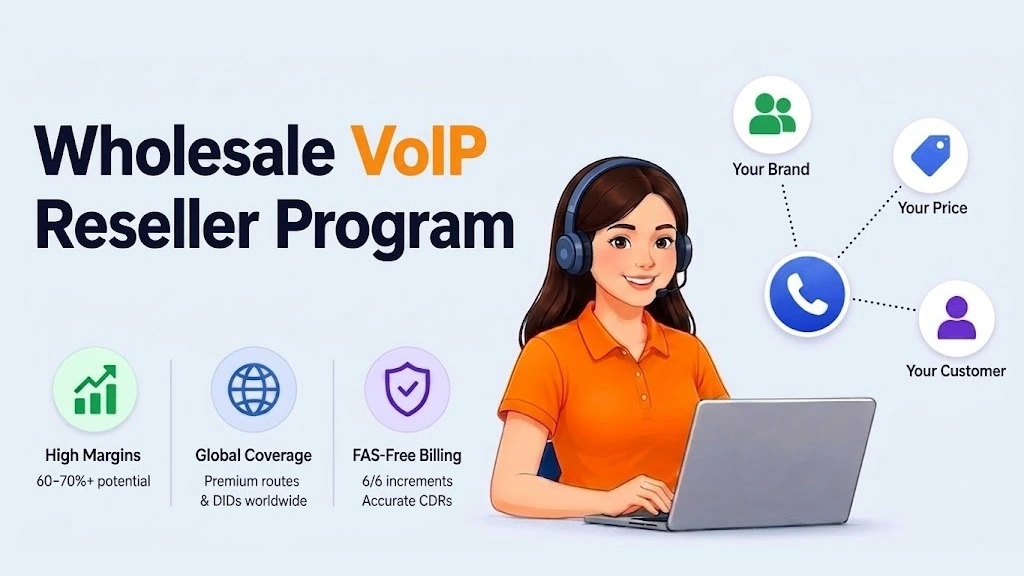
One reseller customer paying $200/month costs nothing extra once they're live. Two hundred customers paying $200/month is $40,000 in monthly recurring revenue from infrastructure someone else built and maintains. That's the wholesale VoIP reseller program model in one paragraph — and why MSPs, IT consultants, and telecom providers are building it into their core offering in 2026.
A wholesale VoIP reseller program is a structured partnership where a carrier-grade provider supplies voice termination, SIP trunking, DID numbers, and supporting infrastructure at wholesale rates — and the reseller packages, brands, prices, and sells those services to end customers under their own name. The reseller keeps the margin between wholesale cost and retail price. The provider handles the network.
The mechanics are straightforward. The complexity is in the execution.
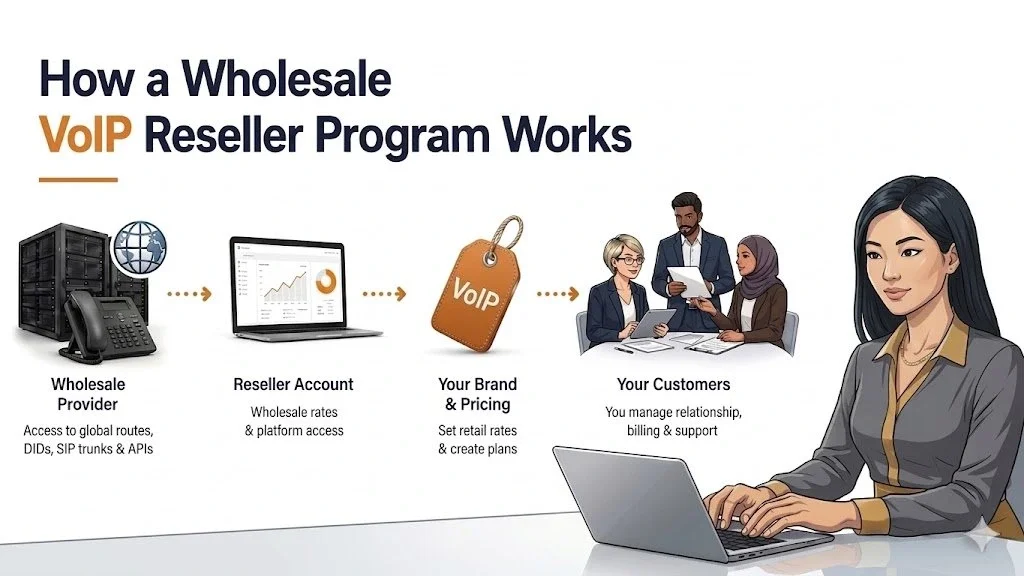
The reseller establishes a wholesale account with a provider like Ajoxi, gaining access to A-Z voice termination rates, SIP trunking capacity, global DID numbers, and (in some programs) SMS and CPaaS APIs — all at wholesale pricing below what retail customers would pay directly. The reseller then sets their own retail rate card, packages services into customer-facing plans, and manages the customer relationship end-to-end.
The provider stays invisible. Your customers see your brand on the invoice, your number on the support line, and your service name on the portal. The carrier infrastructure — the interconnects, routing, fraud protection, uptime SLA — runs in the background.
The wholesale VoIP platform is built specifically for this model: pay-as-you-go pricing with no lock-in contracts, a clean dashboard for route and call management, transparent CDRs for retail billing reconciliation, and 24/7 engineer support accessible by chat, email, or ticket.
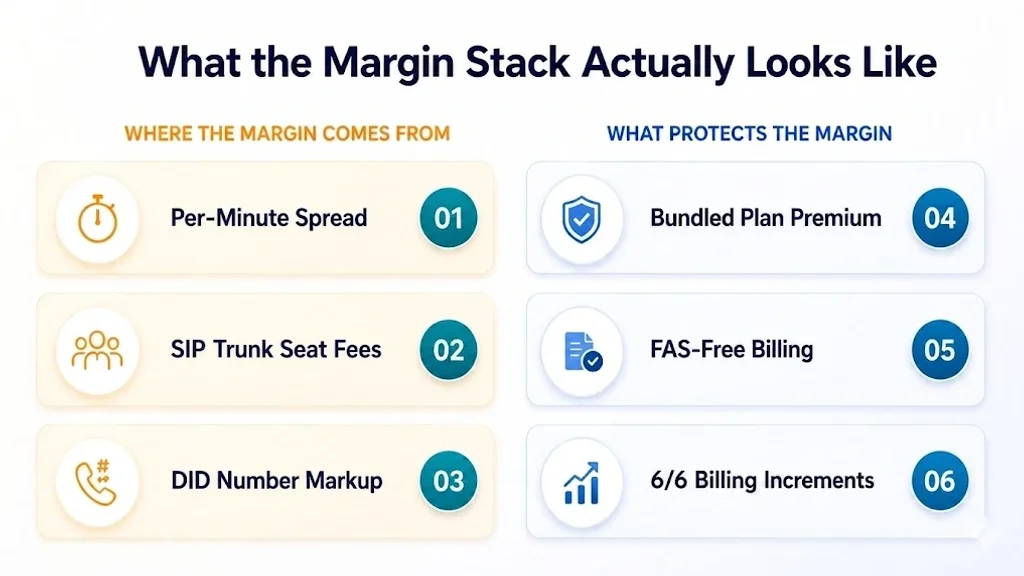
Reseller margins in wholesale VoIP programs can exceed 60–70% once the account is established (SkySwitch, 2025). The spread comes from per-minute termination, monthly SIP trunk seat fees, DID number rental, and bundled plan premiums.
Margin protection depends on FAS-free billing (so wholesale cost matches CDR data), accurate billing increments (6/6 rather than 60/60), and route quality high enough that customer answer rates hold. Ajoxi operates FAS-free billing across all routes with 6/6 increments available on applicable plans.
Not every business benefits equally. The model works well for specific profiles:
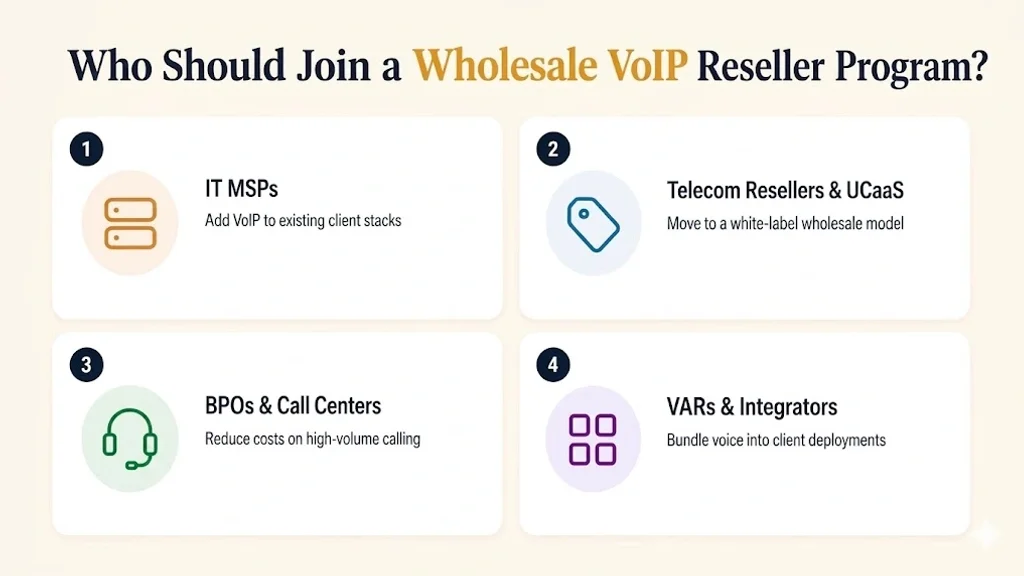
IT Managed Service Providers (MSPs). MSPs already manage technology stacks for their clients. Adding wholesale VoIP to the stack means existing accounts generate new recurring revenue without new customer acquisition cost. Ajoxi's program suits MSPs through SIP trunking compatible with Asterisk, FreePBX, 3CX, and major PBX platforms without requiring custom development.
Telecom Resellers and UCaaS Providers. Existing telecom resellers switching from a retail-only model to a white-label wholesale model take full pricing control. Instead of earning a commission on someone else's services, they own the margin and the customer relationship.
BPO Operators and Call Center Businesses. High-volume call center operations that previously bought retail voice at standard rates find significant savings by transitioning to a wholesale reseller account. The same infrastructure serves their internal calls and potentially a resale revenue stream.
VARs and System Integrators. Businesses that integrate communications technology into client environments — CRM implementations, contact center deployments, unified communications projects — can bundle voice services into their delivery. Wholesale termination access means the voice layer is priced competitively into the project without the margin going to a third-party carrier.
Entrepreneurs Entering Telecom. The capital barrier to starting a VoIP reseller business is lower now than at any point in the industry's history. No physical switching infrastructure. No owned network. No regulatory filings for most markets. A wholesale account, a rate card, a payment gateway, and customer acquisition capability is enough to start.
Ajoxi's free trial account (live in under 60 seconds, no credit card required) removes even the onboarding friction.
Not all programs are built equally. Several criteria determine whether a program supports a scalable business or creates ongoing operational drag:
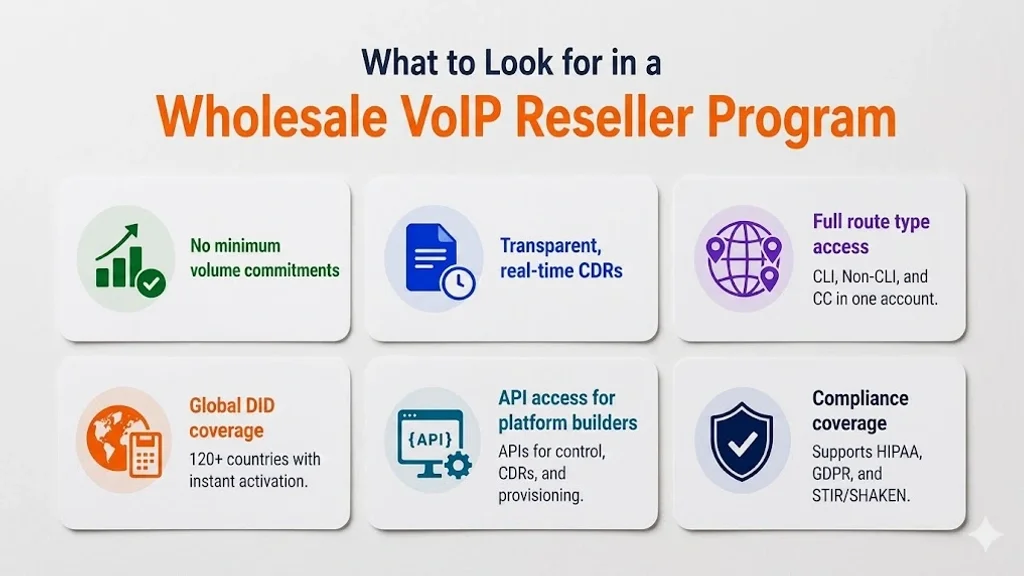
No minimum volume commitments. Programs that require minimum monthly traffic to access competitive rates lock small resellers out of profitability until they reach arbitrary thresholds. Ajoxi's pay-as-you-go model provides competitive wholesale rates from the first minute of traffic — no minimum commitment required.
Transparent, real-time CDRs. Resellers build retail invoices from wholesale CDR data. If CDR access is delayed, limited, or requires a support ticket to retrieve, billing reconciliation becomes a recurring operational burden. The dashboard provides real-time call detail records accessible directly by the account holder.
Full route type access under one account. Resellers serving diverse customer types need CLI routes for enterprise customers, non-CLI routes for high-volume outbound campaigns, and CC routes for calling card operations — ideally under one account without separate rate negotiations. CLI, Non-CLI, and CC routes are available under a single wholesale account.
Global DID coverage paired with termination. Resellers whose customers need local phone numbers in multiple countries shouldn't manage separate DID and termination vendors. DID numbers are available across 120+ countries with instant activation and porting support — paired with the same wholesale termination account.
API access for platform builders. Resellers building their own customer portals, billing systems, or integration layers need API-level access to account management, CDR retrieval, number provisioning, and route control. RESTful APIs support programmatic integration without requiring manual portal interaction for routine operations.
Compliance coverage for regulated industries. Resellers serving healthcare, finance, or insurance clients need a provider whose infrastructure satisfies the underlying compliance requirements. The platform covers GDPR and FCC STIR/SHAKEN requirements — meaning resellers can serve healthcare, finance, and insurance clients without sourcing separate compliance documentation.
The onboarding process is designed to get resellers to live traffic in under an hour:
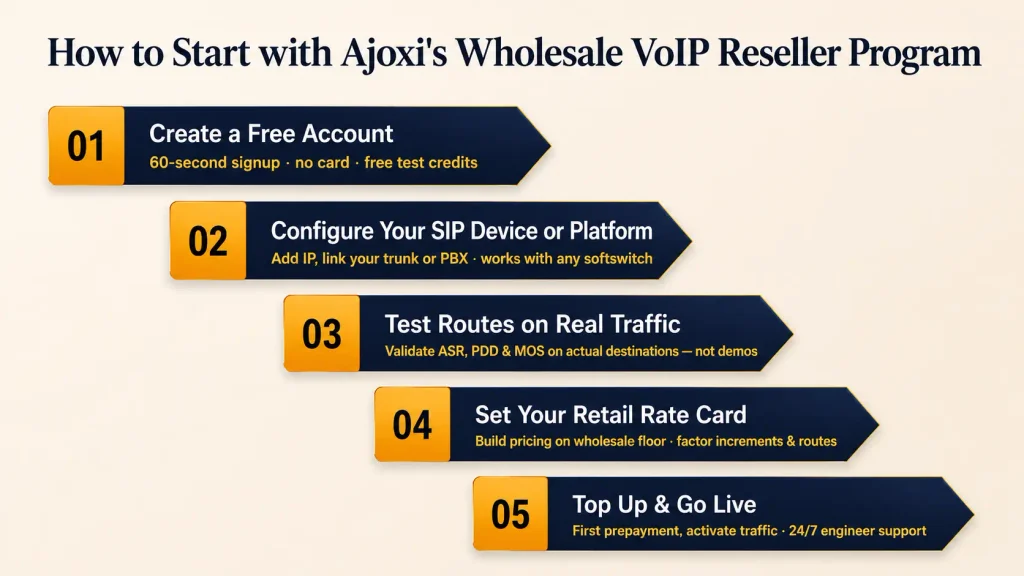
Sign up at ajoxi.com in 60 seconds. No credit card required. Free test credits are included to validate route quality before any financial commitment.
Add your IP address to the Ajoxi portal. Configure your SIP trunk or PBX using the setup guide. The platform supports standard SIP and is compatible with all major softswitch and PBX systems.
Use the free test credits on real call destinations that represent your expected customer traffic — not synthetic test calls. Review ASR, PDD, and MOS data from the CDR dashboard before proceeding.
Build your customer-facing pricing using the wholesale rates as the cost floor. Account for billing increment, route type, and destination mix when calculating retail margins.
Make your first prepayment, activate live traffic, and begin onboarding customers. Ajoxi's 24/7 support team handles technical issues via chat, email, or ticket — so reseller support load stays manageable from day one.
The full sequence — account creation to live traffic — takes under an hour. Most resellers are sending production calls within the same business day. Visit ajoxi.com/wholesale-voip to start your free trial.
A wholesale VoIP reseller program turns a single carrier-grade voice account into a recurring-revenue product line. The margin compounds month over month — termination spread, monthly seat fees, DID rental, bundle premiums — provided the provider keeps FAS off the invoice and route quality high enough to avoid customer churn.
Pay-as-you-go pricing, real-time CDRs, white-label tooling, and compliance coverage decide whether the program scales or stalls. For MSPs, telecom resellers, BPOs, VARs, and entrepreneurs entering telecom, the technical barrier has rarely been lower; the discipline is in customer acquisition and route management, not infrastructure.
Start with a free trial, validate ASR and PDD on your actual top corridors, then ramp into production with two pricing models in your mix rather than one.
A wholesale VoIP reseller program is a partnership where a carrier-grade VoIP provider supplies voice termination, SIP trunking, and DID numbers at below-retail wholesale rates. The reseller packages these services under their own brand, sets their own retail pricing, manages the customer relationship, and keeps the margin between wholesale cost and retail revenue. The provider handles all underlying network infrastructure, routing, and compliance.
Reseller margins in established VoIP programs can exceed 60–70% of retail revenue once a customer base is built. The exact margin depends on the spread between wholesale rate and retail pricing, traffic volume, and route type mix. Recurring monthly seat fees and DID rental margins stack on top of per-minute termination revenue, building a compounding monthly recurring revenue base.
No. The provider owns and operates all carrier interconnects, routing infrastructure, SBCs, and compliance systems. Resellers need a wholesale account, a retail pricing strategy, a billing method, and a customer acquisition approach. No physical hardware, no carrier licenses in most markets, and no network operations team are required.
In a white-label reseller model, you sell services under your own brand with your company name on the invoice, your support number, and your pricing. In an agent model, you refer customers to the provider and earn a commission, but the provider owns the customer relationship. White-label reselling captures higher margins and full customer ownership. Agent selling generates commission income rather than recurring margin.
FAS (False Answer Supervision) is a billing practice where a carrier counts ring time as connected call time, inflating wholesale cost above the nominal per-minute rate. At scale, FAS can add 15–30% to effective wholesale cost while your retail billing reflects genuine connected time. The gap directly compresses your margin. FAS-free billing confirmed in writing is non-negotiable. All Ajoxi routes are FAS-free.
AI receptionists, wholesale routes, virtual numbers — built on one platform with transparent pricing and a 24/7 NOC.