Wholesale VoIP Termination Rates: What Your Rate Card Isn't Telling You
The gap between rate-card pricing and effective cost — billing increments, ASR, ACD, PDD, FAS, and regulatory layers that move your real per-connected-minute price.
VoIP wholesale rates — the per-minute prices businesses, resellers, and carriers pay for bulk voice traffic — are the engine behind every modern phone network. A 2026 walkthrough of how rates are structured, what drives them, and how to evaluate a provider's pricing.
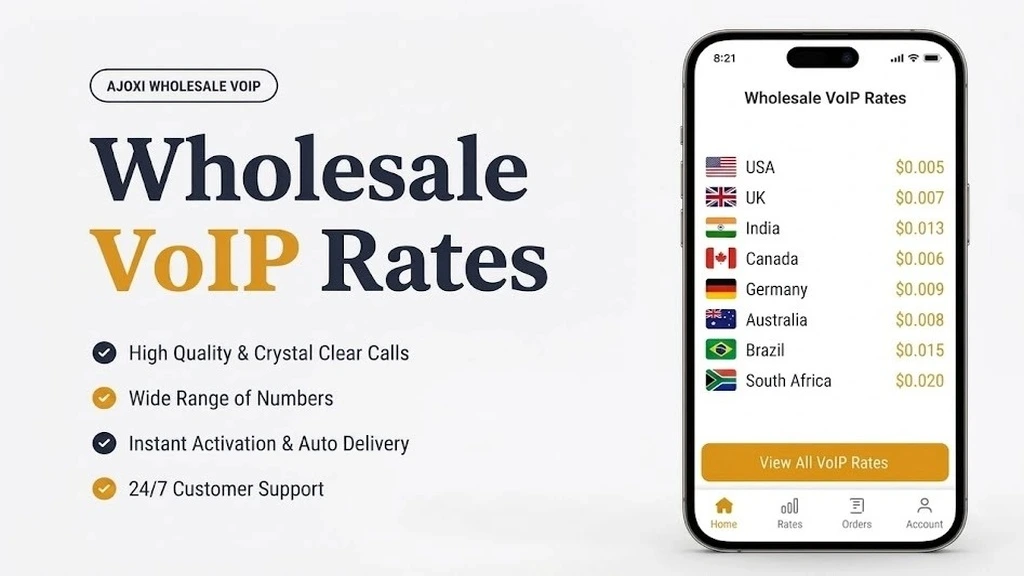
A single cent per minute. That's roughly what high-volume carriers pay to terminate a call to a US landline today. Scale that to millions of minutes a month and the difference between a good rate and a great one is real money — and bulk per-minute pricing is the engine behind every modern phone network.
VoIP wholesale rates are the per-minute prices at which voice minutes are purchased in bulk across IP networks. Unlike retail rates billed to end users, wholesale rates are negotiated between carriers, aggregators, and resellers at volume — typically starting from tens of thousands of minutes per month — and vary by destination country, route type, and traffic quality benchmarks such as ASR and MOS.
Wholesale VoIP pricing isn't a single number. It's a combination of several pricing variables that stack on top of each other:
Per-minute rate is the baseline — quoted in USD per minute for a specific destination. US landline rates hover around $0.006–$0.012/min. International mobile destinations like India or Nigeria run $0.01–$0.04/min depending on route quality.
Billing increment determines how precisely time is counted. A 6/6-second increment is standard for high-quality routes (charges in 6-second blocks after a 6-second minimum). A 60/60 increment rounds every call to the nearest minute — costing you more on short calls. See how billing increments impact your real wholesale VoIP termination rates.
Route type shapes both cost and reliability. Three primary types exist:
| Route Type | Caller ID Passed? | Typical Cost vs. CLI | Best For |
|---|---|---|---|
| CLI (White) | Yes — full caller ID | Baseline | Enterprises, contact centers |
| Non-CLI | No | 20–40% lower | High-volume outbound where ID isn't critical |
| CC Routes | Country code only | Middle range | BPOs, call centers with mixed traffic |
Minimum volume commitments affect your negotiated rate. Providers offer plans that scale from moderate to carrier-grade volumes — meaning you're not locked into inflexible minimums to access competitive pricing.
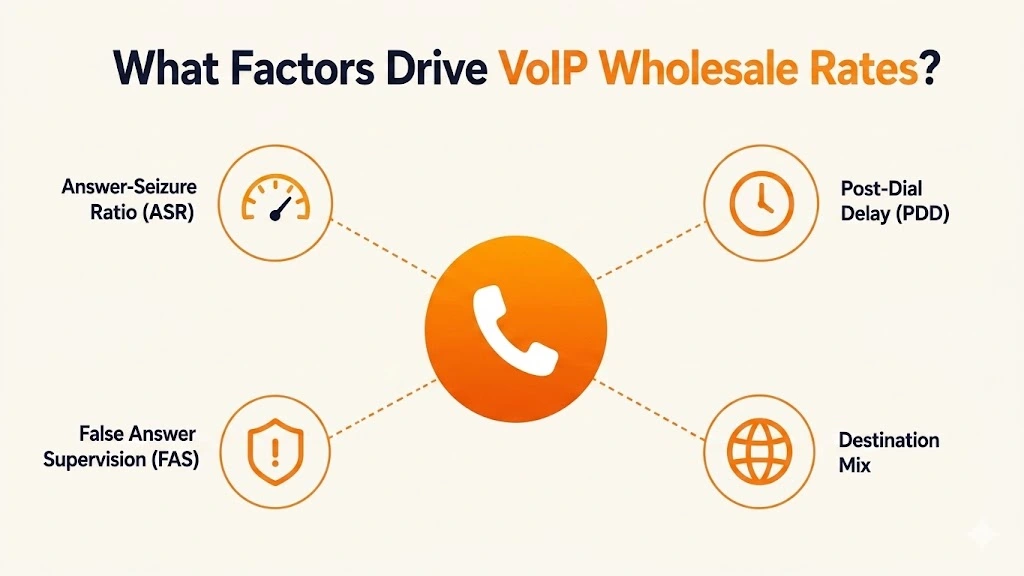
The nominal rate on a rate card is rarely your actual cost. Four factors determine what you pay in practice:
ASR measures what percentage of call attempts actually connect. A route advertising $0.005/min with a 60% ASR costs more than a $0.008/min route with a 95% ASR — because failed attempts still consume signaling resources and engineering time. Top-tier wholesale providers target ASR above 95% — a benchmark worth demanding in any trial routing period.
PDD is the time between dialing and the first ringback tone. Over three seconds consistently signals routing inefficiency. Low PDD is a hallmark of direct interconnects — providers with global tier-1 coverage spanning 243+ territories consistently outperform re-routed alternatives.
FAS occurs when a carrier's switch signals "call answered" before a human picks up — billing you for ring time. FAS-free billing is a non-negotiable requirement for resellers managing margins. Always confirm FAS-free status before signing any wholesale agreement.
Your traffic profile matters. A call center routing 80% of traffic to mobile numbers in Southeast Asia pays more per minute than one routing to US landlines. CC and CLI routes built for mixed-destination traffic give resellers flexibility without per-destination rate surprises.
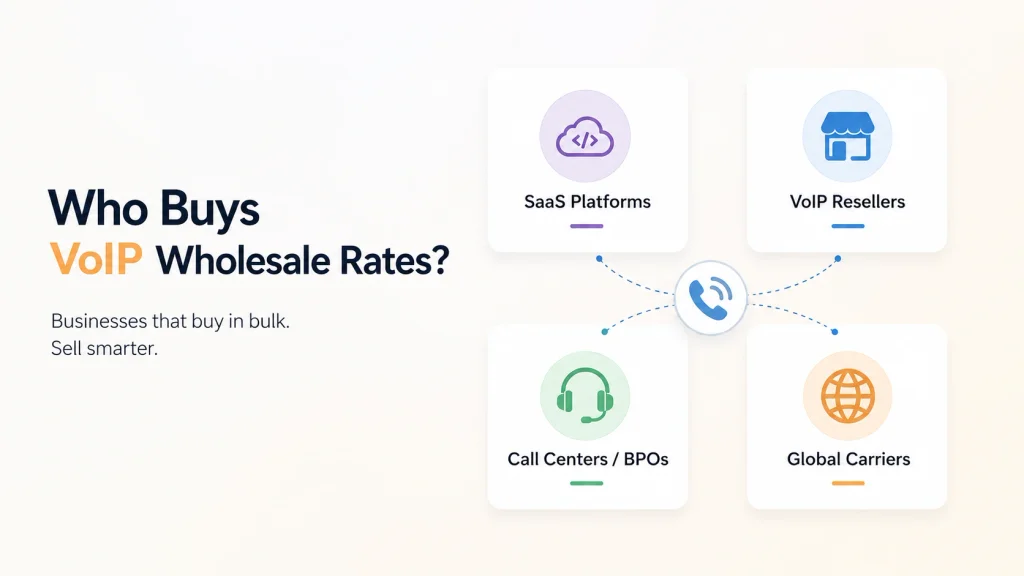
Wholesale VoIP pricing isn't just for telcos. Several business types operate in this space:
VoIP resellers and MVNOs buy minutes in bulk and sell them under their own brand. The margin is the spread between wholesale and retail pricing.
BPOs and call centers need high-volume outbound termination with stable per-minute costs. Unpredictable rates destroy budget forecasting. Fixed-rate wholesale agreements address this directly.
SaaS platforms with calling features — think CRM software with click-to-call — need programmatic access to wholesale termination. SIP trunking integrates directly into platforms via standard SIP, bypassing retail calling rates entirely.
International carriers and aggregators route traffic across regions, often arbitraging rate differentials between originating and terminating networks. The wholesale voice network covers 243 territories with tier-1 interconnects — giving aggregators stable routes without gray-market risk.
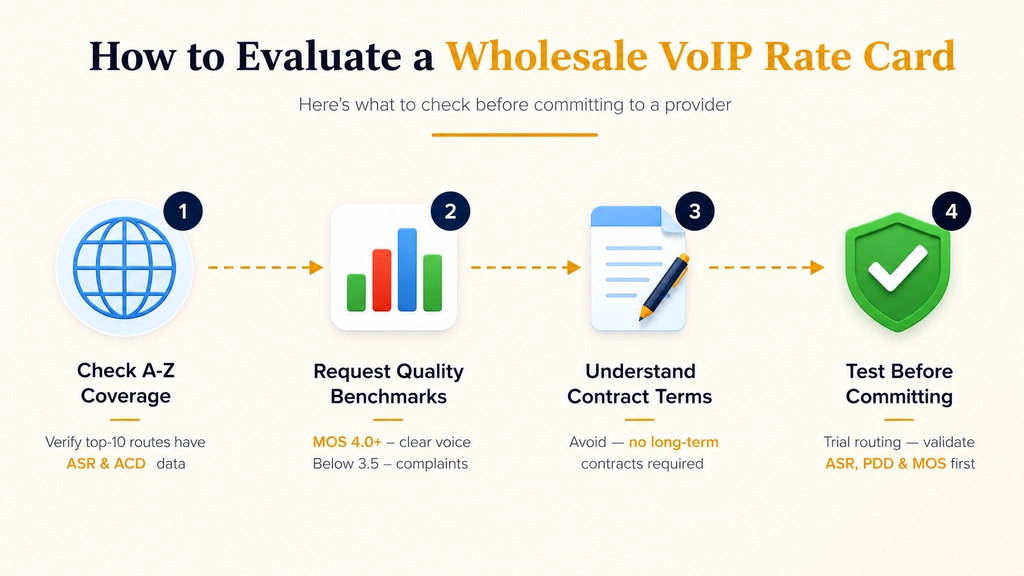
Not all rate decks are equal. Here's what to check before committing to a wholesale VoIP provider:
Check the A-Z coverage. A rate card that covers 190+ countries but has gaps in your top-10 destination countries is a problem. Ask for destination-specific ASR and ACD data, not just rates.
Request quality benchmarks alongside pricing. Mean Opinion Score (MOS) above 4.0 indicates clear, natural voice. MOS below 3.5 is noticeable to callers. No serious wholesale provider should hesitate to share these numbers.
Understand the contract structure. Month-to-month flexibility matters more than a fractionally lower rate locked into a 12-month minimum. Reputable providers offer flexible wholesale agreements — no long-term contracts required.
Test before committing. A legitimate provider offers trial routing to validate ASR, PDD, and MOS on your actual traffic before you move volume.
Three shifts are reshaping wholesale pricing this year:
AI-driven least-cost routing (LCR) now adjusts routes in real time based on live quality data. Carriers using AI-optimized LCR report per-minute cost reductions of 30–50% while maintaining quality benchmarks. Leading wholesale networks now incorporate real-time routing intelligence across their global infrastructure to stay competitive.
Stricter compliance requirements — particularly STIR/SHAKEN attestation for US traffic and GDPR requirements for European routes — are eliminating gray-market providers. Compliant wholesale routes command a small premium but eliminate the regulatory risk of using non-attested origination.
5G interconnects are beginning to reduce latency on mobile termination corridors in South Asia and Africa, where PDD has historically been the biggest quality variable.
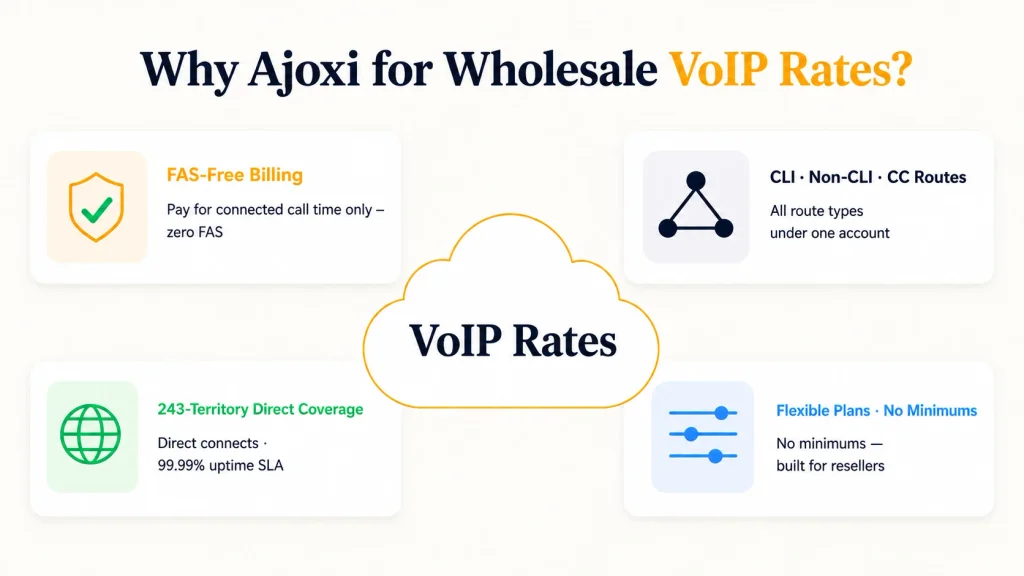
Ajoxi operates a tier-1 carrier network across 243 territories with 99.99% uptime SLA. The team brings 50+ years of combined telecom expertise — meaning route decisions are made by people who understand traffic patterns, not just rate sheets.
Key differentiators for wholesale buyers:
Explore wholesale VoIP plans or speak with the team about custom termination pricing for your traffic profile.
Wholesale VoIP rates in 2026 reward buyers who model effective cost — per-minute price multiplied by ACD, divided by ASR — not the nominal rate alone.
ASR, PDD, MOS, and FAS-free billing are the four levers between the rate card and the invoice; teams that audit them quarterly stay ahead of the bifurcation between premium CLI routes (holding firm in mature markets) and emerging-market termination (steadily cheaper).
The cheapest column wins on paper. The most disciplined operator wins on margin. Match route type to traffic profile, demand 1/1 billing and per-destination quality data, run trial routing before committing volume, and treat compliance — STIR/SHAKEN, GDPR, FAS-free billing — as a cost-saver, not a cost.
Get the rate strategy right and voice stays one of the most reliable revenue engines in your communications stack.
VoIP wholesale rates are the per-minute prices carriers, resellers, and businesses pay to purchase bulk voice minutes across IP networks. Rates vary by destination, route type (CLI, Non-CLI, CC), billing increment, and volume commitment. They differ from retail rates in that they require higher minimum volumes in exchange for significantly lower per-minute pricing.
US landline termination typically runs $0.006–$0.012 per minute on CLI routes. International mobile destinations vary widely — India mobile averages $0.012–$0.025/min, while some African mobile corridors reach $0.035–$0.06/min. Rates fluctuate based on interconnect agreements, regulatory changes, and market competition.
CLI (white) routes pass the caller's full number to the destination, enabling caller ID display. Non-CLI routes strip this information and are typically 20–40% cheaper. CLI routes are preferred for contact centers and enterprises where caller ID is critical to answer rates; Non-CLI suits high-volume outbound where ID display is less important.
FAS (False Answer Supervision) is a billing practice where a carrier signals 'call answered' before a human picks up, billing for ring time. At scale, FAS significantly inflates per-minute costs. FAS-free billing — where you're charged only for genuinely connected call time — is the industry standard among reputable wholesale providers.
Evaluate providers on four metrics beyond the rate card: ASR (target above 95%), PDD (under 3 seconds), MOS (above 4.0), and FAS-free billing. Request a test period before committing volume. Compare route types available (CLI/Non-CLI/CC) and confirm coverage for your top destination countries. Flexible, month-to-month contracts reduce risk during evaluation.
AI receptionists, wholesale routes, virtual numbers — built on one platform with transparent pricing and a 24/7 NOC.