Ajoxi
  • เสา
    คลาวด์โฟน

    โทรศัพท์บนคลาวด์ การส่งข้อความ วิดีโอ แฟกซ์ แชท — สแต็ค UCaaS เต็มรูปแบบ

    • หมายเลขโทรศัพท์เสมือนหมายเลขท้องถิ่นและหมายเลขโทรฟรีทุกที่
    • โทรศัพท์ธุรกิจการโทร, SMS, วิดีโอ, การเข้าสู่ระบบเพียงครั้งเดียว
    • การมีส่วนร่วมของลูกค้าทุกช่องหนึ่งเธรด
    • เอไอส่วนตัวผู้ช่วย AI สำหรับทุกตัวแทน
    • SMS และ MMSข้อความจากสายธุรกิจหลัก
    • แชททีมแชทภายในเชื่อมโยงกับลูกค้า
    • การประชุมทางวิดีโอห้องที่มีบันทึก AI + สรุป
    • แฟกซ์ออนไลน์แฟกซ์โดยไม่ต้องใช้เครื่องแฟกซ์
    • เว็บไซต์แชทบอทแก้ไขสถานะคำสั่งซื้อและการคืนสินค้าอัตโนมัติ
    • ระบบโทรศัพท์PBX สมัยใหม่พร้อม AI ในตัว
    จุดเด่น
    รวมทุกอย่างแล้ว
    โทรศัพท์คลาวด์, ศูนย์ติดต่อ AI, พนักงานต้อนรับ AI, SMS, วิดีโอ, การบูรณาการมากกว่า 300 รายการ
    ดูแผนและราคา
  • ความสามารถหลัก
    • พนักงานต้อนรับ AIคำตอบแรกทุกวันตลอด 24 ชั่วโมง · 32 ภาษา
    • ความรู้สึกของเอไอกำหนดเส้นทางผู้โทรที่ไม่พอใจโดยอัตโนมัติ
    • ความช่วยเหลือตัวแทน AIสคริปต์กระซิบ + การดำเนินการที่ดีที่สุดถัดไป
    • ข่าวกรองการสนทนาการถอดเสียง ความรู้สึก การคัดค้าน
    • บันทึกการโทรความเที่ยงตรงเต็มรูปแบบ + การค้นหาคำหลัก
    • ระบบต่อสายอัตโนมัติเครื่องมือสร้างภาพ IVR แบบลากและวาง
    • เครื่องมือหัวหน้างานฟัง · กระซิบ · เรือ · บันทึกการตรวจสอบ
    • หมายเลขโทรฟรี800, 888, 877 — จัดเตรียมอย่างรวดเร็ว
    ใหม่
    ความรู้สึกของ AI ·การให้คะแนนสด
    กำหนดเส้นทางลูกค้าที่ไม่พอใจไปยังเจ้าหน้าที่อาวุโสทันทีที่ทัศนคติลดลง ในทุกแผนการชำระเงิน
    ดูความรู้สึกของ AI
  • โดยอุตสาหกรรมและทีมงาน
    • การเงินSOC 2 · เส้นทางการตรวจสอบที่พร้อมใช้ FINRA
    • ขายปลีกช่องทาง Omni + SMS กู้คืนรถเข็น
    • SaaSAPIs + AI ส่วนตัวทุกที่นั่ง
    • โลจิสติกส์การกำหนดเส้นทางการจัดส่งหลายไซต์
    • ทีมขายPower Dialer + การฝึกสอน AI แบบสด
    • ทีมสนับสนุนหน่วยความจำที่ใช้ร่วมกันผ่าน 8 ช่อง
    • ทีมระยะไกลหมายเลขเดียวกันในทุกอุปกรณ์
    • ธุรกิจขนาดกลางและขนาดย่อมพนักงานต้อนรับ AI เป็นแผนกต้อนรับส่วนหน้าของคุณ
    • ไอทีระดับองค์กรSSO, SCIM, การกำกับดูแลหลายไซต์
    ได้รับการยอมรับมากที่สุด
    การปฏิบัติตามข้อกำหนดการเรียกสแต็กไว้วางใจ
    การบันทึกการโทร, กวน/สั่น, การกำหนดเส้นทางความรู้สึก เส้นทางการตรวจสอบที่พร้อมใช้ SOC 2, PCI และ FINRA
    ดูการเงิน
  • การซิงค์แบบเนทีฟ
    • ฮับสปอตการซิงค์แบบสองทาง · ทริกเกอร์วงจรชีวิต
    • โซโหCRM · โต๊ะ · หนังสือ · Bigin
    เร็วๆ นี้
    พนักงานขาย ไปป์ไดรฟ์ ขายสด.
    การซิงค์แบบสองทางแบบเนทีฟทั้งสามรายการในไตรมาสที่ 3 ปี 2026 ต้องการทราบล่วงหน้าเมื่อเปิดตัวหรือไม่
    ส่งอีเมลถึงฉันเมื่อเปิดตัว
  • ราคา
  • เรียนรู้
    • บล็อกหมายเหตุด้านวิศวกรรมและผลิตภัณฑ์
    • เรื่องราวของลูกค้าผลลัพธ์จริง ตัวเลขจริง
    • คำแนะนำหนังสือเล่นทีละขั้นตอน
    • การสัมมนาผ่านเว็บถ่ายทอดสดทุกวันพฤหัสบดี · ตามความต้องการ
    • ติดต่อเราพูดคุยกับฝ่ายขายหรือรับการสนับสนุน
    สร้าง
    • เอกสารทุกอย่างทำงานอย่างไร
    • การอ้างอิง APIREST + เว็บฮุค
    • SDKโหนด, ไพธอน, โก, รูบี้
    • บันทึกการเปลี่ยนแปลงเรือทุกลำในที่เดียว
    เชื่อมั่น
    • หน้าสถานะสถานะการออนไลน์ + เหตุการณ์ที่เกิดขึ้น
    • ความปลอดภัย + การปฏิบัติตามข้อกำหนดSOC 2 · GDPR · PCI
    • ความเป็นส่วนตัวสิ่งที่เรารวบรวมและทำไม
    • เงื่อนไขสัญญาในบทต่างๆ
    หมึกสด
    วัดผลการโทร 8,400 ครั้ง
    ความแม่นยำของพนักงานต้อนรับด้วย AI ตามภาษา สำเนียง และประเภทการโทร — หมายเลขที่ไม่มีการตัดต่อ
    อ่านโพสต์
  • English flagภาษาอังกฤษ
  • Español flagสเปน
  • Français flagฝรั่งเศส
  • Deutsch flagเยอรมัน
  • Italiano flagอิตาเลียโน่
  • Português flagภาษาโปรตุเกส
  • Nederlands flagเนเธอร์แลนด์
  • Русский flagรัสเซีย
  • Polski flagโพลสกี้
  • Türkçe flagเติร์กเช่
  • العربية flagالعربية
  • हिन्दी flagहिन्दी
  • 简体中文 flag简体中文
  • 日本語 flag日本語
  • 한국어 flagเกาหลี
  • Tiếng Việt flagเตียงเวียต
  • Bahasa Indonesia flagบาฮาซาอินโดนีเซีย
  • ไทย flagไทย
  • Svenska flagสเวนสกา
  • Українська flagУкра́ська
เข้าสู่ระบบเริ่มทดลองใช้
คลาวด์โฟน
หมายเลขโทรศัพท์เสมือนหมายเลขท้องถิ่นและหมายเลขโทรฟรีทุกที่โทรศัพท์ธุรกิจการโทร, SMS, วิดีโอ, การเข้าสู่ระบบเพียงครั้งเดียวการมีส่วนร่วมของลูกค้าทุกช่องหนึ่งเธรดเอไอส่วนตัวผู้ช่วย AI สำหรับทุกตัวแทนSMS และ MMSข้อความจากสายธุรกิจหลักแชททีมแชทภายในเชื่อมโยงกับลูกค้าการประชุมทางวิดีโอห้องที่มีบันทึก AI + สรุปแฟกซ์ออนไลน์แฟกซ์โดยไม่ต้องใช้เครื่องแฟกซ์เว็บไซต์แชทบอทแก้ไขสถานะคำสั่งซื้อและการคืนสินค้าอัตโนมัติระบบโทรศัพท์PBX สมัยใหม่พร้อม AI ในตัว
ศูนย์ติดต่อ
หลากหลายช่องทางหนึ่งคิวสำหรับทุกช่องตัวเรียกเลขหมายขาออกคาดการณ์ ทรงพลัง ดูตัวอย่างตัวแทนช่วยเหลือการฝึกสอนแบบกระซิบสดผู้ช่วยหัวหน้างานตรวจจับการโทรที่ไม่ดีแบบเรียลไทม์การวิเคราะห์การโต้ตอบAuto-QA แนวโน้มของหัวข้อองค์กรการดำเนินงานมากกว่า 500 ที่นั่ง
ครอบครัวเอไอ
อาจ๊อกซี่ วอยซ์พนักงานต้อนรับ AI ที่จองการนัดหมายผู้ช่วยเอไอร่าง สรุป การติดตามผลAI การสนทนาอ่านทุกสายเพื่อให้คุณไม่พลาดสิ่งใด
พนักงานต้อนรับ AIคำตอบแรกทุกวันตลอด 24 ชั่วโมง · 32 ภาษาความรู้สึกของเอไอกำหนดเส้นทางผู้โทรที่ไม่พอใจโดยอัตโนมัติความช่วยเหลือตัวแทน AIสคริปต์กระซิบ + การดำเนินการที่ดีที่สุดถัดไปข่าวกรองการสนทนาการถอดเสียง ความรู้สึก การคัดค้านบันทึกการโทรความเที่ยงตรงเต็มรูปแบบ + การค้นหาคำหลักระบบต่อสายอัตโนมัติเครื่องมือสร้างภาพ IVR แบบลากและวางเครื่องมือหัวหน้างานฟัง · กระซิบ · เรือ · บันทึกการตรวจสอบหมายเลขโทรฟรี800, 888, 877 — จัดเตรียมอย่างรวดเร็ว
การเงินSOC 2 · เส้นทางการตรวจสอบที่พร้อมใช้ FINRAขายปลีกช่องทาง Omni + SMS กู้คืนรถเข็นSaaSAPIs + AI ส่วนตัวทุกที่นั่งโลจิสติกส์การกำหนดเส้นทางการจัดส่งหลายไซต์ทีมขายPower Dialer + การฝึกสอน AI แบบสดทีมสนับสนุนหน่วยความจำที่ใช้ร่วมกันผ่าน 8 ช่องทีมระยะไกลหมายเลขเดียวกันในทุกอุปกรณ์ธุรกิจขนาดกลางและขนาดย่อมพนักงานต้อนรับ AI เป็นแผนกต้อนรับส่วนหน้าของคุณไอทีระดับองค์กรSSO, SCIM, การกำกับดูแลหลายไซต์
ฮับสปอตการซิงค์แบบสองทาง · ทริกเกอร์วงจรชีวิตโซโหCRM · โต๊ะ · หนังสือ · Bigin
เรียนรู้
บล็อกหมายเหตุด้านวิศวกรรมและผลิตภัณฑ์เรื่องราวของลูกค้าผลลัพธ์จริง ตัวเลขจริงคำแนะนำหนังสือเล่นทีละขั้นตอนการสัมมนาผ่านเว็บถ่ายทอดสดทุกวันพฤหัสบดี · ตามความต้องการติดต่อเราพูดคุยกับฝ่ายขายหรือรับการสนับสนุน
สร้าง
เอกสารทุกอย่างทำงานอย่างไรการอ้างอิง APIREST + เว็บฮุคSDKโหนด, ไพธอน, โก, รูบี้บันทึกการเปลี่ยนแปลงเรือทุกลำในที่เดียว
เชื่อมั่น
หน้าสถานะสถานะการออนไลน์ + เหตุการณ์ที่เกิดขึ้นความปลอดภัย + การปฏิบัติตามข้อกำหนดSOC 2 · GDPR · PCIความเป็นส่วนตัวสิ่งที่เรารวบรวมและทำไมเงื่อนไขสัญญาในบทต่างๆ
  • English flagภาษาอังกฤษ
  • Español flagสเปน
  • Français flagฝรั่งเศส
  • Deutsch flagเยอรมัน
  • Italiano flagอิตาเลียโน่
  • Português flagภาษาโปรตุเกส
  • Nederlands flagเนเธอร์แลนด์
  • Русский flagรัสเซีย
  • Polski flagโพลสกี้
  • Türkçe flagเติร์กเช่
  • العربية flagالعربية
  • हिन्दी flagहिन्दी
  • 简体中文 flag简体中文
  • 日本語 flag日本語
  • 한국어 flagเกาหลี
  • Tiếng Việt flagเตียงเวียต
  • Bahasa Indonesia flagบาฮาซาอินโดนีเซีย
  • ไทย flagไทย
  • Svenska flagสเวนสกา
  • Українська flagУкра́ська
เข้าสู่ระบบเริ่มทดลองใช้
Ajoxi

ศูนย์ติดต่อโทรศัพท์ระบบคลาวด์และ AI บนเครือข่ายระดับผู้ให้บริการเครือข่ายเดียว

เอสโอซี 2GDPRPCI-DSS

ห้อง C ชั้น 7 อาคารเวิลด์ทรัสต์ทาวเวอร์
50 ถนนสแตนลีย์ เซ็นทรัล
ฮ่องกง

info@ajoxi.com+1 (512) 612-4425

คลาวด์โฟน

  • โทรศัพท์ธุรกิจ
  • การมีส่วนร่วมของลูกค้า
  • SMS และ MMS
  • แชททีม
  • การประชุมทางวิดีโอ
  • ระบบโทรศัพท์

ศูนย์ติดต่อ

  • หลากหลายช่องทาง
  • ตัวเรียกเลขหมายขาออก
  • ตัวแทนช่วยเหลือ
  • การวิเคราะห์การโต้ตอบ
  • CCaaS ระดับองค์กร

AI

  • แพลตฟอร์มเอไอ
  • พนักงานต้อนรับ AI
  • ผู้ช่วยเอไอ
  • AI การสนทนา
  • ความรู้สึกของเอไอ
  • ข่าวกรองการสนทนา

โซลูชั่น

  • การเงิน
  • การค้าปลีกและอีคอมเมิร์ซ
  • SaaS และเทคโนโลยี
  • ทีมขาย
  • ธุรกิจขนาดกลางและขนาดย่อม

ตัวแทนจำหน่าย

  • ขายส่ง VoIP
  • ขายส่งเสียง
  • การเดินสาย SIP
  • เส้นทาง CLI

บริษัท

  • ราคา
  • เกี่ยวกับ
  • ลูกค้า
  • ติดต่อเรา
  • รหัสประเทศ
  • รหัสพื้นที่
  • เอกสาร
  • สถานะ
  • ความปลอดภัย

© 2026 อาจ๊อกซี่. สงวนลิขสิทธิ์.

ปกติทุกระบบ
  • ความเป็นส่วนตัว
  • เงื่อนไข
  • แผนผังเว็บไซต์
บล็อก/ขายส่ง VoIP/Wholesale VoIP Termination Rates: What Your Rate Card Isn't Telling You

Wholesale VoIP Termination Rates: What Your Rate Card Isn't Telling You

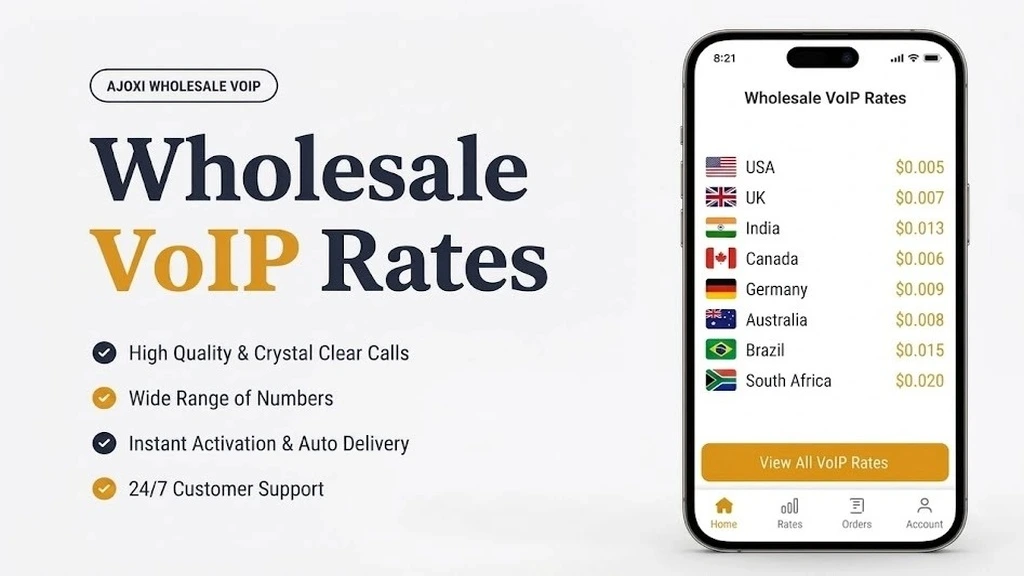
Your rate card says $0.009/min. Your invoice says something higher. The gap is where most VoIP businesses quietly lose margin — and it's almost never the provider's fault. A 2026 walkthrough of pricing structure, quality metrics, regulatory costs, and how to read a rate sheet before committing volume.

ขายส่ง VoIP

Wholesale VoIP Termination Rates: What Your Rate Card Isn't Telling You

Wholesale VoIP Termination Rates: What Your Rate Card Isn't Telling You
Table of Contents
  • 1.Introduction
  • 2.How termination pricing is structured
  • 3.Why rate card isn't real cost
  • 4.Route types and use cases
  • 5.How to read a rate sheet
  • 6.Least-cost routing done right
  • 7.Hidden regulatory costs
  • 8.Pre-sign checklist
  • 9.Conclusion
  • 10.คำถามที่พบบ่อย

Introduction

Your rate card says $0.009 per minute. Your invoice says something higher. The gap between those two numbers is where most VoIP businesses quietly lose margin — and it's almost never the provider's fault. It's the billing model, the route type, and the quality metrics nobody mentioned before you signed up.

Wholesale VoIP termination rates are the per-minute or per-second fees carriers and resellers pay to deliver a voice call from an IP network to its final destination — a mobile handset, a landline, or a PSTN endpoint anywhere in the world. Rates are negotiated at volume, quoted in USD per minute, and vary by destination country, route type, call quality tier, and billing increment.

Understanding the gap between the quoted rate and the effective cost is what separates profitable voice operations from ones constantly chasing margin.

How Wholesale VoIP Termination Pricing Is Structured

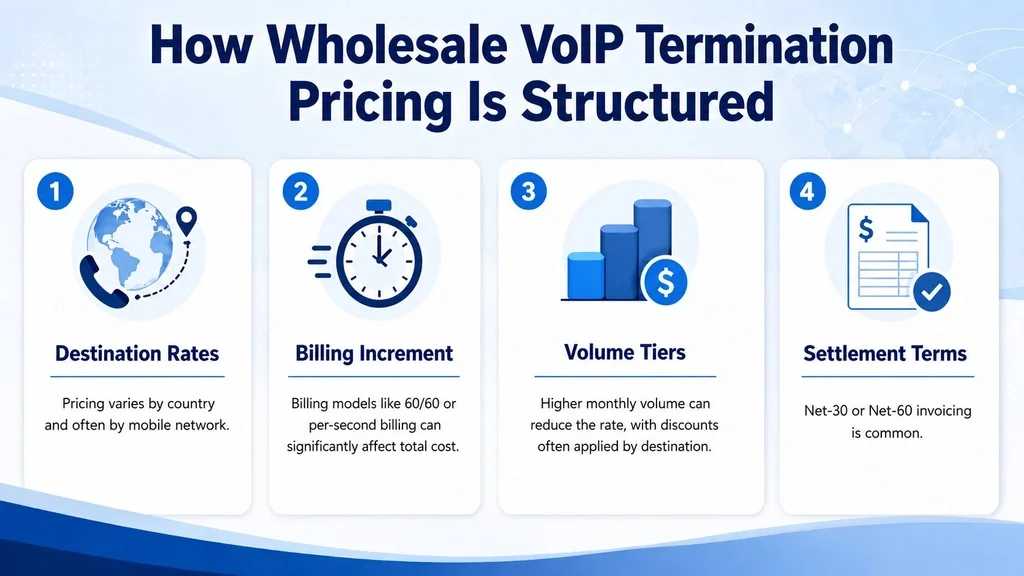
Termination pricing isn't a single number — it's a stack of variables that multiply together. Here's what sits inside every rate:

How wholesale VoIP termination pricing is structured — four variables: destination rates, billing increment, volume tiers, and settlement terms
Four variables stack into every termination rate — destination pricing, billing increment, volume tiers, and settlement terms.

Per-minute rate by destination. Every country — often every mobile network within a country — has its own rate. A Germany landline terminates around $0.0045/min. A mobile number in Nigeria can reach $0.028–$0.035/min. These aren't arbitrary — they reflect local carrier interconnect costs, regulatory surcharges, and the scarcity of direct routes from Tier-1 providers.

Billing increment. This is the single most overlooked cost driver. A 60/60 billing increment (60-second minimum, 60-second rounding) charges a full minute for a 5-second call. A 6/6 increment charges six seconds. For contact centers running auto-dialers with high abandonment, the difference between billing models can exceed the rate differential between two competing providers.

Per-second billing is available on premium routes and is worth the modest premium for short-duration traffic.

Tiered volume pricing. Most providers publish a stepped rate structure. A typical tier table looks like this:

Monthly VolumeRate per Minute (Sample)
0 – 1M minutes$0.009
1M – 5M minutes$0.008
5M+ minutes$0.007

The catch: volume tiers are often calculated per destination, not total traffic. Moving 5M minutes to 12 different countries may not unlock the same discount as 5M minutes to a single country. Always confirm how tiers are calculated before projecting savings.

Settlement terms. Net-30 or net-60 invoicing is standard. Cash flow matters in high-volume termination. Providers who demand prepayment without offering trial routing or CDR transparency are a red flag.

Why Your Rate Card Isn't Your Real Cost

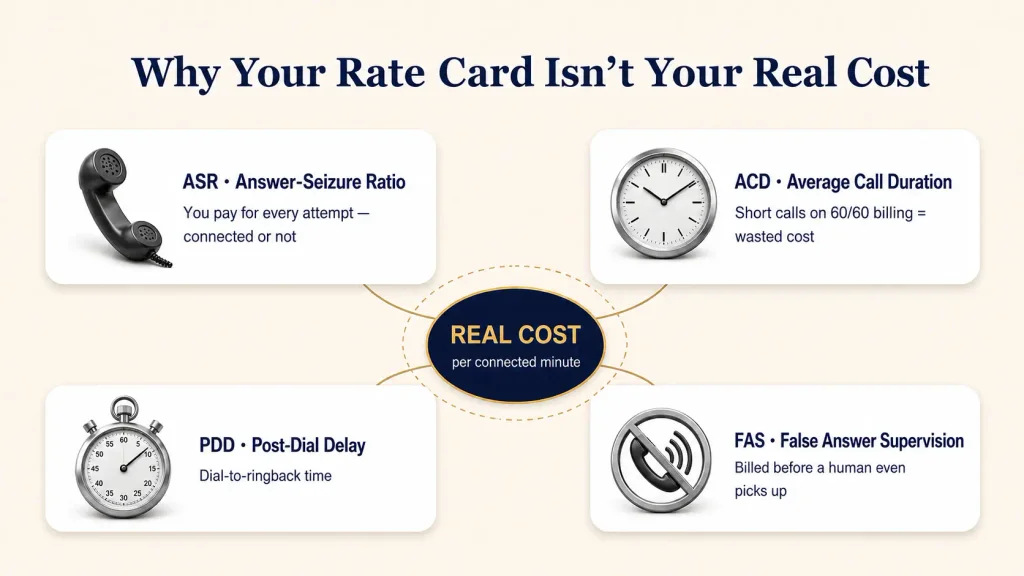
This is where most buyers get burned. Four quality metrics determine your actual cost per successfully connected minute — and none of them appear on a rate card:

Answer-Seizure Ratio (ASR)

ASR is the percentage of call attempts that actually connect. A route with a $0.007/min rate and a 55% ASR costs more per successful minute than a $0.009/min route with a 92% ASR — because you pay for every attempt, connected or not. The math: at 55% ASR, your effective cost on $0.007 routes is $0.0127/successful minute.

At 92% ASR, a $0.009 route costs $0.0098/successful minute.

Ajoxi's voice termination network targets ASR above 90% on premium CLI routes across its 243-territory coverage. Before routing volume, request destination-specific ASR data — not a network average.

Average Call Duration (ACD)

ACD measures average connected call length. Short ACD on auto-dialer traffic (under 30 seconds) combined with per-minute billing creates a disproportionate cost. A provider who offers per-second or 6/6 billing for call center traffic is genuinely cheaper than one quoting a lower flat rate on 60/60 increments.

Post-Dial Delay (PDD)

PDD is the time between completing a dial and the first ringback. Under 3 seconds is the benchmark. Over 5 seconds consistently signals a gray-market or heavily re-routed path. High PDD doesn't just affect call quality — it inflates call attempt duration, which on 60/60 billing means you're paying for dead air.

False Answer Supervision (FAS)

FAS happens when a carrier's switch signals "answered" before a human picks up — billing you for ring time or even pre-ring network activity. At scale, FAS adds a measurable percentage to effective per-minute cost. FAS-free billing means you pay only for calls a person actually answered. It's the single most important contract term to confirm before signing with any wholesale provider.

Ajoxi operates FAS-free on all routes.

Why your rate card is not your real cost: four hidden metrics — ASR (answer-seizure ratio), ACD (average call duration), PDD (post-dial delay), and FAS (false answer supervision) — determine what you actually pay per connected minute
Four hidden metrics — ASR, ACD, PDD, and FAS — determine your real cost per successfully connected minute, and none of them appear on a rate card.

Route Types and What They're Actually For

Not every call needs the same route quality. Paying CLI rates for non-CLI traffic is money wasted. Routing enterprise sales calls over economy paths damages answer rates and brand credibility. Matching route type to traffic profile is how you optimize margin without compromising quality.

Route TypeCLI Passed?Relative CostBest Traffic Profile
Premium CLIFull caller IDHighestEnterprise, outbound sales, healthcare
Standard CLIFull caller IDMid-rangeGeneral business, contact centers
Non-CLINone / stripped20–40% lowerHigh-volume bulk outbound, marketing
CC RoutesCountry code onlyMid-rangeBPOs, mixed international traffic

Ajoxi provides CLI and CC routes under one account — no need to manage separate vendor relationships for different traffic types. For BPOs and contact centers handling mixed international traffic, this single-account access to multiple route types is a meaningful operational simplification.

How to Read a VoIP Rate Sheet Before Committing Volume

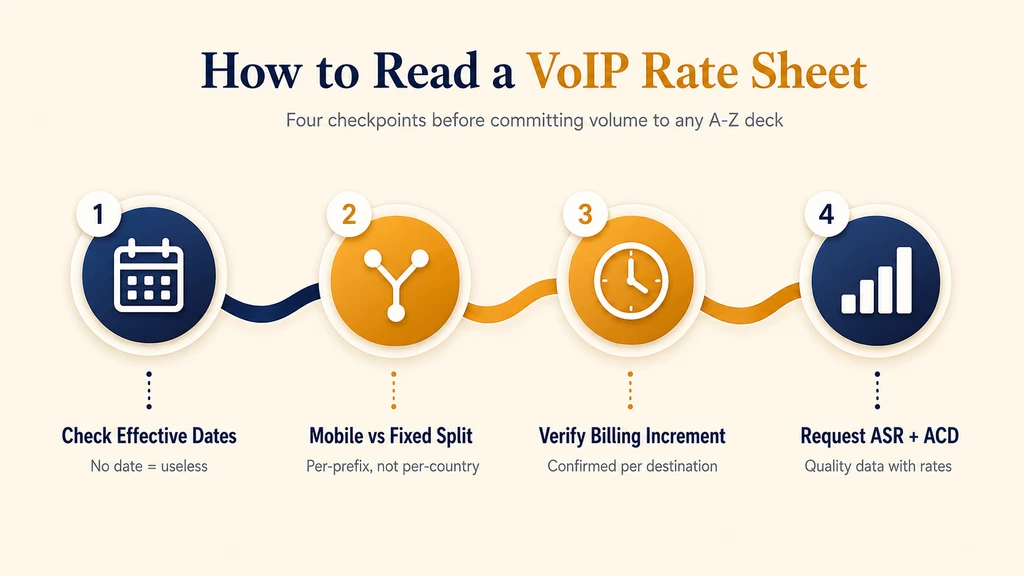
A rate sheet (also called an A-Z deck) is a CSV or spreadsheet listing per-minute rates by country code, often by mobile operator prefix. Here's how to evaluate one properly:

Check effective dates. Rates update frequently — sometimes weekly for volatile corridors like African mobile or South Asian mobile. A rate sheet with no effective date is operationally useless.

Look for mobile vs. fixed split. A single row for "India" on a rate sheet is a warning sign. India has dozens of mobile operators, each with different termination costs. A quality A-Z deck shows per-prefix pricing.

Verify billing increment per destination. Some providers apply different increments to different destinations. Confirm 6/6 or per-second billing is available for your high-volume corridors before assuming the low per-minute rate applies to your actual traffic pattern.

Request ASR and ACD data alongside rates. A provider who shares quality benchmarks with rate information is transparent. One who doesn't, isn't.

Ajoxi publishes destination-specific quality metrics alongside rate information for its wholesale VoIP clients — giving resellers and carriers the data to make routing decisions, not just pricing comparisons.

How to read a VoIP rate sheet in four checkpoints: check effective dates, mobile vs fixed split per prefix, verify billing increment per destination, and request ASR and ACD quality data alongside rates
Four checkpoints before committing volume to any A-Z deck — effective dates, mobile vs fixed split, billing increment per destination, and ASR/ACD quality data.

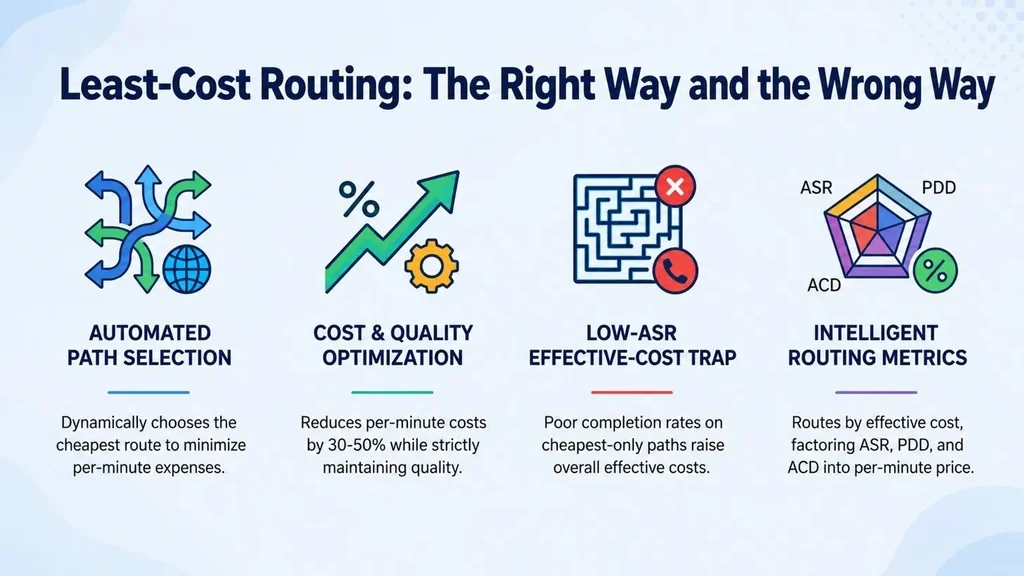
Least-Cost Routing: The Right Way and the Wrong Way

Least-cost routing (LCR) automatically selects the cheapest available path for each call. Done right, it reduces per-minute cost by 30–50% (VideoSDK, 2025) while maintaining quality thresholds. Done wrong, it sends calls down the cheapest path regardless of ASR — producing the exact effective-cost trap described earlier.

Least-cost routing the right way and the wrong way — automated path selection, cost and quality optimization, the low-ASR effective-cost trap, and intelligent routing metrics (ASR, PDD, ACD)
Least-cost routing done right balances automated path selection and quality optimization; done wrong, the cheapest-only path raises effective cost through low ASR.

A well-configured LCR system routes by effective cost per connected minute, not nominal rate. That means ASR, PDD, and ACD are factored into the routing decision alongside the per-minute price.

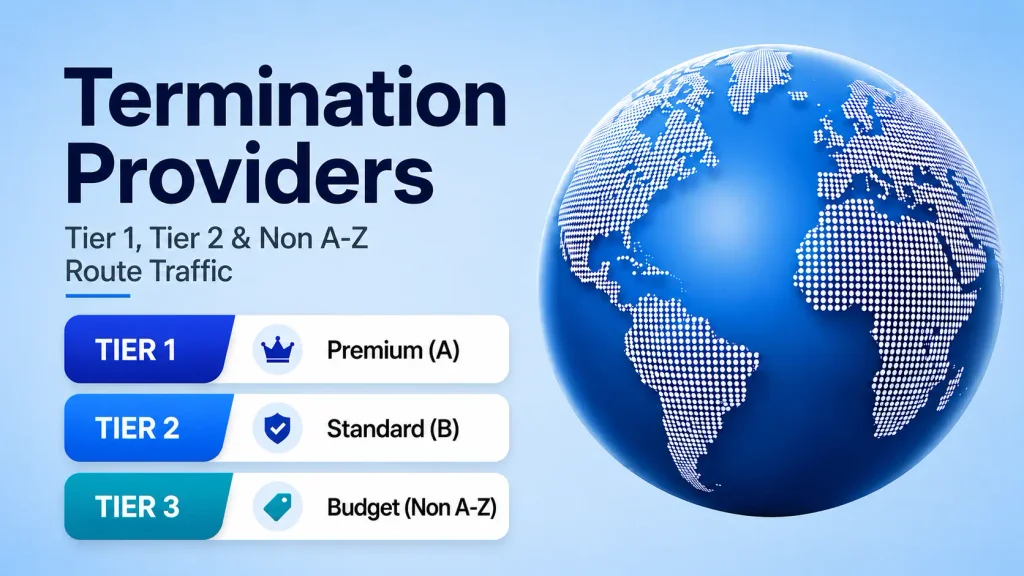
For resellers managing mixed traffic, Ajoxi's SIP trunking infrastructure supports LCR integration — routing high-value CLI traffic to premium paths and cost-sensitive bulk traffic to standard routes automatically, without manual intervention. The broader wholesale VoIP termination providers guide covers how to evaluate which carrier tier actually owns these routing decisions.

Regulatory Costs Hidden Inside Termination Rates

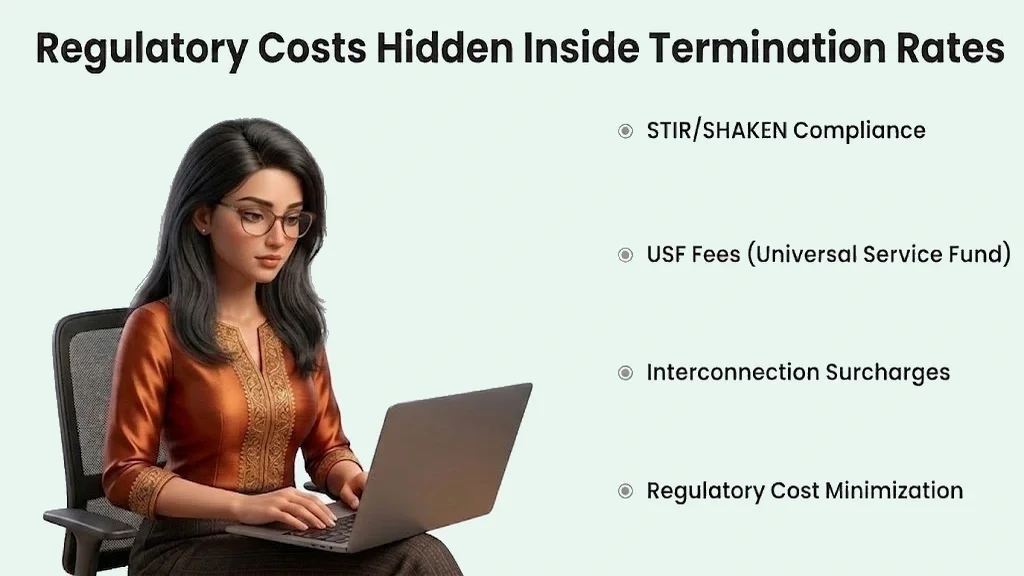
Several cost components sit beneath the per-minute rate and appear only in the fine print:

Regulatory costs hidden inside termination rates — STIR/SHAKEN compliance, USF (Universal Service Fund) fees, interconnection surcharges, and how to minimize the regulatory cost layer
The regulatory cost layer — STIR/SHAKEN compliance, USF fees, and interconnection surcharges — inflates effective rates beyond the per-minute figure on a rate card.

STIR/SHAKEN compliance costs. US-bound traffic now requires attestation under the FCC's STIR/SHAKEN framework. Compliant routes carry a small premium over non-attested routes — but non-attested calls risk being flagged as spam or blocked outright by destination carriers, which destroys ASR and makes the "cheap" route effectively unusable.

Universal Service Fund (USF) fees. US carriers pass USF contributions through to wholesale buyers. The percentage shifts quarterly. Confirm whether your provider quotes rates inclusive or exclusive of USF before comparing figures from different vendors.

Interconnection surcharges. Cross-network interconnects — particularly for terminating to mobile networks in regulated markets like India, Brazil, and parts of Europe — carry fees that vary by bilateral agreement. A provider with direct interconnects pays less than one routing through aggregators, and passes that saving on to buyers.

Ajoxi maintains STIR/SHAKEN compliant origination for US traffic and direct interconnects across its 243-territory network — minimizing the regulatory cost layer that inflates effective rates with indirect providers.

What to Confirm Before You Sign Any Termination Agreement

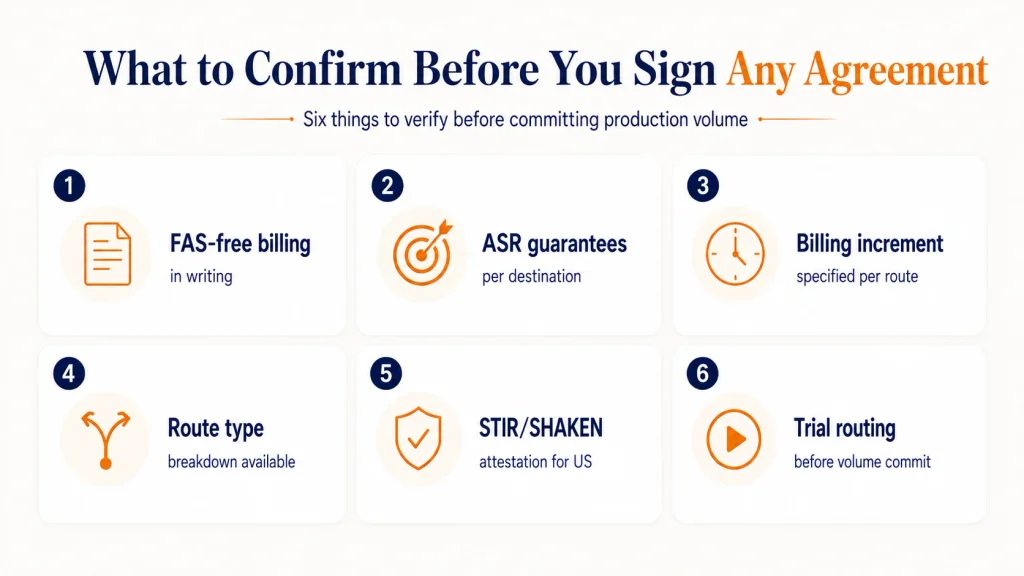
Run through this list before committing volume to any wholesale termination provider:

  • FAS-free billing confirmed in writing? If not confirmed, assume FAS applies. Negotiate it out or walk away.
  • ASR guarantees per destination? A network-average ASR stat is meaningless for your specific traffic. Get destination-level data.
  • Billing increment per destination specified? Confirm 6/6 or per-second billing for short-duration traffic before comparing per-minute rates.
  • Route type breakdown available? Can you see CLI vs. Non-CLI vs. CC rates separately, and route different traffic types independently?
  • STIR/SHAKEN attestation for US traffic? Non-attested routes will cost you in blocked calls. Confirm compliance upfront.
  • Trial routing before volume commitment? Any serious provider offers test routing to validate ASR, PDD, and MOS before you move production traffic.

The platform offers trial routing with full CDR transparency — so you validate real performance metrics, not provider claims, before committing. For buyers also weighing the reseller model, the guide to wholesale VoIP minutes covers how billing increments and volume tiers stack on top of the per-minute rate.

What to confirm before you sign any termination agreement: six checks — FAS-free billing in writing, ASR guarantees per destination, billing increment per route, route type breakdown, STIR/SHAKEN attestation for US, and trial routing before volume commit
Six things to verify before committing production volume to any wholesale provider — FAS-free billing, per-destination ASR, billing increment, route type breakdown, STIR/SHAKEN attestation, and trial routing.

Conclusion

Wholesale VoIP termination rates in 2026 are a multi-variable problem disguised as a per-minute price. The rate card is a starting line, not a finishing line. Billing increments, ASR, ACD, PDD, FAS, route-type mix, and the regulatory cost layer all sit between the column you see and the invoice you pay.

Businesses building on this foundation can go deeper in the wholesale voice services overview or the wholesale VoIP providers comparison for a broader market view.

Buyers who win measure effective cost per connected minute, demand FAS-free billing in writing, validate routes on real traffic before committing volume, and match route type to traffic profile rather than chasing the lowest nominal rate.

Voice stays a margin-positive revenue engine when the rate sheet is read with the discipline it deserves — and when STIR/SHAKEN, USF, and interconnect surcharges are accounted for before the comparison, not after the invoice arrives.

VoIP Wholesale Rates 2026: Complete Per-Minute Pricing Guide for US Businesses

How wholesale VoIP rates are structured, what drives effective per-minute cost above the nominal rate, and how to evaluate a rate card against ASR, PDD, MOS, and FAS.

Read the article

FAQ: Wholesale VoIP Termination Rates

What are wholesale VoIP termination rates?

Wholesale VoIP termination rates are the per-minute or per-second fees a carrier charges to deliver a VoIP call from an IP network to its destination — a mobile phone, landline, or PSTN endpoint. Rates vary by destination country, route type (CLI, Non-CLI, CC), billing increment, and volume commitment. They represent the core cost input for VoIP resellers, call centers, and carriers.

What is the difference between CLI and Non-CLI termination routes?

CLI (Calling Line Identification) routes pass the caller's full number to the destination, enabling caller ID display. Non-CLI routes strip this information and typically cost 20–40% less. CLI routes produce higher answer rates and comply with regulations in markets where caller ID is mandatory. Non-CLI suits bulk outbound traffic where cost-per-minute is the primary priority and caller ID is not required.

How does billing increment affect my actual termination cost?

Billing increment determines how precisely call time is measured. A 60/60 increment rounds every call to the nearest minute — a 12-second call costs one full minute. A 6/6 increment charges in 6-second blocks. For contact centers with short average call durations, switching from 60/60 to 6/6 billing can reduce effective per-minute cost significantly, even if the nominal rate is slightly higher.

What is FAS and how does it inflate termination costs?

FAS (False Answer Supervision) occurs when a carrier's network signals 'call answered' before a human picks up, triggering billing during ring time. At scale, FAS meaningfully inflates cost per successfully connected minute. FAS-free billing — where charges apply only to genuinely answered calls — is the industry standard among reputable wholesale providers and should be confirmed in writing before signing any agreement.

What is ASR and why does it matter more than the per-minute rate?

ASR (Answer-Seizure Ratio) is the percentage of call attempts that successfully connect. A route with a low per-minute rate but poor ASR — say 50% — costs more per connected call than a higher-rate route with 90%+ ASR. Because you pay for every attempt, your effective cost per successful minute is the nominal rate divided by the ASR.

Always evaluate routes on effective cost, not headline rate.

Run your voice on Ajoxi.

AI receptionists, wholesale routes, virtual numbers — built on one platform with transparent pricing and a 24/7 NOC.

See pricing Talk to us
Keep Reading

Related reading

Hand-picked next reads from the Ajoxi blog.

VoIP Wholesale Rates 2026: Complete Per-Minute Pricing Guide for US Businesses
ขายส่ง VoIP

VoIP Wholesale Rates 2026: Complete Per-Minute Pricing Guide for US Businesses

How wholesale VoIP rates are structured, what drives effective per-minute cost above the nominal rate, and how to evaluate a rate card against ASR, PDD, MOS, and FAS.

Read article
Wholesale VoIP Termination Providers: How to Choose the Right Partner
ขายส่ง VoIP

Wholesale VoIP Termination Providers: How to Choose the Right Partner

Tier-1 vs Tier-2 vs gray-market providers, the six evaluation criteria that matter, and a practical sequence for trial routing before you commit volume.

Read article
How Much Bandwidth Does Wholesale Voice Actually Need?
ขายส่ง VoIP

How Much Bandwidth Does Wholesale Voice Actually Need?

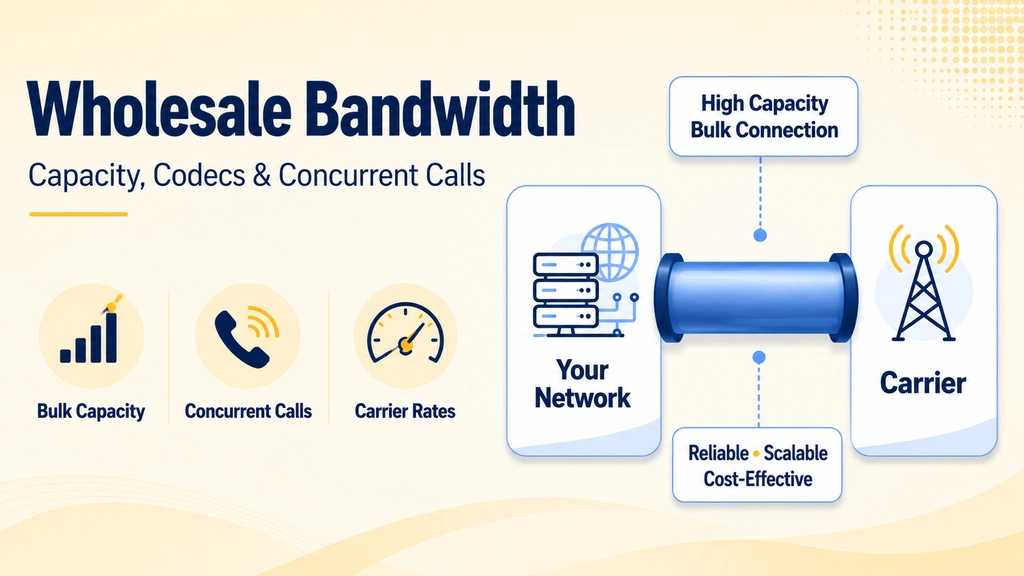
What wholesale bandwidth means for voice traffic, how codec choice changes capacity per call, and a practical method for sizing committed and burstable capacity against your busy hour.

Read article