VoIP Wholesale Rates 2026: Complete Per-Minute Pricing Guide for US Businesses
How wholesale VoIP rates are structured, what drives effective per-minute cost above the nominal rate, and how to evaluate a rate card against ASR, PDD, MOS, and FAS.
Your rate card says $0.009/min. Your invoice says something higher. The gap is where most VoIP businesses quietly lose margin — and it's almost never the provider's fault. A 2026 walkthrough of pricing structure, quality metrics, regulatory costs, and how to read a rate sheet before committing volume.
Your rate card says $0.009 per minute. Your invoice says something higher. The gap between those two numbers is where most VoIP businesses quietly lose margin — and it's almost never the provider's fault. It's the billing model, the route type, and the quality metrics nobody mentioned before you signed up.
Wholesale VoIP termination rates are the per-minute or per-second fees carriers and resellers pay to deliver a voice call from an IP network to its final destination — a mobile handset, a landline, or a PSTN endpoint anywhere in the world. Rates are negotiated at volume, quoted in USD per minute, and vary by destination country, route type, call quality tier, and billing increment.
Understanding the gap between the quoted rate and the effective cost is what separates profitable voice operations from ones constantly chasing margin.
Termination pricing isn't a single number — it's a stack of variables that multiply together. Here's what sits inside every rate:
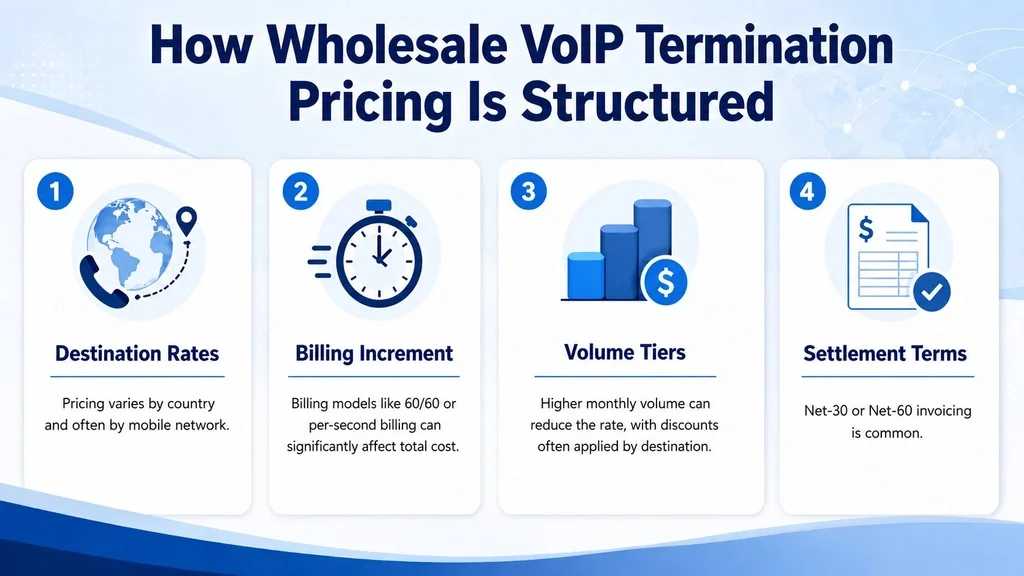
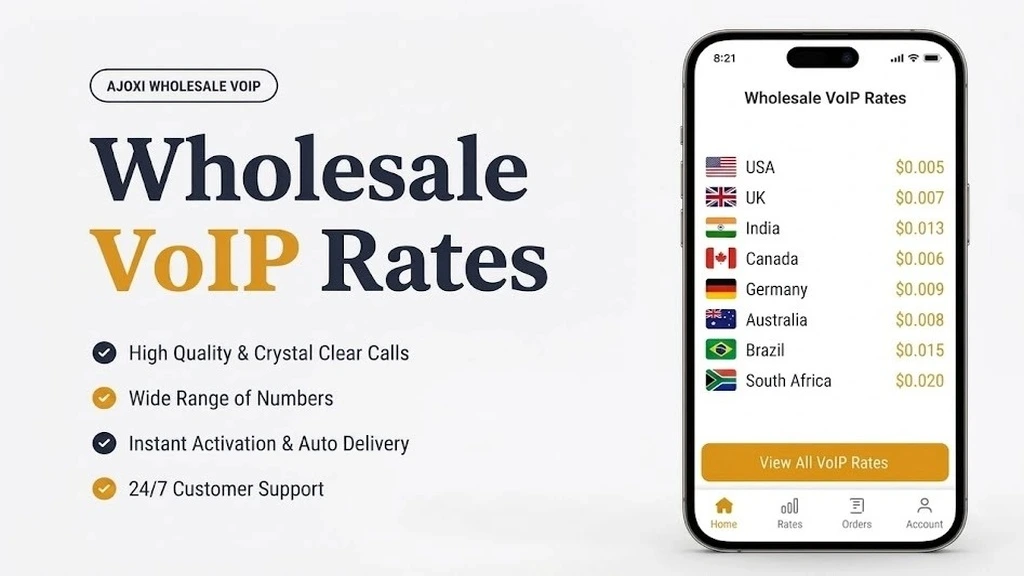
Per-minute rate by destination. Every country — often every mobile network within a country — has its own rate. A Germany landline terminates around $0.0045/min. A mobile number in Nigeria can reach $0.028–$0.035/min. These aren't arbitrary — they reflect local carrier interconnect costs, regulatory surcharges, and the scarcity of direct routes from Tier-1 providers.
Billing increment. This is the single most overlooked cost driver. A 60/60 billing increment (60-second minimum, 60-second rounding) charges a full minute for a 5-second call. A 6/6 increment charges six seconds. For contact centers running auto-dialers with high abandonment, the difference between billing models can exceed the rate differential between two competing providers.
Per-second billing is available on premium routes and is worth the modest premium for short-duration traffic.
Tiered volume pricing. Most providers publish a stepped rate structure. A typical tier table looks like this:
| Monthly Volume | Rate per Minute (Sample) |
|---|---|
| 0 – 1M minutes | $0.009 |
| 1M – 5M minutes | $0.008 |
| 5M+ minutes | $0.007 |
The catch: volume tiers are often calculated per destination, not total traffic. Moving 5M minutes to 12 different countries may not unlock the same discount as 5M minutes to a single country. Always confirm how tiers are calculated before projecting savings.
Settlement terms. Net-30 or net-60 invoicing is standard. Cash flow matters in high-volume termination. Providers who demand prepayment without offering trial routing or CDR transparency are a red flag.
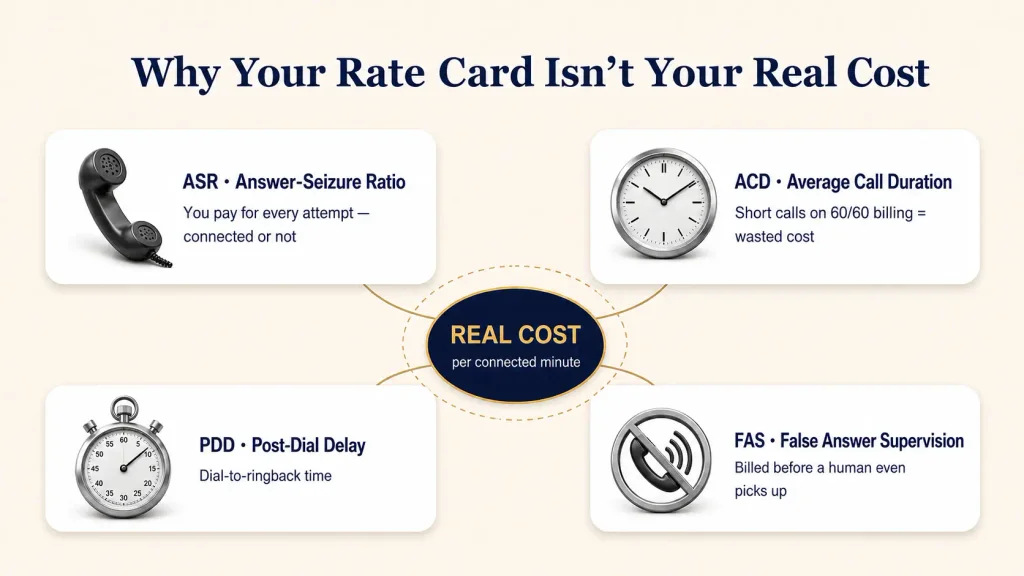
This is where most buyers get burned. Four quality metrics determine your actual cost per successfully connected minute — and none of them appear on a rate card:
ASR is the percentage of call attempts that actually connect. A route with a $0.007/min rate and a 55% ASR costs more per successful minute than a $0.009/min route with a 92% ASR — because you pay for every attempt, connected or not. The math: at 55% ASR, your effective cost on $0.007 routes is $0.0127/successful minute.
At 92% ASR, a $0.009 route costs $0.0098/successful minute.
Ajoxi's voice termination network targets ASR above 90% on premium CLI routes across its 243-territory coverage. Before routing volume, request destination-specific ASR data — not a network average.
ACD measures average connected call length. Short ACD on auto-dialer traffic (under 30 seconds) combined with per-minute billing creates a disproportionate cost. A provider who offers per-second or 6/6 billing for call center traffic is genuinely cheaper than one quoting a lower flat rate on 60/60 increments.
PDD is the time between completing a dial and the first ringback. Under 3 seconds is the benchmark. Over 5 seconds consistently signals a gray-market or heavily re-routed path. High PDD doesn't just affect call quality — it inflates call attempt duration, which on 60/60 billing means you're paying for dead air.
FAS happens when a carrier's switch signals "answered" before a human picks up — billing you for ring time or even pre-ring network activity. At scale, FAS adds a measurable percentage to effective per-minute cost. FAS-free billing means you pay only for calls a person actually answered. It's the single most important contract term to confirm before signing with any wholesale provider.
Ajoxi operates FAS-free on all routes.
Not every call needs the same route quality. Paying CLI rates for non-CLI traffic is money wasted. Routing enterprise sales calls over economy paths damages answer rates and brand credibility. Matching route type to traffic profile is how you optimize margin without compromising quality.
| Route Type | CLI Passed? | Relative Cost | Best Traffic Profile |
|---|---|---|---|
| Premium CLI | Full caller ID | Highest | Enterprise, outbound sales, healthcare |
| Standard CLI | Full caller ID | Mid-range | General business, contact centers |
| Non-CLI | None / stripped | 20–40% lower | High-volume bulk outbound, marketing |
| CC Routes | Country code only | Mid-range | BPOs, mixed international traffic |
Ajoxi provides CLI and CC routes under one account — no need to manage separate vendor relationships for different traffic types. For BPOs and contact centers handling mixed international traffic, this single-account access to multiple route types is a meaningful operational simplification.
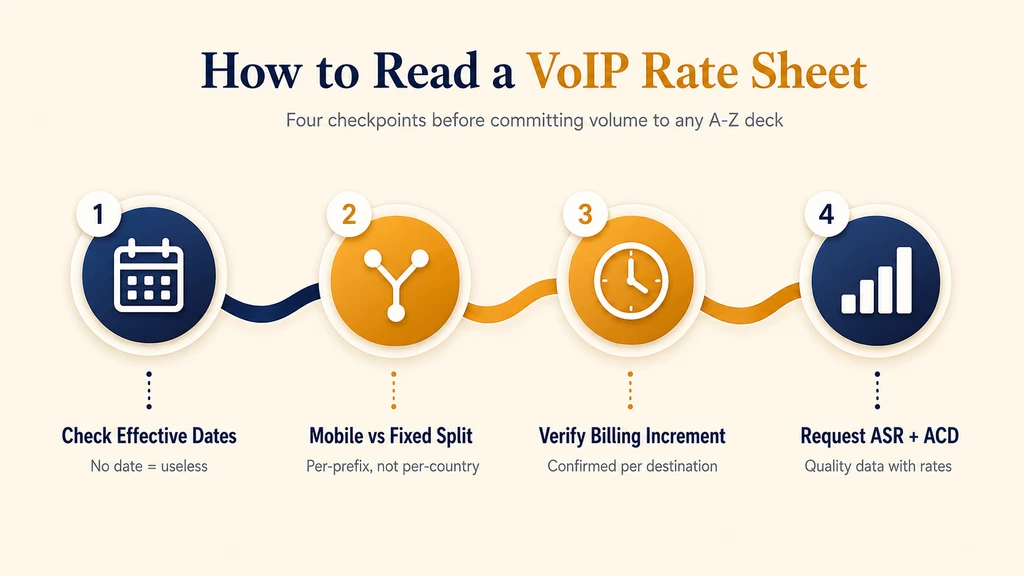
A rate sheet (also called an A-Z deck) is a CSV or spreadsheet listing per-minute rates by country code, often by mobile operator prefix. Here's how to evaluate one properly:
Check effective dates. Rates update frequently — sometimes weekly for volatile corridors like African mobile or South Asian mobile. A rate sheet with no effective date is operationally useless.
Look for mobile vs. fixed split. A single row for "India" on a rate sheet is a warning sign. India has dozens of mobile operators, each with different termination costs. A quality A-Z deck shows per-prefix pricing.
Verify billing increment per destination. Some providers apply different increments to different destinations. Confirm 6/6 or per-second billing is available for your high-volume corridors before assuming the low per-minute rate applies to your actual traffic pattern.
Request ASR and ACD data alongside rates. A provider who shares quality benchmarks with rate information is transparent. One who doesn't, isn't.
Ajoxi publishes destination-specific quality metrics alongside rate information for its wholesale VoIP clients — giving resellers and carriers the data to make routing decisions, not just pricing comparisons.
Least-cost routing (LCR) automatically selects the cheapest available path for each call. Done right, it reduces per-minute cost by 30–50% (VideoSDK, 2025) while maintaining quality thresholds. Done wrong, it sends calls down the cheapest path regardless of ASR — producing the exact effective-cost trap described earlier.
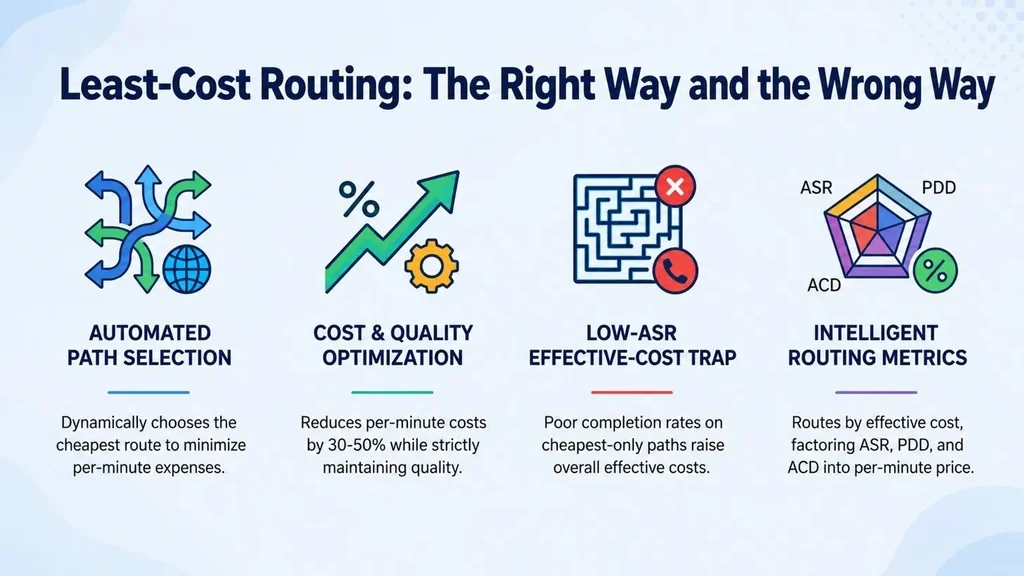
A well-configured LCR system routes by effective cost per connected minute, not nominal rate. That means ASR, PDD, and ACD are factored into the routing decision alongside the per-minute price.
For resellers managing mixed traffic, Ajoxi's SIP trunking infrastructure supports LCR integration — routing high-value CLI traffic to premium paths and cost-sensitive bulk traffic to standard routes automatically, without manual intervention. The broader wholesale VoIP termination providers guide covers how to evaluate which carrier tier actually owns these routing decisions.
Several cost components sit beneath the per-minute rate and appear only in the fine print:
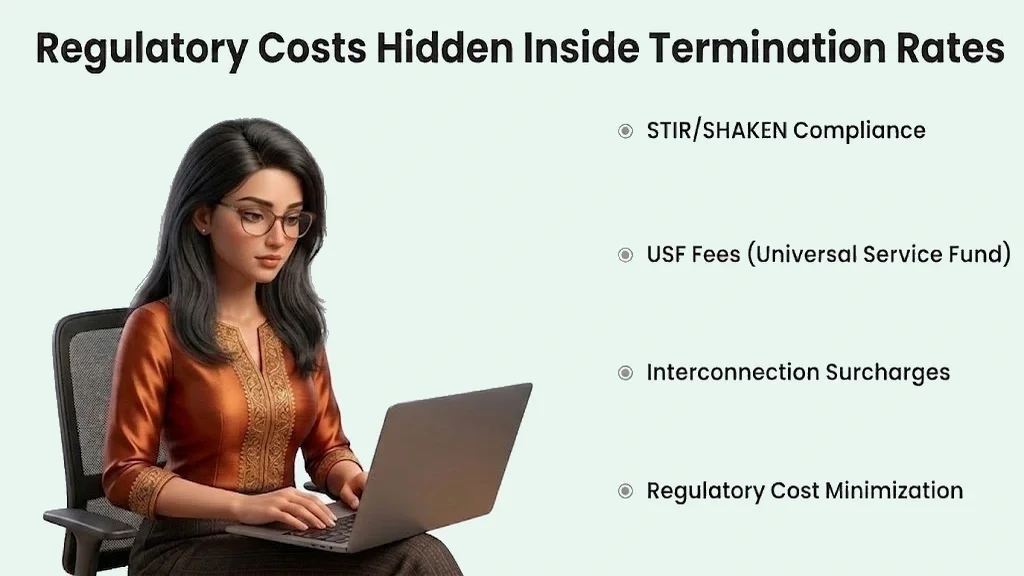
STIR/SHAKEN compliance costs. US-bound traffic now requires attestation under the FCC's STIR/SHAKEN framework. Compliant routes carry a small premium over non-attested routes — but non-attested calls risk being flagged as spam or blocked outright by destination carriers, which destroys ASR and makes the "cheap" route effectively unusable.
Universal Service Fund (USF) fees. US carriers pass USF contributions through to wholesale buyers. The percentage shifts quarterly. Confirm whether your provider quotes rates inclusive or exclusive of USF before comparing figures from different vendors.
Interconnection surcharges. Cross-network interconnects — particularly for terminating to mobile networks in regulated markets like India, Brazil, and parts of Europe — carry fees that vary by bilateral agreement. A provider with direct interconnects pays less than one routing through aggregators, and passes that saving on to buyers.
Ajoxi maintains STIR/SHAKEN compliant origination for US traffic and direct interconnects across its 243-territory network — minimizing the regulatory cost layer that inflates effective rates with indirect providers.
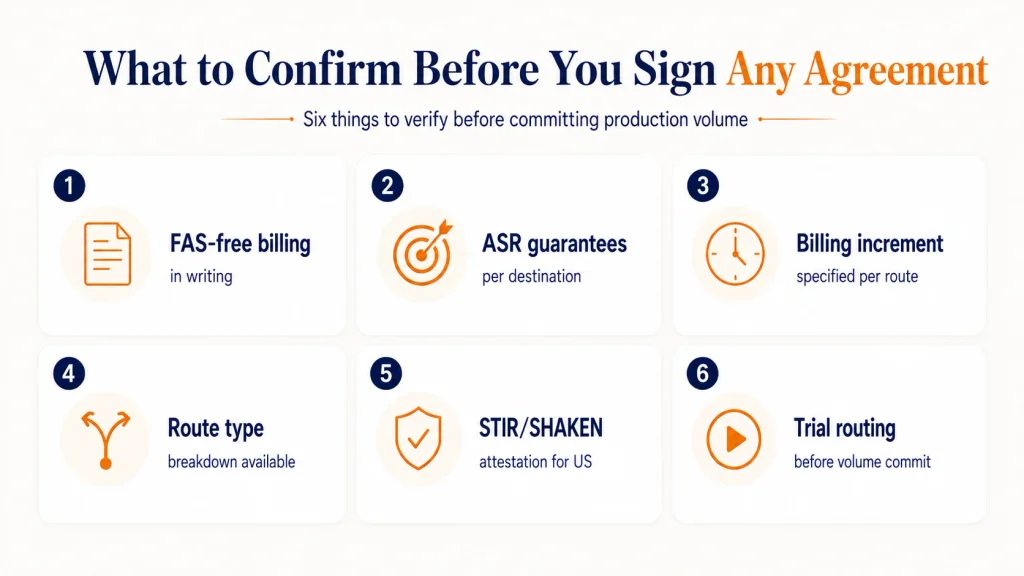
Run through this list before committing volume to any wholesale termination provider:
The platform offers trial routing with full CDR transparency — so you validate real performance metrics, not provider claims, before committing. For buyers also weighing the reseller model, the guide to wholesale VoIP minutes covers how billing increments and volume tiers stack on top of the per-minute rate.
Wholesale VoIP termination rates in 2026 are a multi-variable problem disguised as a per-minute price. The rate card is a starting line, not a finishing line. Billing increments, ASR, ACD, PDD, FAS, route-type mix, and the regulatory cost layer all sit between the column you see and the invoice you pay.
Businesses building on this foundation can go deeper in the wholesale voice services overview or the wholesale VoIP providers comparison for a broader market view.
Buyers who win measure effective cost per connected minute, demand FAS-free billing in writing, validate routes on real traffic before committing volume, and match route type to traffic profile rather than chasing the lowest nominal rate.
Voice stays a margin-positive revenue engine when the rate sheet is read with the discipline it deserves — and when STIR/SHAKEN, USF, and interconnect surcharges are accounted for before the comparison, not after the invoice arrives.
Wholesale VoIP termination rates are the per-minute or per-second fees a carrier charges to deliver a VoIP call from an IP network to its destination — a mobile phone, landline, or PSTN endpoint. Rates vary by destination country, route type (CLI, Non-CLI, CC), billing increment, and volume commitment. They represent the core cost input for VoIP resellers, call centers, and carriers.
CLI (Calling Line Identification) routes pass the caller's full number to the destination, enabling caller ID display. Non-CLI routes strip this information and typically cost 20–40% less. CLI routes produce higher answer rates and comply with regulations in markets where caller ID is mandatory. Non-CLI suits bulk outbound traffic where cost-per-minute is the primary priority and caller ID is not required.
Billing increment determines how precisely call time is measured. A 60/60 increment rounds every call to the nearest minute — a 12-second call costs one full minute. A 6/6 increment charges in 6-second blocks. For contact centers with short average call durations, switching from 60/60 to 6/6 billing can reduce effective per-minute cost significantly, even if the nominal rate is slightly higher.
FAS (False Answer Supervision) occurs when a carrier's network signals 'call answered' before a human picks up, triggering billing during ring time. At scale, FAS meaningfully inflates cost per successfully connected minute. FAS-free billing — where charges apply only to genuinely answered calls — is the industry standard among reputable wholesale providers and should be confirmed in writing before signing any agreement.
ASR (Answer-Seizure Ratio) is the percentage of call attempts that successfully connect. A route with a low per-minute rate but poor ASR — say 50% — costs more per connected call than a higher-rate route with 90%+ ASR. Because you pay for every attempt, your effective cost per successful minute is the nominal rate divided by the ASR.
Always evaluate routes on effective cost, not headline rate.
AI receptionists, wholesale routes, virtual numbers — built on one platform with transparent pricing and a 24/7 NOC.