Wholesale VoIP Termination Rates: What Your Rate Card Isn't Telling You
The gap between rate-card pricing and effective cost — billing increments, ASR, ACD, PDD, FAS, and regulatory layers that move your real per-connected-minute price.
Not all wholesale VoIP termination providers are equal. The 2026 buyer's guide to coverage, tier-1 vs gray-market routes, quality metrics, fraud protection, compliance, and SLAs — written for resellers and carriers who need infrastructure that protects their brand.
When a call drops, the caller blames the brand on their screen — not the wholesale carrier three layers below. That single fact makes provider selection the most consequential infrastructure decision in any voice-dependent business. The wrong wholesale VoIP termination provider doesn't just cost you margin. It costs you customer relationships.
Wholesale VoIP termination providers are carriers and aggregators that route high-volume voice calls from an IP network to their final destination — a mobile handset, landline, or PSTN endpoint — on behalf of resellers, enterprises, and service providers. Unlike retail VoIP, which serves end users directly, wholesale termination operates at the infrastructure layer: providers manage carrier interconnects, route optimization, fraud detection, and compliance so their customers don't have to build that infrastructure themselves.
The term "termination" describes the last leg of a call's journey. Your call originates on an IP network. At some point it must cross into a traditional phone network — the PSTN — to reach the recipient. The wholesale VoIP termination provider manages that crossing.
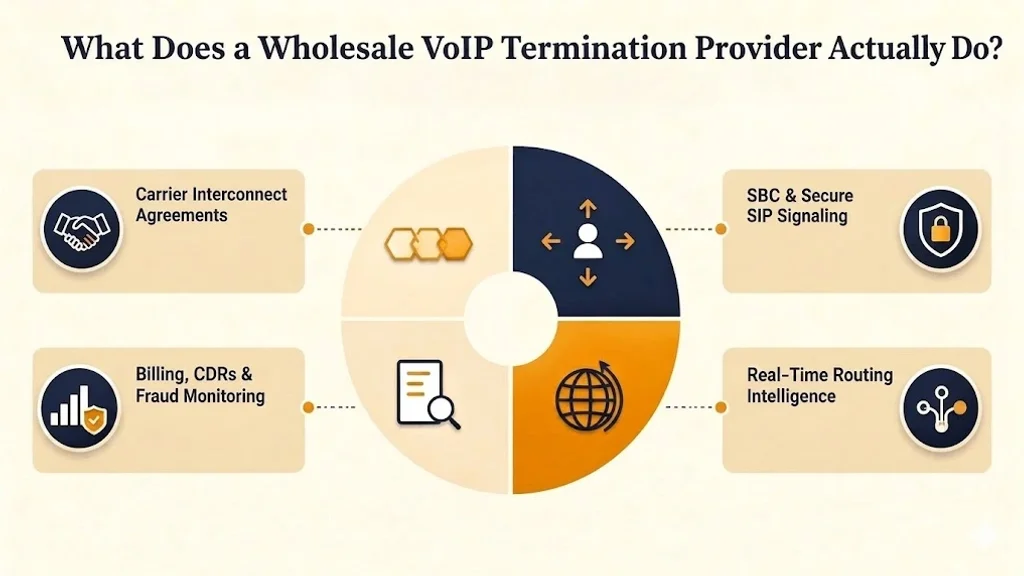
Specifically, a provider handles: carrier interconnect agreements with national and regional operators worldwide, session border control (SBC) for secure SIP signaling, real-time routing decisions across hundreds of possible paths for each call, billing and CDR generation, and fraud monitoring to catch toll fraud before it hits your account.
What they don't do: serve your end users directly, provide your softphone or UCaaS interface, or manage your customer relationships. The provider is invisible to the caller. Which is exactly the problem when they fail.
The platform handles every layer of this infrastructure — carrier agreements, routing intelligence, security, and compliance — across 243 territories, so resellers and enterprises connect a single SIP trunk and access global reach without building the underlying network. Explore wholesale VoIP providers compared side by side for a broader view of the market.
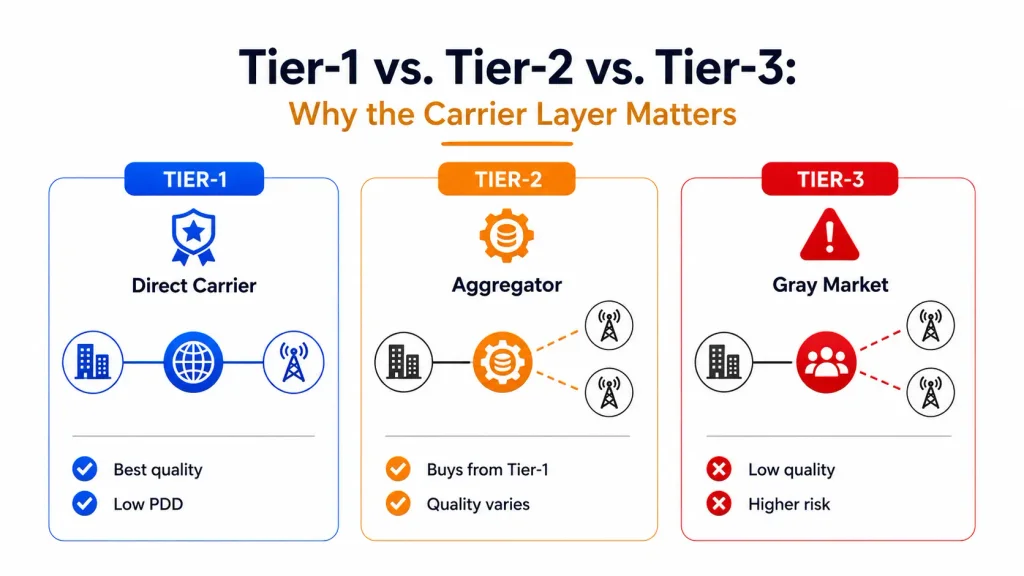
Not all wholesale VoIP termination providers sit at the same level of the carrier stack. Understanding where your provider operates directly predicts route quality, pricing, and risk.
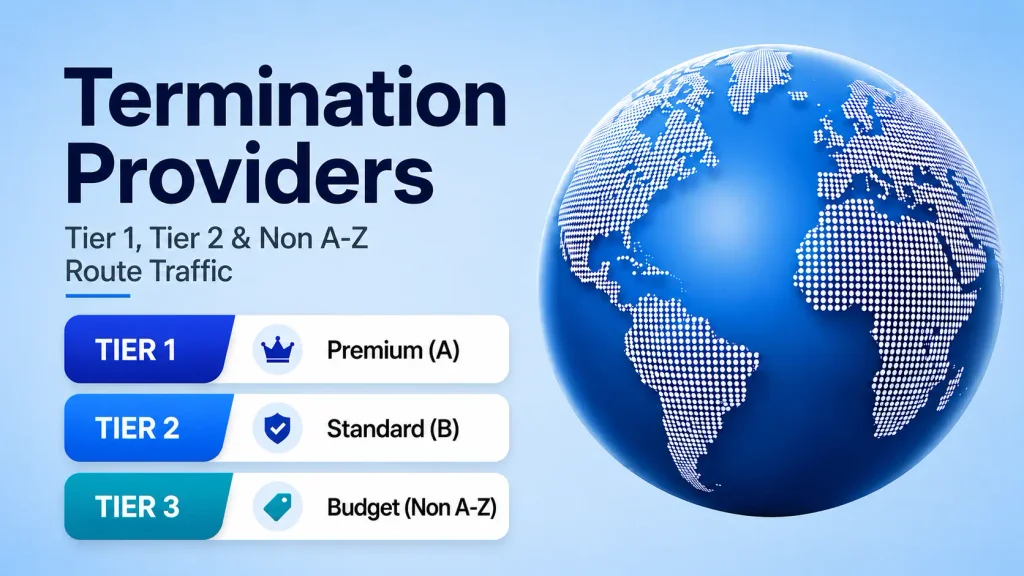
Tier-1 carriers hold direct peering agreements with national PSTN operators and mobile networks. They own the interconnects. No intermediary. Tier-1 routes produce the highest ASR, lowest PDD, and cleanest CLI. They cost more per minute than gray-market alternatives — and they're worth it.
Tier-2 aggregators buy capacity from Tier-1 carriers and resell it with a margin. Route quality depends entirely on which Tier-1s they're buying from and how they manage traffic during congestion. Some Tier-2 providers are excellent. Others route through whichever carrier bids lowest in real time — which means quality inconsistency.
Tier-3 and gray-market routes exist below the aggregator layer. Per-minute rates look attractive. FAS billing is common. CLI spoofing is a fraud risk. STIR/SHAKEN attestation is rare. Businesses that chase the lowest nominal rate through Tier-3 routes consistently report higher effective cost per connected minute once failed calls, billing disputes, and compliance incidents are factored in.
Ajoxi operates at the tier-1 level with direct interconnects across its 243-territory network — meaning routes don't pass through aggregators whose quality control is opaque. The 99.99% uptime SLA reflects the infrastructure redundancy that tier-1 positioning enables.
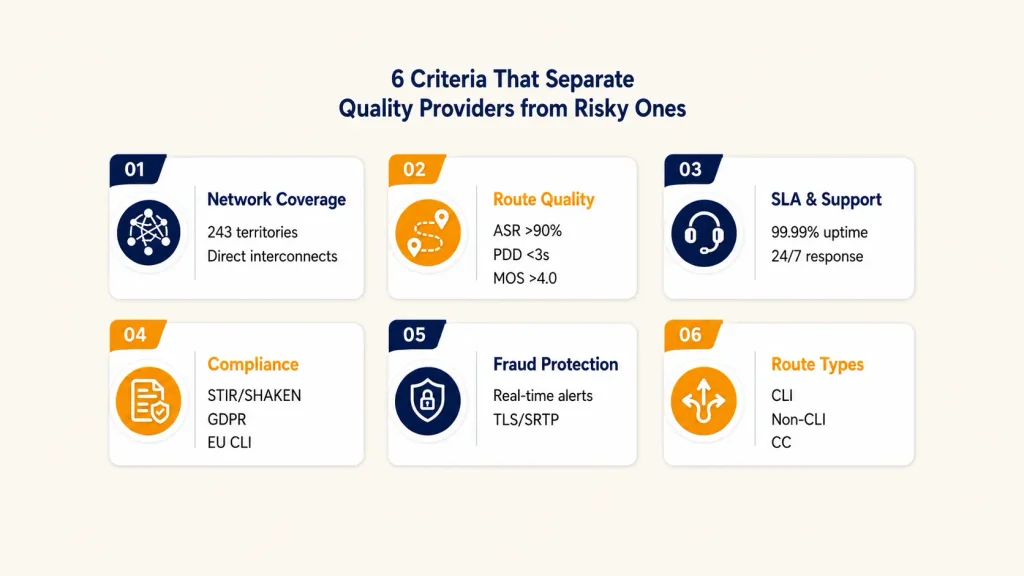
Evaluating wholesale VoIP termination providers on price alone produces predictably bad outcomes. Here are the six criteria that actually determine whether a provider is a reliable long-term partner.
A rate deck listing 190 countries means nothing if your top-10 destination countries are routed through subpar interconnects. Before committing, request destination-specific ASR data for the corridors that represent 80% of your traffic volume. A provider confident in their network shares this without hesitation. One that deflects to network-average statistics is hiding something.
Ajoxi covers 243 territories through voice termination infrastructure with direct interconnects — not re-routed gray traffic. For resellers whose customers call across Latin America, South Asia, and Sub-Saharan Africa, this depth of real coverage (not claimed coverage) is the differentiator.
Four numbers define whether a route is actually usable:
| Metric | What It Measures | Benchmark |
|---|---|---|
| ASR (Answer-Seizure Ratio) | % of call attempts that connect | >90% for premium CLI |
| PDD (Post-Dial Delay) | Seconds from dial to ringback | <3 seconds |
| NER (Network Effectiveness Ratio) | Technical performance excluding user-end failures | >95% |
| MOS (Mean Opinion Score) | Perceived voice clarity (1–5 scale) | >4.0 |
Any provider worth evaluating should share these figures per destination, not as a single network average. Low ACD (Average Call Duration) alongside low ASR is a double red flag — it suggests callers are hanging up because the connection is poor even when it does connect.
Premium CLI routes guarantee caller ID delivery, produce higher answer rates, and satisfy compliance requirements in markets like the EU where CLI manipulation carries penalties. Non-CLI routes cost 20–40% less and suit bulk outbound traffic where caller ID isn't required. CC (calling card) routes are engineered for low-ACD traffic patterns common in calling card operations and BPOs.
A provider that covers all three route types under a single account eliminates the operational overhead of managing multiple carrier relationships.
Toll fraud is a multi-billion dollar problem in wholesale voice. International Revenue Share Fraud (IRSF), Wangiri, and SIM-box fraud all target wholesale termination infrastructure. A provider's fraud architecture matters more than their stated policy.
Specifically, look for: real-time CDR monitoring with automated threshold alerts, SIP-level fraud detection that blocks abnormal call patterns before they complete, STIR/SHAKEN attestation for US-bound traffic, and TLS/SRTP encryption for SIP signaling and media transport. A provider who responds to a fraud incident after the fact — rather than preventing it — is exposing your business to liability and billing disputes.
Regulatory requirements for voice termination have tightened materially since 2024. STIR/SHAKEN is mandatory for US traffic. The EU has introduced CLI authentication requirements in multiple member states, with Belgium, France, and Germany among those implementing specific blocking rules for non-compliant international traffic. Brazil's Resolution No. 777 (April 2025) added new anti-fraud requirements for international termination.
A provider who isn't tracking these changes in real time is routing traffic that may be blocked or flagged without warning. For healthcare, finance, and insurance businesses where compliance isn't optional, provider compliance posture is non-negotiable.
An SLA that guarantees 99.99% uptime is meaningful only if the provider enforces it with real remedies for downtime. Read the SLA before signing — specifically the definitions of "outage," the notification windows, and the credit structure for breach.
Support responsiveness during an actual incident matters more than the availability claim. A provider with 24/7 support that takes four hours to respond during a routing failure is effectively providing no support when you need it. Ask specific questions during evaluation: What is your average response time for P1 incidents? Do you provide a dedicated account contact for wholesale customers? What is your incident communication protocol?
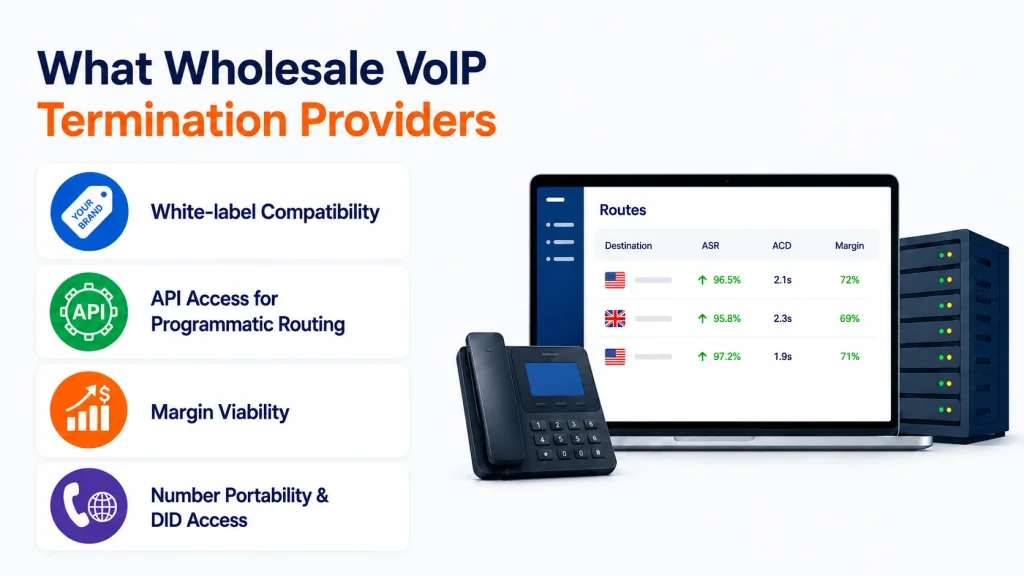
Resellers buying termination wholesale and selling retail don't just need quality routes. They need infrastructure that supports a reseller business model. Several capabilities matter specifically to this buyer:
White-label compatibility. Can you present routes to your customers under your own brand, with your own rate deck? A provider who requires their branding in your customer-facing tooling limits your positioning.
API access for programmatic routing. Resellers building platforms or integrating with CRMs and dialers need API-level access to route control, CDR retrieval, and account management. Ajoxi's SIP trunking infrastructure supports standard SIP integration compatible with Asterisk, FreePBX, 3CX, and similar platforms.
Margin viability. Wholesale termination margins for resellers can reach 70% when route quality supports premium retail pricing. That margin disappears if poor route quality produces customer churn or billing disputes. The combination of tier-1 routes, FAS-free billing, and transparent CDRs is what protects reseller margin long-term.
Number portability and DID access. Resellers often need to pair termination with inbound DID numbers. A provider who supplies both — like Ajoxi, with virtual and local numbers across 120+ countries — eliminates a second vendor relationship and simplifies provisioning for end customers. Understanding termination rates across destinations is equally critical to protecting reseller margins.
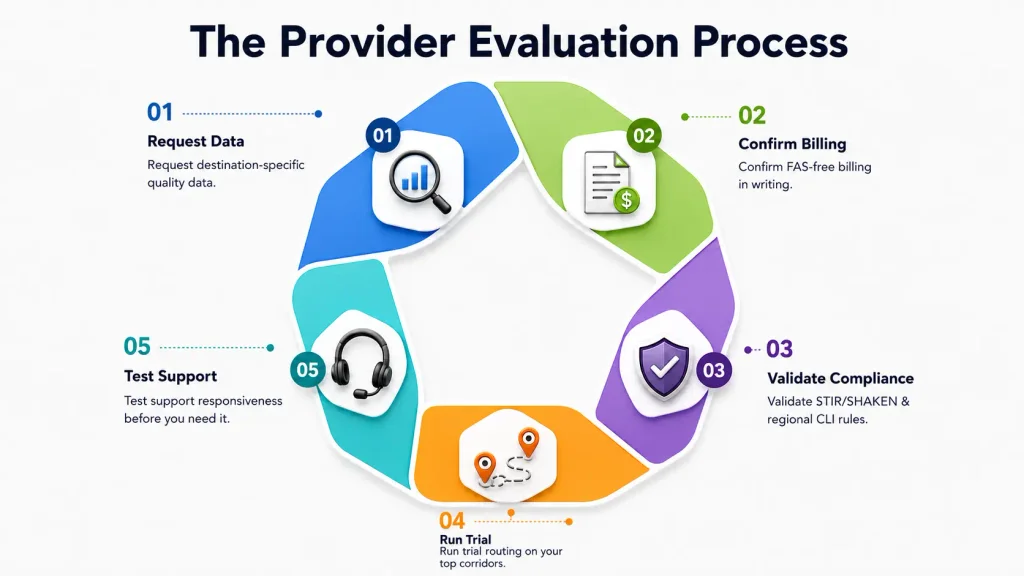
Don't evaluate providers on paper alone. Follow this sequence before committing production traffic:
Step 1 — Request destination-specific quality data. ASR, PDD, NER, and MOS per route, not network averages. Any provider who can't or won't provide this fails the first filter.
Step 2 — Confirm FAS-free billing in writing. FAS billing can inflate your actual cost by 15–30% above the nominal rate. Confirm FAS-free status in the contract, not just in sales conversation.
Step 3 — Validate STIR/SHAKEN and compliance posture. For US traffic, confirm attestation level (A, B, or C). For European traffic, ask specifically about Belgium, France, and Germany CLI requirements.
Step 4 — Run trial routing on your actual top corridors. A 2–4 week trial with CDR access lets you validate ASR, PDD, and ACD on real traffic — not synthetic test calls. Providers confident in their network offer this without requiring a volume commitment first.
Step 5 — Test support responsiveness before you need it. Submit a technical question during the trial period and time the response. If the pre-sales support is slow, the incident support will be slower.
The platform offers trial routing with full CDR transparency — so quality is validated on real traffic before any commitment. Buyers evaluating route options can also review wholesale VoIP minutes provider criteria for context on how minute-level billing decisions affect total cost.
The wholesale VoIP termination provider you choose ends up wearing your brand's reputation on every call. Tier-1 carriers earn the premium they charge through real coverage, route-quality transparency, fraud protection, compliance posture, and SLA enforcement that actually pays out when downtime happens.
The six criteria — coverage, ASR/PDD/NER/MOS metrics, route-type completeness, fraud architecture, regulatory coverage, and support responsiveness — separate partners that scale your business from carriers that quietly cost you customers. Run the evaluation sequence honestly: destination-specific quality data, FAS-free billing in writing, STIR/SHAKEN validation, 2–4 week trial routing on real corridors, and a real support test before you commit volume. For businesses building a reseller operation, understanding wholesale voice services and the wholesale voice carrier business model gives essential context before choosing a termination partner. The carriers willing to be measured are the ones worth signing.
A wholesale VoIP termination provider is a carrier or aggregator that routes high-volume voice calls from an IP network to their final destination on the PSTN or mobile networks. They provide the carrier interconnects, routing infrastructure, fraud protection, and compliance coverage that resellers, enterprises, and other service providers use to deliver voice services without building that infrastructure themselves.
Tier-1 providers hold direct peering agreements with national PSTN and mobile operators, giving them the lowest-cost, highest-quality route access without intermediaries. Tier-2 aggregators buy capacity from Tier-1 carriers and resell it with a margin — quality depends on their sourcing discipline. Tier-1 routes produce higher ASR, lower PDD, and more consistent MOS.
The four essential metrics are ASR (Answer-Seizure Ratio — target above 90%), PDD (Post-Dial Delay — under 3 seconds), NER (Network Effectiveness Ratio — above 95%), and MOS (Mean Opinion Score — above 4.0). Request these per destination, not as a network average. Also confirm ACD (Average Call Duration) is healthy for your traffic type.
Quality providers implement real-time CDR monitoring, automated threshold alerts for abnormal calling patterns, and SIP-level blocking before fraudulent calls complete. STIR/SHAKEN attestation for US traffic prevents spoofed caller ID. TLS/SRTP encryption protects SIP signaling and voice media. Providers who detect fraud after invoice generation rather than preventing it in real time are not protecting your business.
FAS (False Answer Supervision) is a billing practice where a carrier marks a call as answered — and starts billing — before the destination actually picks up. On high-volume traffic, FAS can add 15–30% to your effective cost above the nominal per-minute rate. Avoid it by confirming FAS-free billing in writing as a contract term. All Ajoxi routes are FAS-free.
AI receptionists, wholesale routes, virtual numbers — built on one platform with transparent pricing and a 24/7 NOC.