How a Wholesale Voice Carrier Business Works in 2026: Operations, KPIs & Entry Path
Inside a wholesale voice carrier business in 2026 — the five operational pillars, six core departments, $300K-$1M entry capital, KPIs that actually define health, and the white-label alternative that drops the entry cost under $50K.
Wholesale Voice
How a Wholesale Voice Carrier Business Works in 2026: Operations, KPIs & Entry Path
Introduction
It's Monday morning at a 12-year-old wholesale voice carrier business. The night-shift NOC engineer is signing off after rerouting two corridors that degraded in Asia overnight. The route-management desk is working through 47 rate-change notifications from upstream carriers that arrived between midnight and 6 a.m. The compliance lead is preparing a STIR/SHAKEN traceback response for the FCC, due by Friday.
The CFO is on a 7 a.m. call about FX hedging for next quarter's Latin American settlements. None of this looks like "voice over IP" from the outside.
The wholesale voice carrier business is a complicated operational machine that lives behind every retail VoIP plan, every CPaaS API, and every contact-center voice channel in 2026.
This guide breaks down what that machine actually does — the five operational pillars, daily work, six core departments, KPIs that define success, and what it takes to enter or scale a wholesale voice carrier business this year in the US and globally.
What Is a Wholesale Voice Carrier Business?
A wholesale voice carrier business buys voice capacity from upstream tier-1 networks and resells routed minutes, DIDs, and termination services in bulk to other businesses — resellers, BPOs, MVNOs, CPaaS platforms, and enterprises. The business operates SBCs, softswitches, routing engines, billing platforms, and compliance infrastructure. Revenue comes from per-minute margins, DID rentals, value-added routing services, and partner program fees.
Most US wholesale voice carriers register with the FCC under common-carrier classifications and the Robocall Mitigation Database. The full range of services this business model delivers is covered in the wholesale voice services overview.
The Five Operational Pillars of a Wholesale Voice Carrier
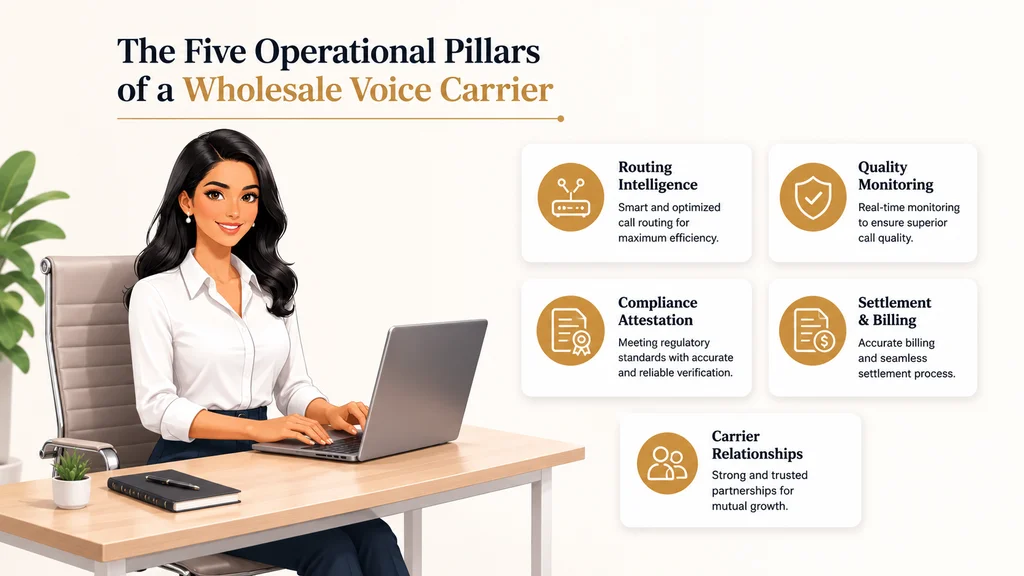
Every functioning wholesale voice carrier runs on the same five pillars regardless of size or specialization:
Routing intelligence — the engine that scores every available path for every call in real time
Quality monitoring — continuous measurement of ASR, ACD, PDD, and FAS on every active route
Settlement and billing — CDR collection, reconciliation against upstream invoices, downstream billing to customers
Carrier relationships — bilateral contracts with tier-1 networks (AT&T, Verizon Business, Lumen, T-Mobile in the US), regulators, and destination operators
Carriers that under-invest in any of the five eventually feel it. Most failures in this business trace back to under-resourced compliance or under-developed carrier relationships. For buyers evaluating wholesale VoIP termination providers, understanding these pillars helps identify which carriers have genuinely built the infrastructure versus those that are aggregating gray routes.
The five operational pillars every wholesale voice carrier runs on — routing intelligence, quality monitoring, compliance attestation, settlement & billing, and carrier relationships.
Daily Operations: What Actually Happens
A wholesale voice carrier in production runs on a 24/7 cycle. The NOC monitors route quality in real time, with alerts firing when ASR drops below thresholds on any active corridor. The route-management desk processes upstream rate-change notifications continuously — major destinations move weekly on volatile corridors, monthly on stable ones.
Compliance teams handle attestation chain verification, respond to FCC traceback requests within mandated windows, and maintain Robocall Mitigation Database entries. Settlement teams reconcile billions of CDR records against upstream and downstream invoices. Engineering teams maintain SBCs, deploy routing algorithm updates, and respond to incidents.
By the time a single business voice call connects, somewhere between three and seven of these teams have touched its path or its billing in the last quarter. None of that is visible to the end user — which is the entire point.
The Six Core Departments of a Wholesale Voice Carrier
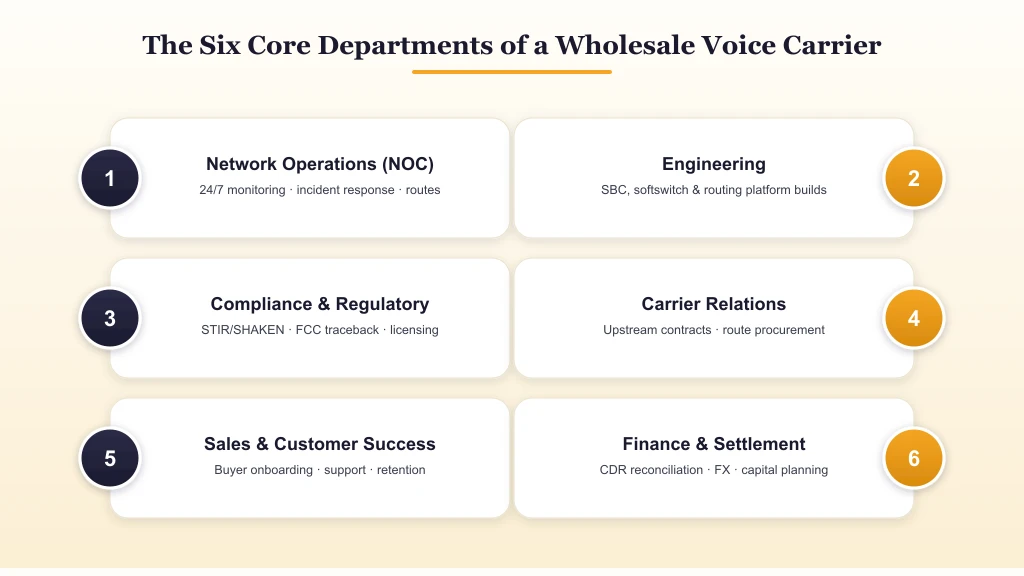
A typical mid-size wholesale voice carrier organizes around six core departments:
Sales and customer success — buyer onboarding, support, retention
Finance and settlement — CDR reconciliation, FX management, capital planning
Smaller carriers consolidate roles, larger ones spawn sub-teams. The work itself stays similar across scales. Most wholesale voice carriers in 2026 sit between 30 and 300 full-time employees.
The six core departments a wholesale voice carrier organizes around — NOC, engineering, compliance & regulatory, carrier relations, sales & customer success, and finance & settlement.
KPIs That Define Carrier Business Success
Five numbers tell you whether a wholesale voice carrier is healthy. Report carrier fraud to the FTC:
KPI
What It Measures
Healthy Range
Effective ASR per destination
Quality benchmark on real connected traffic
60%+ on premium routes
Margin per minute
Spread between upstream cost and downstream rate
Mils (tenths of a cent)
Customer churn rate
Annual buyer attrition
Below 6-8% per year
CDR reconciliation accuracy
Invoice vs CDR match
Within 1-2%
Route portfolio diversification
Upstream partners per top destination
3+ partners per corridor
What It Takes to Enter the Wholesale Voice Carrier Business in 2026
Entry is harder than it was a decade ago and easier in some specific ways. Capital requirements have dropped because SBC and routing software run on cloud infrastructure instead of dedicated hardware. Regulatory requirements have grown because STIR/SHAKEN, 10DLC, FCC Robocall Mitigation Database registration, and equivalent international frameworks now require real compliance infrastructure from day one.
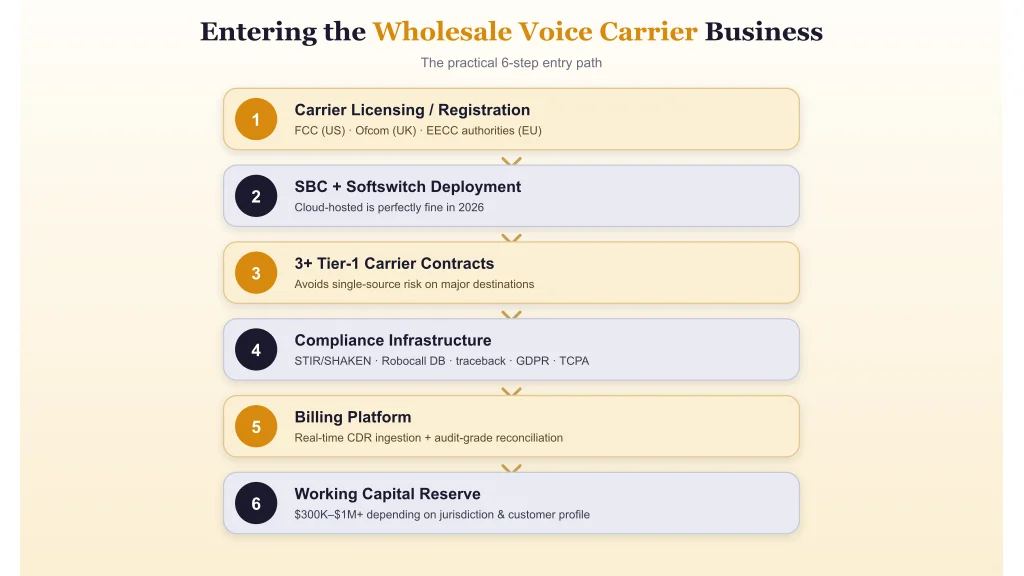
A practical entry path looks like:
Carrier licensing or registration in your operating jurisdiction (FCC in the US, Ofcom in the UK, EECC authorities in the EU)
A primary SBC and softswitch deployment (cloud-hosted is fine in 2026)
At least three upstream tier-1 carrier contracts to avoid single-source risk on every major destination
Billing platform with real-time CDR ingestion and audit-grade reconciliation
$300K-$1M+ in initial working capital depending on jurisdiction and target customer profile
Modern alternative: white-label or partner-program models let resellers operate a carrier-like business on top of an existing wholesale voice carrier's infrastructure without the full capital and licensing burden. Capital requirement drops to under $50K versus $300K-$1M+ for a full build.
The VoIP reseller program model supports this approach with 24-48 hour sandbox onboarding — a viable entry point for operators who want carrier-like capabilities without the full infrastructure build.
The practical 6-step entry path into the wholesale voice carrier business — licensing, SBC/softswitch, tier-1 contracts, compliance, billing platform, and working capital.
US-Specific Compliance for Wholesale Voice Carriers
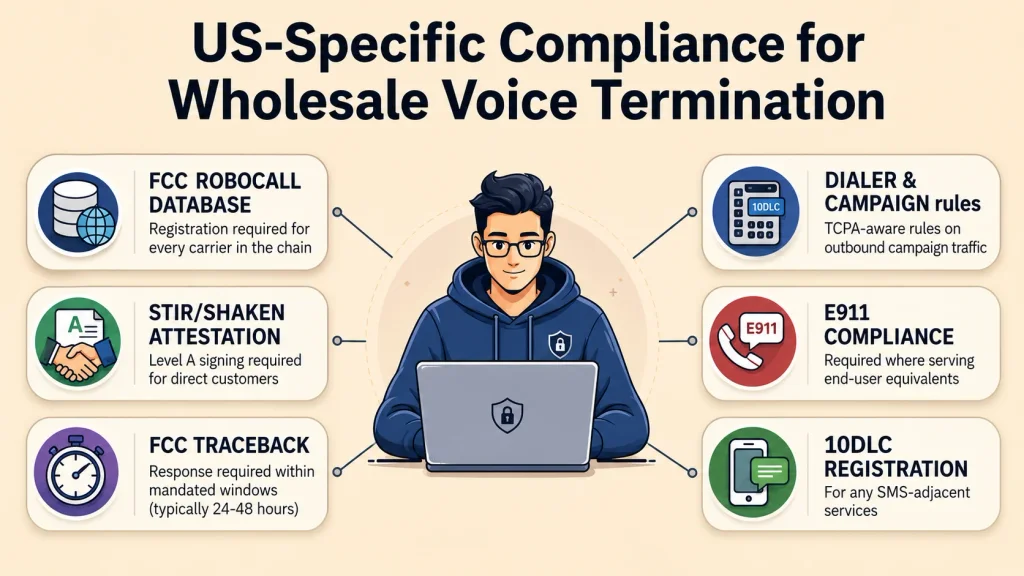
Operating a wholesale voice carrier business with US-bound traffic in 2026 requires non-negotiable compliance infrastructure:
FCC Robocall Mitigation Database registration — disqualifying if missing
STIR/SHAKEN attestation with Level A signing for direct customers
FCC traceback response within mandated windows (typically 24-48 hours)
TCPA-aware dialer rules on outbound campaign traffic
E911 compliance where serving end-user equivalents
10DLC registration for any SMS-adjacent services
Kari's Law / RAY BAUM'S Act for any multi-line telephone systems
The non-negotiable US compliance checklist for wholesale voice carriers in 2026 — FCC Robocall Mitigation DB, STIR/SHAKEN Level A, traceback response, TCPA, E911, 10DLC, and Kari's Law / RAY BAUM'S Act.
The Future of the Wholesale Voice Carrier Business
AI-driven routing, pay-as-you-go billing, and cross-channel stacks are reshaping how new wholesale voice carriers compete against tier-1 incumbents. The carriers that grow fastest in 2026 are the ones that layer AI intelligence on top of carrier-grade voice rather than competing on rate cards alone.
Three forces define the next 24 months: AI workload demand spikes, tightening US STIR/SHAKEN enforcement, and continued tier-1 supply consolidation that makes direct interconnect relationships more valuable than they've been in a decade.
Conclusion
Operating a wholesale voice carrier business in 2026 is an operational discipline more than a technology project. Five pillars — routing intelligence, quality monitoring, compliance attestation, settlement and billing, and carrier relationships — define whether the business scales or stalls. Six departments coordinate around them.
The KPIs that matter aren't revenue and uptime; they're effective ASR per destination, margin per minute, customer churn, CDR reconciliation accuracy, and route diversification. The buyer-side view of these decisions — how to evaluate termination rates and compare wholesale VoIP providers — is covered in the companion guides.
For new entrants, the path bifurcates. A full build still costs $300K-$1M+ and demands FCC registration, three-plus upstream tier-1 contracts, and six months of working capital before the business stabilizes. A white-label partnership cuts that to under $50K and 24-48 hour onboarding.
Choose based on whether you want commercial responsibility for the network or commercial responsibility for the customer relationship — both are valid businesses; they're just different businesses. The voice termination setup guide details the three configuration choices that determine whether the platform you build today survives at 100x the volume.
Frequently Asked Questions
How does a wholesale voice carrier business operate day-to-day?
A wholesale voice carrier operates 24/7 across five operational pillars: routing intelligence, quality monitoring, compliance attestation, settlement and billing, and carrier relationships. NOC engineers monitor route quality continuously, route managers process upstream rate-change notifications, compliance teams handle attestation chains and FCC traceback responses, and settlement teams reconcile CDRs against invoices. Most mid-size carriers run 30-300 staff across six core departments touching every call's path.
What licenses do I need to start a wholesale voice carrier business?
Wholesale voice carrier licensing depends on jurisdiction. In the US, carriers register with the FCC under common-carrier classifications and the Robocall Mitigation Database. The UK requires Ofcom registration. The EU imposes various national authorizations under the European Electronic Communications Code. KYC documentation, traffic-pattern disclosure, and corporate registration are universal requirements. Compliance frameworks like STIR/SHAKEN and GDPR add operational obligations beyond the base license.
How much capital is required to enter the wholesale voice carrier business in 2026?
Entering the wholesale voice carrier business in 2026 typically requires $300K to $1M+ in initial working capital, depending on jurisdiction, target customer profile, and infrastructure choices. Cloud-hosted SBCs and softswitches have dropped infrastructure capex substantially compared to a decade ago. Working capital covers upstream carrier deposits, compliance infrastructure, licensing fees, and 6-12 months of operational runway before customer revenue stabilizes.
White-label partner models can lower this barrier to under $50K.
What are the main KPIs for a wholesale voice carrier business?
Five KPIs define wholesale voice carrier health: effective ASR per destination (ideally above 60% on premium routes), margin per minute (typically tenths of a cent on competitive corridors), customer churn rate (above 6-8% annually signals problems), CDR reconciliation accuracy (within 1-2% of customer CDRs), and route portfolio diversification (three or more upstream partners per top destination).
Carriers that report only revenue and uptime are usually not measuring the operational reality.
Can a small US startup enter the wholesale voice carrier market in 2026?
Yes. Modern AI-native platforms, cloud-hosted SBC infrastructure, and white-label partner programs have lowered capital and operational barriers significantly for US startups. Three viable paths exist: niche regional specialization, white-label on top of an existing US carrier's infrastructure, or AI-overlay platforms that score routes on existing wholesale capacity. Pure-play US tier-1 incumbency remains out of reach for most new entrants.
Run your voice on Ajoxi.
AI receptionists, wholesale routes, virtual numbers — built on one platform with transparent pricing and a 24/7 NOC.