Wholesale Voice Business Model: A Comprehensive Guide
The wholesale voice business model turns bulk voice traffic into recurring revenue. This guide explains how it works, the role of termination, the technology driving it, the benefits, the leading providers, and how to build one of your own.
Wholesale Voice
Wholesale Voice Business Model: A Comprehensive Guide
What Is the Wholesale Voice Business Model?
Strip the wholesale voice business model down to its essence and it is arbitrage: secure voice traffic in bulk at a low rate, then sell it onward — to smaller carriers, VoIP providers, and businesses — at a price that leaves a margin. It is a business-to-business game from start to finish.
Wholesale players move millions of minutes a day, stitching calls together across networks and national borders, yet they almost never touch the person who actually places the call. For a primer on the underlying market, see our overview of wholesale voice.
This is not a passing trend. Aggregating and reselling voice has underpinned global telecom for decades, and in 2026 it is still very much alive, kept buoyant by the relentless growth of international and IP-based calling.
Key takeaways
The math runs on volume — economies of scale are the engine, where more traffic unlocks cheaper per-minute buy rates.
Solid infrastructure — softswitches, interconnects, monitoring, and fraud controls — is what keeps quality up and margins from leaking away.
Disciplined pricing and routing are how raw minutes become profit; the spread between what you pay and what you charge is the business.
The Role of Wholesale Termination
Termination is the spine the whole model hangs on. It is the act of handing calls off to their destination networks, and everything else in the operation exists to make that handoff reliable, profitable, and lawful. A robust voice termination is the foundation everything else builds on.
Redundancy that keeps traffic flowing. Any serious wholesaler holds several routes to every destination, so when one carrier path sags or drops, traffic shifts to another automatically. Multi-carrier design and disaster-recovery planning are what keep the lights on when a single interconnect fails.
Features customers can actually use. Beyond plain connectivity, the providers that win offer APIs, live call detail records, flexible billing, and granular routing controls that let customers steer their own traffic instead of filing a ticket.
Compliance and security as table stakes. Caller-ID authentication such as STIR/SHAKEN for U.S. traffic, data-protection law, and round-the-clock fraud monitoring are not nice-to-haves. They are what stand between the business and a regulatory fine or a flood of fraudulent minutes.
Staying competitive on quality. In a price-sensitive market it is the blend of strong quality of service — measured by ASR, PDD, and MOS — alongside sharp rates that wins new customers and keeps the ones you have.
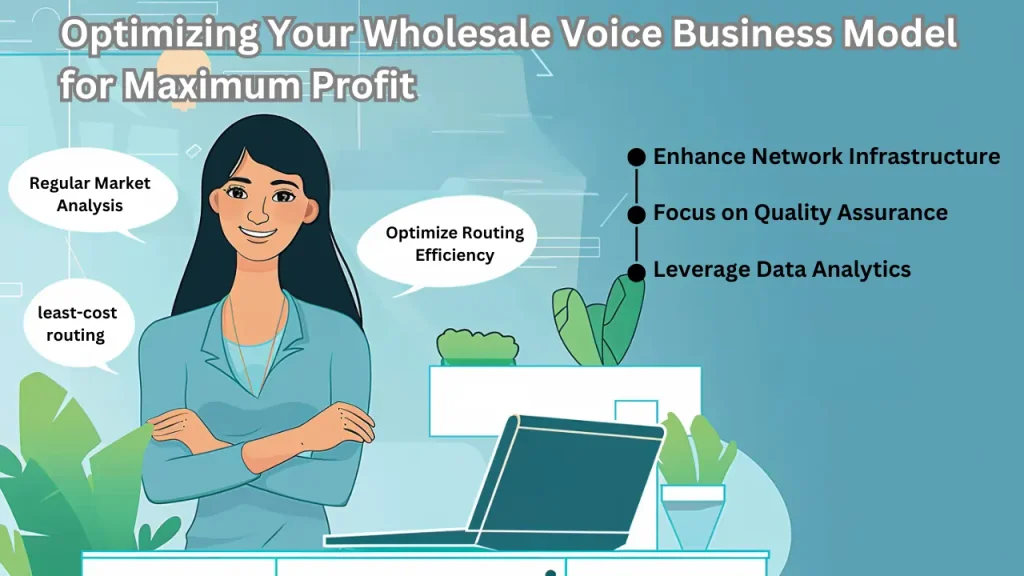
Optimizing for profit — analytics, infrastructure, dynamic pricing, QA, and carrier partnerships.
How the Wholesale Voice Business Model Works
At heart, the model is aggregation followed by resale. The wholesaler starts by buying voice traffic in bulk from Tier-1 carriers — the giants that own direct interconnects across the globe — at rates that only become possible at enormous volume.
From there it sells that capacity on to smaller carriers, VoIP providers, call centers, and businesses that are nowhere near big enough to buy from a Tier-1 operator directly. Because the wholesaler pools demand from many of these buyers, its own purchasing volume stays large enough to keep its buy rates low — the economies of scale that make the entire thing hang together.
Whether it turns a profit comes down to four things done well:
Cost management — sourcing the lowest buy rate that still meets quality, then setting a sell rate that protects the margin.
Quality of service — holding ASR, PDD, and MOS high so customers stay and grow, because poor quality triggers churn and churn drains the volume the whole model depends on.
Scalability — infrastructure that swallows traffic spikes and new destinations without buckling.
Diversification — spreading across many routes, destinations, and customer types so risk is shared and revenue stays smooth.
The Technology Driving the Model
Wholesale voice is, increasingly, as much a software business as a connectivity one.
AI and machine learning now sit behind traffic forecasting, dynamic least-cost routing that reacts to live quality data instead of a static rate table, and fraud detection that catches abnormal patterns — IRSF, Wangiri, SIM-box abuse — before they ever land on a bill.
Blockchain is being trialed for tamper-resistant inter-carrier settlement and number verification, an answer to the disputes over billing and caller-ID trust that have dogged the industry for years.
Automation takes care of provisioning, rate uploads, monitoring, and reconciliation, stripping out manual work so a lean team can run traffic volumes that would once have needed a department.
Benefits of the Wholesale Voice Business Model
Run well, the model pays off for the provider and for everyone downstream of it.
Cost efficiency — bulk buying and scale push per-minute costs far below retail, and that saving cascades down the chain.
Scalability — IP infrastructure flexes on demand with no new physical lines, so growth is quick and light on capital.
Revenue diversification — serving many customer types across many destinations spreads risk and builds several steady income streams instead of one.
Global reach — through carrier interconnects a wholesaler can deliver calls almost anywhere, opening worldwide markets without setting foot in them.
Top Wholesale Voice Providers
The field runs from global Tier-1 carriers through specialist aggregators to nimble newer entrants. What sorts the leaders from the rest is rarely the headline rate — it is the combination of route quality, transparent billing, responsive support, and genuine global coverage.
Ajoxi sits in that top tier, running direct Tier-1 interconnects across a broad footprint with AI-driven route optimization, FAS-free billing, proactive fraud monitoring, and compliance built in for regulated industries. Around Ajoxi, the wider market still includes the major global carriers and the long-established aggregators that have served the wholesale segment for years.
Our guides to wholesale voice services and the wholesale voice carrier business go deeper on how to evaluate them.
When you compare providers, look past the cheapest column on the rate deck. Weigh the quality metrics (ASR, PDD, MOS), how transparent the billing is, which destinations they actually cover on quality routes, how fast their support responds, and the security and compliance posture they bring to the table.
What to look for in a wholesale voice provider — quality, support, and global reach.
How to Build a Wholesale Voice Business
Standing up a profitable wholesale voice operation follows a fairly predictable sequence, and each step builds on the one before it. Report voice fraud to the FTC.
Understand the market
Work out which destinations and customer segments you can serve at a profit. Study the demand, size up the competition, and map the rate spreads on your target routes before you put a dollar of capital at risk.
Invest in infrastructure
Build out the core — softswitches, Session Border Controllers, billing and mediation systems, and monitoring. This is the layer that decides how reliable you are and how much traffic you can carry. A white-label or partner platform can slash the upfront cost of entry dramatically.
Optimize routing and cost
Put least-cost routing in place that weighs price against live quality, and negotiate buy rates with several carriers so you always have a competitive, redundant path to every destination you sell.
Ensure quality of service
Watch ASR, PDD, and MOS continuously and reroute off degraded paths automatically. Quality is what keeps customers, retention is what grows volume, and volume is what drives the margin.
Focus on scalability
Design for growth from the first day — elastic capacity, heavy automation, and a diversified mix of routes and customers — so the business can take on new traffic and new markets without cracking.
Conclusion
The wholesale voice business model has stayed one of telecom's most durable engines for a reason: aggregate bulk traffic, deliver it reliably through quality termination, and pocket the spread between buy and sell rates. Its profitability rides on volume, infrastructure, smart routing, and an unbroken focus on quality and compliance.
The operators pulling ahead in 2026 treat wholesale voice as a technology business — leaning on AI-driven routing, automation, and strong security to keep quality consistent at scale. For anyone weighing an entry, the path is well marked: understand the demand, build or partner for solid infrastructure, optimize the routing, defend the quality, and design for growth from the outset.
FAQ: Wholesale Voice Business Model
What is the wholesale voice business model?
It is a business-to-business model where a provider buys voice traffic in bulk at low rates and resells it — to smaller carriers, VoIP providers, and businesses — at a margin. The profit is the spread between the bulk buy rate and the sell rate, which economies of scale keep wide.
How do wholesale voice providers make money?
They earn on the gap between the discounted bulk rates they pay Tier-1 carriers and the rates they charge their own customers. High volume holds the buy rate down, while strong quality and routing keep customers and traffic growing, which compounds the margin over time.
What is wholesale voice termination?
Wholesale voice termination is the bulk delivery of calls to their destination networks. It is the backbone of the model, supported by redundant routes, advanced routing features, fraud controls, and compliance that together keep delivery reliable and profitable.
How much capital does it take to start a wholesale voice business?
It ranges widely. Building the full stack from scratch can demand substantial capital, whereas a white-label or partner platform can cut the entry cost dramatically by removing the need to build your own softswitches, billing, and interconnects.
What technology powers modern wholesale voice?
AI and machine learning drive traffic forecasting, dynamic least-cost routing, and fraud detection; blockchain is being explored for transparent inter-carrier settlement; and automation handles provisioning, monitoring, and reconciliation so small teams can run very large volumes.
How do I choose a wholesale voice provider?
Compare quality metrics (ASR, PDD, MOS), billing transparency, the destinations covered on quality routes, support responsiveness, and the security and compliance posture. The lowest headline rate rarely yields the lowest effective cost once quality and fraud risk are factored in.
Run your voice on Ajoxi.
AI receptionists, wholesale routes, virtual numbers — built on one platform with transparent pricing and a 24/7 NOC.