Ajoxi
  • 기둥
    클라우드폰

    클라우드 전화, 메시징, 비디오, 팩스, 채팅 — 전체 UCaaS 스택.

    • 가상 전화번호어디서나 시내 및 무료 전화번호
    • 회사 전화통화, SMS, 영상, 원로그인
    • 고객 참여모든 채널, 하나의 스레드
    • 개인용 AI모든 담당자를 위한 AI 조수
    • SMS 및 MMS주요 사업 분야의 텍스트
    • 팀 채팅고객과 연결된 내부 채팅
    • 화상회의AI 메모가 포함된 회의실 + 요약
    • 온라인 팩스팩스기 없이 팩스 보내기
    • 웹사이트 챗봇주문 상태 및 반품 자동 해결
    • 전화 시스템AI가 내장된 최신 PBX
    추천
    모든 것이 포함되어 있습니다.
    클라우드 전화, AI 컨택센터, AI 접수원, SMS, 비디오, 300개 이상의 통합.
    요금제 및 가격 보기
  • 핵심 역량
    • AI 접수원연중무휴 1차 답변 · 32개 언어
    • AI 감정화가 난 발신자를 자동으로 라우팅합니다.
    • AI 에이전트 지원속삭임 스크립트 + 차선책
    • 대화지능성적표, 감정, 이의제기
    • 통화녹음완전한 충실도 + 키워드 검색
    • 자동 교환드래그 앤 드롭 시각적 IVR 빌더
    • 감독자 도구듣기 · 속삭임 · 바지선 · 감사 로그
    • 무료 전화번호800, 888, 877 — 빠르게 프로비저닝됨
    새로운
    AI 감정·실시간 채점.
    기분이 나빠지는 순간 화가 난 고객을 선임 상담원에게 연결합니다. 모든 유료 플랜에서.
    AI 감정 보기
  • 산업별 및 팀별
    • 재원SOC 2 · FINRA 지원 감사 추적
    • 소매옴니채널 + 장바구니 복구 SMS
    • SaaSAPI + 모든 좌석의 개인 AI
    • 기호 논리학다중 사이트 파견 라우팅
    • 영업팀파워 다이얼러 + 라이브 AI 코칭
    • 지원팀8개 채널에 걸친 공유 메모리
    • 원격 팀모든 기기에서 동일한 번호
    • 중소기업AI 접수원을 프런트 데스크로 활용
    • 엔터프라이즈 ITSSO, SCIM, 다중 사이트 거버넌스
    가장 많이 채택됨
    호출 스택 규정 준수가 신뢰됩니다.
    통화 녹음, STIR/SHAKEN, 감정 라우팅. SOC 2, PCI 및 FINRA 지원 감사 추적.
    금융 보기
  • 기본 동기화
    • 허브스팟양방향 동기화 · 수명 주기 트리거
    • 조호CRM · 책상 · 책 · Bigin
    곧 출시 예정
    세일즈포스. 파이프드라이브. 신선판매.
    2026년 3분기에 세 가지 기본 양방향 동기화가 모두 이루어졌습니다. 출시에 대해 미리 알고 싶으십니까?
    출시 시 이메일을 보내주세요
  • 가격
  • 배우다
    • 블로그엔지니어링 및 제품 노트
    • 고객 스토리실제 결과, 실수
    • 가이드단계별 플레이북
    • 웨비나매주 목요일 생방송 · 주문형
    • 문의하기영업팀에 문의하거나 지원 받기
    짓다
    • 문서모든 작동 방식
    • API 참조REST + 웹훅
    • SDK노드, 파이썬, Go, 루비
    • 변경 내역모든 선박이 한 곳에서
    신뢰하다
    • 상태 페이지실시간 가동 시간 + 사고
    • 보안 + 규정 준수SOC 2 · GDPR · PCI
    • 은둔수집하는 항목 및 이유
    • 자귀계약서(챕터)
    신선한 잉크
    8,400건의 통화가 측정되었습니다.
    언어, 억양, 통화 유형별 AI 접수원의 정확성 — 편집되지 않은 숫자입니다.
    게시물 읽기
  • English flag영어
  • Español flag스페인어
  • Français flag프랑세즈
  • Deutsch flag독일어
  • Italiano flag이탈리아노
  • Português flag포르투갈어
  • Nederlands flag네덜란드
  • Русский flag러시아인
  • Polski flag폴스키
  • Türkçe flag터키어
  • العربية flag아랍어
  • हिन्दी flag힌두교
  • 简体中文 flag简体中文
  • 日本語 flag일본어
  • 한국어 flag한국어
  • Tiếng Việt flag티엥 비엣
  • Bahasa Indonesia flag인도네시아 바하사
  • ไทย flagไท้
  • Svenska flag스벤스카
  • Українська flag모스크바
로그인평가판 시작
클라우드폰
가상 전화번호어디서나 시내 및 무료 전화번호회사 전화통화, SMS, 영상, 원로그인고객 참여모든 채널, 하나의 스레드개인용 AI모든 담당자를 위한 AI 조수SMS 및 MMS주요 사업 분야의 텍스트팀 채팅고객과 연결된 내부 채팅화상회의AI 메모가 포함된 회의실 + 요약온라인 팩스팩스기 없이 팩스 보내기웹사이트 챗봇주문 상태 및 반품 자동 해결전화 시스템AI가 내장된 최신 PBX
컨택센터
옴니채널모든 채널에 하나의 대기열아웃바운드 다이얼러예측, 능력, 미리보기상담원 지원실시간 속삭임 코칭감독자 지원실시간으로 나쁜 전화를 찾아보세요상호작용 분석자동 QA, 주제 동향기업500개 이상의 좌석 운영
AI 가족
아족시 목소리약속을 잡는 AI 접수원AI 어시스턴트초안, 요약, 후속 조치대화 AI모든 통화를 읽어서 하나도 놓치지 마세요
AI 접수원연중무휴 1차 답변 · 32개 언어AI 감정화가 난 발신자를 자동으로 라우팅합니다.AI 에이전트 지원속삭임 스크립트 + 차선책대화지능성적표, 감정, 이의제기통화녹음완전한 충실도 + 키워드 검색자동 교환드래그 앤 드롭 시각적 IVR 빌더감독자 도구듣기 · 속삭임 · 바지선 · 감사 로그무료 전화번호800, 888, 877 — 빠르게 프로비저닝됨
재원SOC 2 · FINRA 지원 감사 추적소매옴니채널 + 장바구니 복구 SMSSaaSAPI + 모든 좌석의 개인 AI기호 논리학다중 사이트 파견 라우팅영업팀파워 다이얼러 + 라이브 AI 코칭지원팀8개 채널에 걸친 공유 메모리원격 팀모든 기기에서 동일한 번호중소기업AI 접수원을 프런트 데스크로 활용엔터프라이즈 ITSSO, SCIM, 다중 사이트 거버넌스
허브스팟양방향 동기화 · 수명 주기 트리거조호CRM · 책상 · 책 · Bigin
배우다
블로그엔지니어링 및 제품 노트고객 스토리실제 결과, 실수가이드단계별 플레이북웨비나매주 목요일 생방송 · 주문형문의하기영업팀에 문의하거나 지원 받기
짓다
문서모든 작동 방식API 참조REST + 웹훅SDK노드, 파이썬, Go, 루비변경 내역모든 선박이 한 곳에서
신뢰하다
상태 페이지실시간 가동 시간 + 사고보안 + 규정 준수SOC 2 · GDPR · PCI은둔수집하는 항목 및 이유자귀계약서(챕터)
  • English flag영어
  • Español flag스페인어
  • Français flag프랑세즈
  • Deutsch flag독일어
  • Italiano flag이탈리아노
  • Português flag포르투갈어
  • Nederlands flag네덜란드
  • Русский flag러시아인
  • Polski flag폴스키
  • Türkçe flag터키어
  • العربية flag아랍어
  • हिन्दी flag힌두교
  • 简体中文 flag简体中文
  • 日本語 flag일본어
  • 한국어 flag한국어
  • Tiếng Việt flag티엥 비엣
  • Bahasa Indonesia flag인도네시아 바하사
  • ไทย flagไท้
  • Svenska flag스벤스카
  • Українська flag모스크바
로그인평가판 시작
Ajoxi

하나의 통신업체 수준 네트워크에 클라우드 전화 및 AI 컨택 센터가 있습니다.

SOC 2GDPRPCI-DSS

스위트 C, 7층, 월드 트러스트 타워,
50 스탠리 스트리트, 센트럴,
홍콩

info@ajoxi.com+1 (512) 612-4425

클라우드폰

  • 회사 전화
  • 고객 참여
  • SMS 및 MMS
  • 팀 채팅
  • 화상회의
  • 전화 시스템

컨택센터

  • 옴니채널
  • 아웃바운드 다이얼러
  • 상담원 지원
  • 상호작용 분석
  • 엔터프라이즈 CCaaS

일체 포함

  • AI 플랫폼
  • AI 접수원
  • AI 어시스턴트
  • 대화형 AI
  • AI 감정
  • 대화지능

솔루션

  • 재원
  • 소매 및 전자상거래
  • SaaS 및 기술
  • 영업팀
  • 중소기업

리셀러

  • 도매 VoIP
  • 도매 음성
  • SIP 트렁킹
  • CLI 경로

회사

  • 가격
  • 에 대한
  • 고객
  • 문의하기
  • 국가 코드
  • 지역번호
  • 문서
  • 상태
  • 보안

© 2026 아족시. 모든 권리 보유.

모든 시스템 정상
  • 은둔
  • 자귀
  • 사이트맵
블로그/도매 VoIP/Wholesale VoIP Termination Providers: How to Choose the Right Partner

Wholesale VoIP Termination Providers: How to Choose the Right Partner

Not all wholesale VoIP termination providers are equal. The 2026 buyer's guide to coverage, tier-1 vs gray-market routes, quality metrics, fraud protection, compliance, and SLAs — written for resellers and carriers who need infrastructure that protects their brand.

도매 VoIP

Wholesale VoIP Termination Providers: How to Choose the Right Partner

Wholesale VoIP Termination Providers: How to Choose the Right Partner
Table of Contents
  • 1.Introduction
  • 2.What termination providers do
  • 3.Tier-1 vs Tier-2 vs Tier-3
  • 4.Six evaluation criteria
  • 5.What resellers need specifically
  • 6.Evaluation process
  • 7.Conclusion
  • 8.Frequently asked questions

Introduction

When a call drops, the caller blames the brand on their screen — not the wholesale carrier three layers below. That single fact makes provider selection the most consequential infrastructure decision in any voice-dependent business. The wrong wholesale VoIP termination provider doesn't just cost you margin. It costs you customer relationships.

Wholesale VoIP termination providers are carriers and aggregators that route high-volume voice calls from an IP network to their final destination — a mobile handset, landline, or PSTN endpoint — on behalf of resellers, enterprises, and service providers.

Unlike retail VoIP, which serves end users directly, wholesale termination operates at the infrastructure layer: providers manage carrier interconnects, route optimization, fraud detection, and compliance so their customers don't have to build that infrastructure themselves.

What Does a Wholesale VoIP Termination Provider Actually Do?

The term "termination" describes the last leg of a call's journey. Your call originates on an IP network. At some point it must cross into a traditional phone network — the PSTN — to reach the recipient. The wholesale VoIP termination provider manages that crossing.

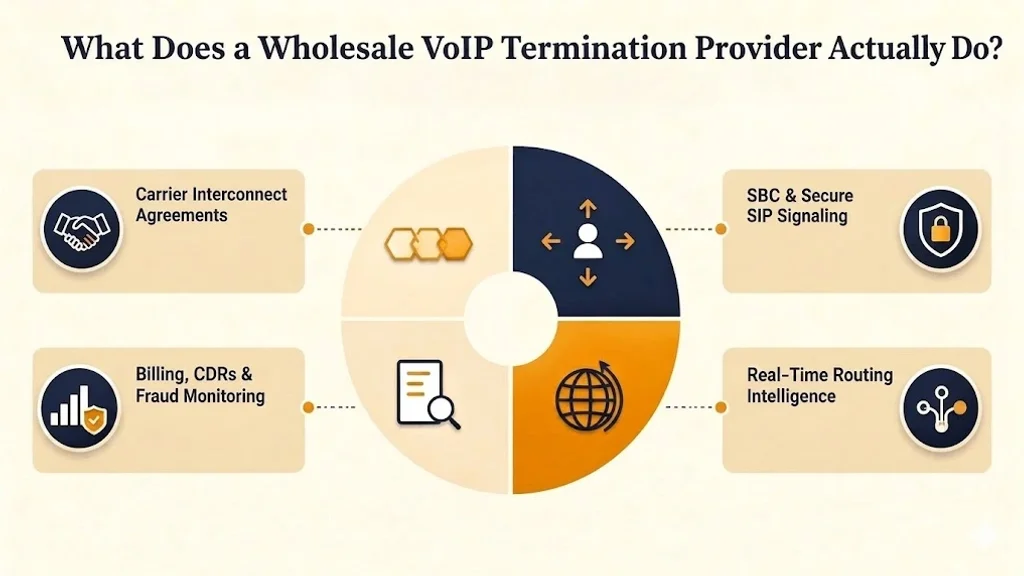
Specifically, a provider handles: carrier interconnect agreements with national and regional operators worldwide, session border control (SBC) for secure SIP signaling, real-time routing decisions across hundreds of possible paths for each call, billing and CDR generation, and fraud monitoring to catch toll fraud before it hits your account.

What they don't do: serve your end users directly, provide your softphone or UCaaS interface, or manage your customer relationships. The provider is invisible to the caller. Which is exactly the problem when they fail.

The platform handles every layer of this infrastructure — carrier agreements, routing intelligence, security, and compliance — across 243 territories, so resellers and enterprises connect a single SIP trunk and access global reach without building the underlying network. Explore wholesale VoIP providers compared side by side for a broader view of the market.

Four-quadrant diagram of what a wholesale VoIP termination provider does: carrier interconnect agreements, SBC and secure SIP signaling, real-time routing intelligence, and billing, CDRs and fraud monitoring
The four core duties of a wholesale VoIP termination provider — carrier interconnects, SBC/SIP security, real-time routing, and billing/fraud monitoring — all running in the background.

Tier-1 vs. Tier-2 vs. Tier-3: Why the Carrier Layer Matters

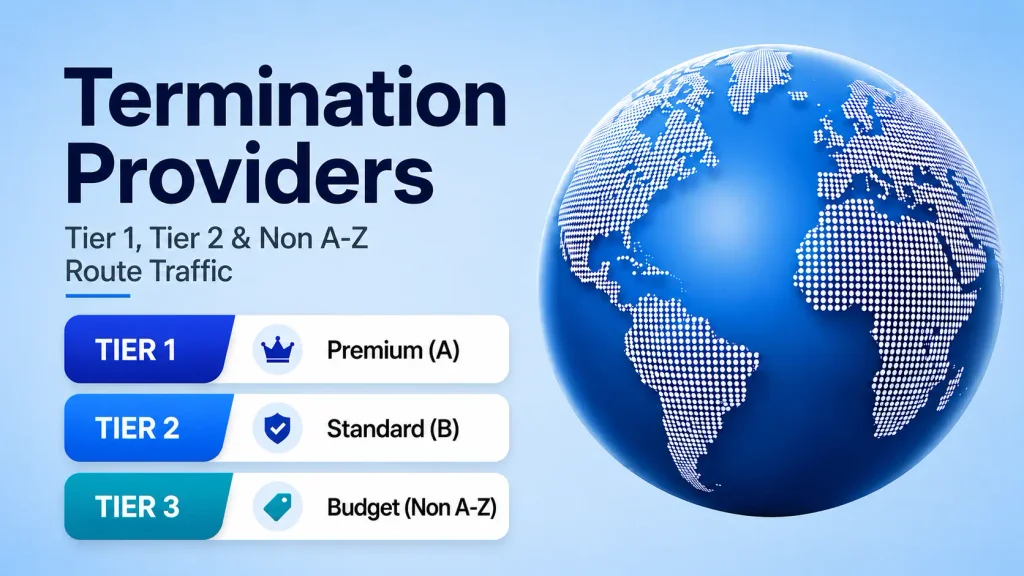
Not all wholesale VoIP termination providers sit at the same level of the carrier stack. Understanding where your provider operates directly predicts route quality, pricing, and risk.

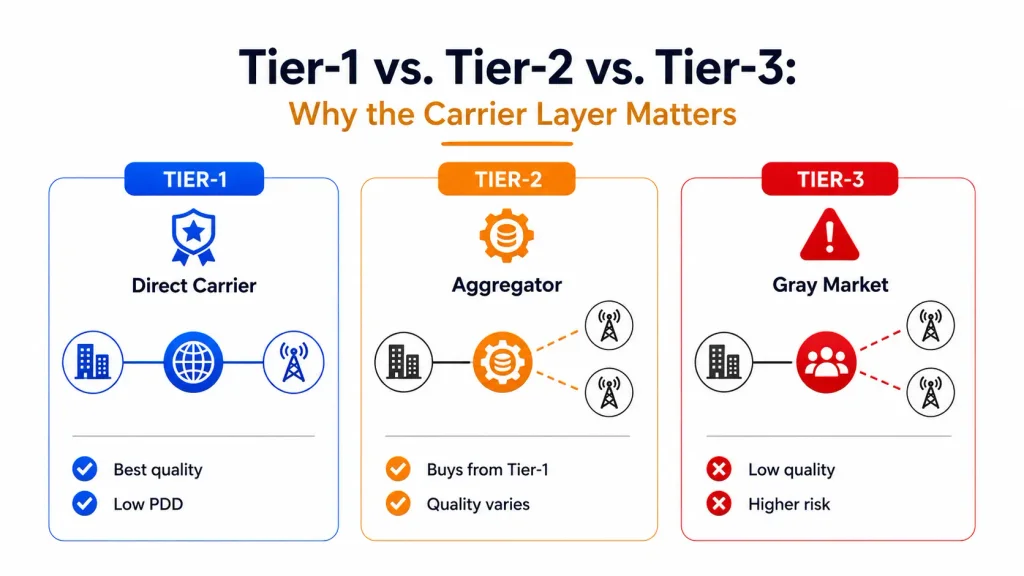
Tier-1 carriers hold direct peering agreements with national PSTN operators and mobile networks. They own the interconnects. No intermediary. Tier-1 routes produce the highest ASR, lowest PDD, and cleanest CLI. They cost more per minute than gray-market alternatives — and they're worth it.

Tier-2 aggregators buy capacity from Tier-1 carriers and resell it with a margin. Route quality depends entirely on which Tier-1s they're buying from and how they manage traffic during congestion. Some Tier-2 providers are excellent. Others route through whichever carrier bids lowest in real time — which means quality inconsistency.

Tier-3 and gray-market routes exist below the aggregator layer. Per-minute rates look attractive. FAS billing is common. CLI spoofing is a fraud risk. STIR/SHAKEN attestation is rare. Businesses that chase the lowest nominal rate through Tier-3 routes consistently report higher effective cost per connected minute once failed calls, billing disputes, and compliance incidents are factored in.

Ajoxi operates at the tier-1 level with direct interconnects across its 243-territory network — meaning routes don't pass through aggregators whose quality control is opaque. The 99.99% uptime SLA reflects the infrastructure redundancy that tier-1 positioning enables.

Tier-1 vs Tier-2 vs Tier-3 carrier comparison: Tier-1 owns direct PSTN peering, Tier-2 aggregators buy from Tier-1 and resell, Tier-3 gray-market routes carry higher risk
Tier-1 (direct PSTN peering) → Tier-2 (aggregators reselling Tier-1) → Tier-3 (gray-market, below the aggregator layer). Where your provider sits predicts quality, price, and risk.

6 Criteria That Separate Quality Providers from Risky Ones

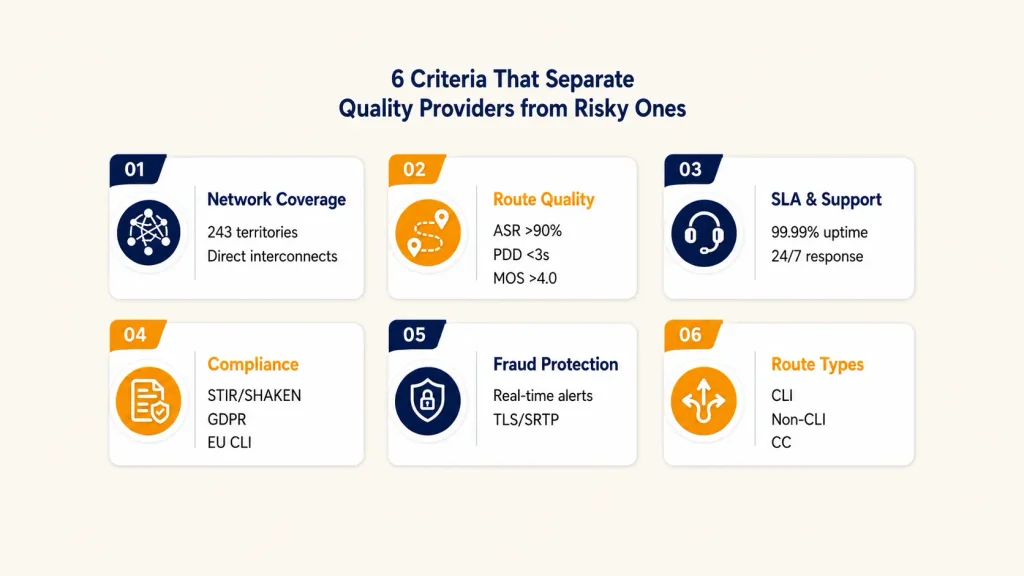
Evaluating wholesale VoIP termination providers on price alone produces predictably bad outcomes. Here are the six criteria that actually determine whether a provider is a reliable long-term partner.

1. Network Coverage — Real Coverage, Not Claims

A rate deck listing 190 countries means nothing if your top-10 destination countries are routed through subpar interconnects. Before committing, request destination-specific ASR data for the corridors that represent 80% of your traffic volume. A provider confident in their network shares this without hesitation. One that deflects to network-average statistics is hiding something.

Ajoxi covers 243 territories through voice termination infrastructure with direct interconnects — not re-routed gray traffic. For resellers whose customers call across Latin America, South Asia, and Sub-Saharan Africa, this depth of real coverage (not claimed coverage) is the differentiator.

2. Route Quality Metrics — ASR, PDD, NER, and MOS

Four numbers define whether a route is actually usable:

MetricWhat It MeasuresBenchmark
ASR (Answer-Seizure Ratio)% of call attempts that connect>90% for premium CLI
PDD (Post-Dial Delay)Seconds from dial to ringback<3 seconds
NER (Network Effectiveness Ratio)Technical performance excluding user-end failures>95%
MOS (Mean Opinion Score)Perceived voice clarity (1–5 scale)>4.0

Any provider worth evaluating should share these figures per destination, not as a single network average. Low ACD (Average Call Duration) alongside low ASR is a double red flag — it suggests callers are hanging up because the connection is poor even when it does connect.

3. Route Type Completeness — CLI, Non-CLI, and CC Under One Account

Premium CLI routes guarantee caller ID delivery, produce higher answer rates, and satisfy compliance requirements in markets like the EU where CLI manipulation carries penalties. Non-CLI routes cost 20–40% less and suit bulk outbound traffic where caller ID isn't required. CC (calling card) routes are engineered for low-ACD traffic patterns common in calling card operations and BPOs.

A provider that covers all three route types under a single account eliminates the operational overhead of managing multiple carrier relationships.

4. Fraud Protection and Security Architecture

Toll fraud is a multi-billion dollar problem in wholesale voice. International Revenue Share Fraud (IRSF), Wangiri, and SIM-box fraud all target wholesale termination infrastructure. A provider's fraud architecture matters more than their stated policy.

Specifically, look for: real-time CDR monitoring with automated threshold alerts, SIP-level fraud detection that blocks abnormal call patterns before they complete, STIR/SHAKEN attestation for US-bound traffic, and TLS/SRTP encryption for SIP signaling and media transport. A provider who responds to a fraud incident after the fact — rather than preventing it — is exposing your business to liability and billing disputes.

5. Compliance Coverage — STIR/SHAKEN, GDPR, and Regional Requirements

Regulatory requirements for voice termination have tightened materially since 2024. STIR/SHAKEN is mandatory for US traffic. The EU has introduced CLI authentication requirements in multiple member states, with Belgium, France, and Germany among those implementing specific blocking rules for non-compliant international traffic. Brazil's Resolution No. 777 (April 2025) added new anti-fraud requirements for international termination.

A provider who isn't tracking these changes in real time is routing traffic that may be blocked or flagged without warning. For healthcare, finance, and insurance businesses where compliance isn't optional, provider compliance posture is non-negotiable.

6. SLA Commitments and Support Responsiveness

An SLA that guarantees 99.99% uptime is meaningful only if the provider enforces it with real remedies for downtime. Read the SLA before signing — specifically the definitions of "outage," the notification windows, and the credit structure for breach.

Support responsiveness during an actual incident matters more than the availability claim. A provider with 24/7 support that takes four hours to respond during a routing failure is effectively providing no support when you need it. Ask specific questions during evaluation: What is your average response time for P1 incidents? Do you provide a dedicated account contact for wholesale customers?

What is your incident communication protocol?

Six-criteria wheel for choosing a wholesale VoIP termination provider: network coverage, route quality metrics, route type access, fraud protection, compliance coverage, and SLA and support
The six criteria that separate quality wholesale VoIP providers from risky ones — coverage, route quality, route types, fraud protection, compliance, and SLA/support.

What Wholesale VoIP Termination Providers Do for Resellers Specifically

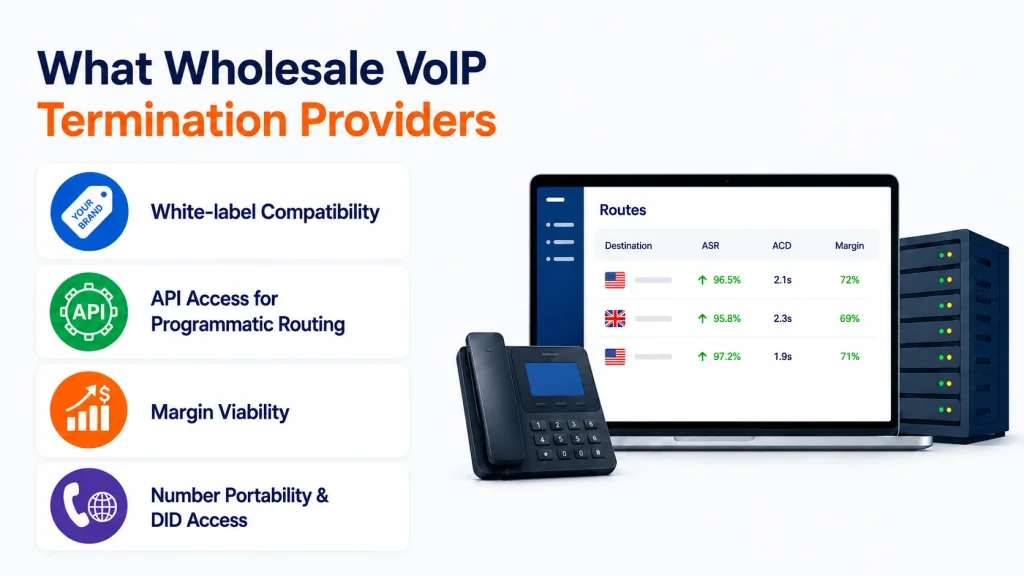
Resellers buying termination wholesale and selling retail don't just need quality routes. They need infrastructure that supports a reseller business model. Several capabilities matter specifically to this buyer:

White-label compatibility. Can you present routes to your customers under your own brand, with your own rate deck? A provider who requires their branding in your customer-facing tooling limits your positioning.

API access for programmatic routing. Resellers building platforms or integrating with CRMs and dialers need API-level access to route control, CDR retrieval, and account management. Ajoxi's SIP trunking infrastructure supports standard SIP integration compatible with Asterisk, FreePBX, 3CX, and similar platforms.

Margin viability. Wholesale termination margins for resellers can reach 70% when route quality supports premium retail pricing. That margin disappears if poor route quality produces customer churn or billing disputes. The combination of tier-1 routes, FAS-free billing, and transparent CDRs is what protects reseller margin long-term.

Number portability and DID access. Resellers often need to pair termination with inbound DID numbers. A provider who supplies both — like Ajoxi, with virtual and local numbers across 120+ countries — eliminates a second vendor relationship and simplifies provisioning for end customers. Understanding termination rates across destinations is equally critical to protecting reseller margins.

What resellers need from a wholesale provider: white-label readiness, API and SIP integration, margins up to 70%, and DID plus termination from one vendor
Four capabilities that separate reseller-ready wholesale infrastructure from generic termination — white-label, API/SIP integration, margin viability, and DID + termination from one vendor.

The Provider Evaluation Process: A Practical Sequence

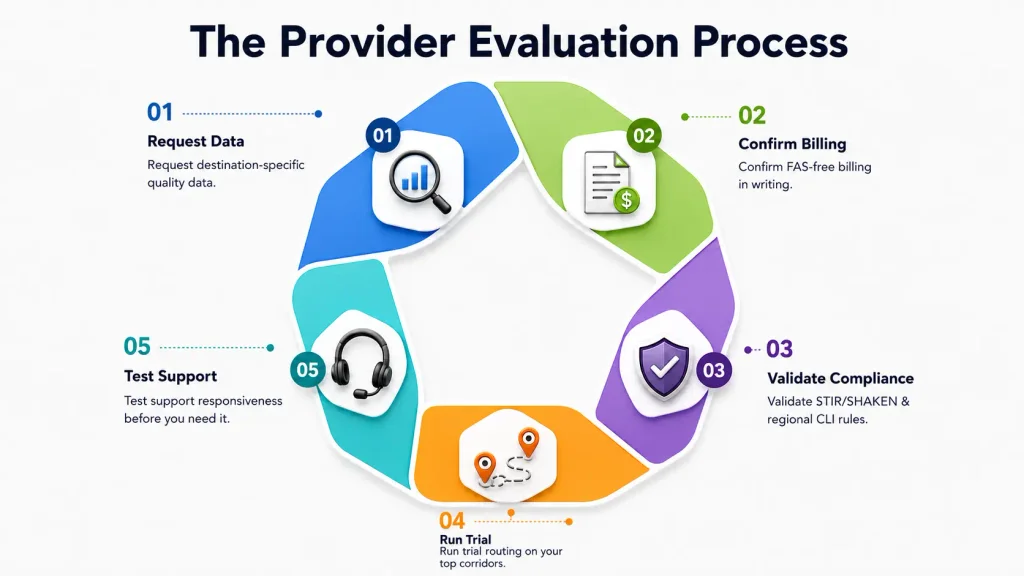
Don't evaluate providers on paper alone. Follow this sequence before committing production traffic:

Step 1 — Request destination-specific quality data. ASR, PDD, NER, and MOS per route, not network averages. Any provider who can't or won't provide this fails the first filter.

Step 2 — Confirm FAS-free billing in writing. FAS billing can inflate your actual cost by 15–30% above the nominal rate. Confirm FAS-free status in the contract, not just in sales conversation.

Step 3 — Validate STIR/SHAKEN and compliance posture. For US traffic, confirm attestation level (A, B, or C). For European traffic, ask specifically about Belgium, France, and Germany CLI requirements.

Step 4 — Run trial routing on your actual top corridors. A 2–4 week trial with CDR access lets you validate ASR, PDD, and ACD on real traffic — not synthetic test calls. Providers confident in their network offer this without requiring a volume commitment first.

Step 5 — Test support responsiveness before you need it. Submit a technical question during the trial period and time the response. If the pre-sales support is slow, the incident support will be slower.

The platform offers trial routing with full CDR transparency — so quality is validated on real traffic before any commitment. Buyers evaluating route options can also review wholesale VoIP minutes provider criteria for context on how minute-level billing decisions affect total cost.

The provider evaluation process in five steps: request destination-specific quality data, confirm FAS-free billing in writing, validate STIR/SHAKEN and regional CLI rules, run trial routing on your top corridors, and test support responsiveness
A practical 5-step sequence to run before committing production traffic — data, billing, compliance, trial, and support.

Conclusion

The wholesale VoIP termination provider you choose ends up wearing your brand's reputation on every call. Tier-1 carriers earn the premium they charge through real coverage, route-quality transparency, fraud protection, compliance posture, and SLA enforcement that actually pays out when downtime happens.

The six criteria — coverage, ASR/PDD/NER/MOS metrics, route-type completeness, fraud architecture, regulatory coverage, and support responsiveness — separate partners that scale your business from carriers that quietly cost you customers. Run the evaluation sequence honestly: destination-specific quality data, FAS-free billing in writing, STIR/SHAKEN validation, 2–4 week trial routing on real corridors, and a real support test before you commit volume.

For businesses building a reseller operation, understanding wholesale voice services and the wholesale voice carrier business model gives essential context before choosing a termination partner. The carriers willing to be measured are the ones worth signing.

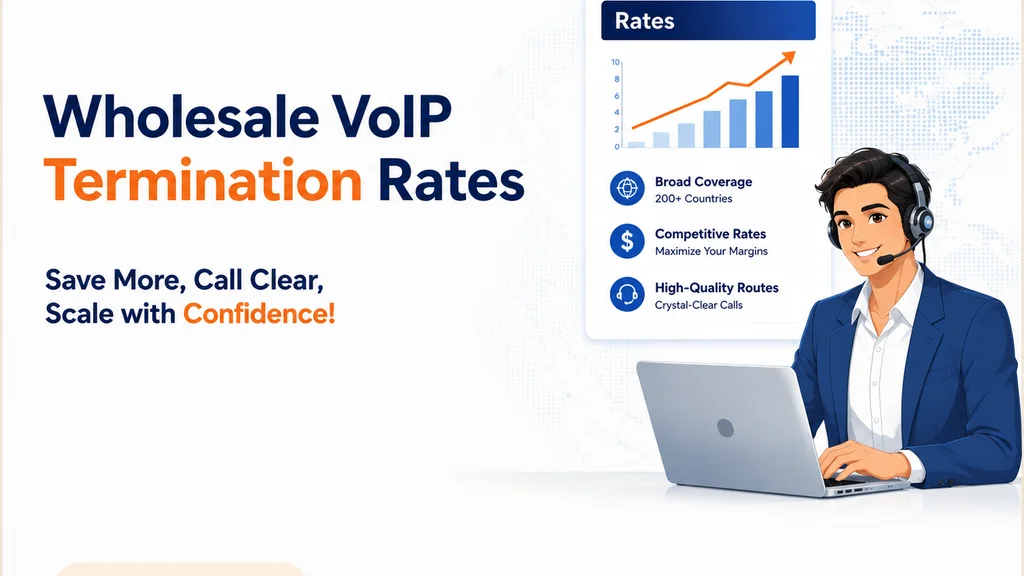
Wholesale VoIP Termination Rates: What Your Rate Card Isn't Telling You

The gap between rate-card pricing and effective cost — billing increments, ASR, ACD, PDD, FAS, and regulatory layers that move your real per-connected-minute price.

Read the article

FAQ: Wholesale VoIP Termination Providers

What is a wholesale VoIP termination provider?

A wholesale VoIP termination provider is a carrier or aggregator that routes high-volume voice calls from an IP network to their final destination on the PSTN or mobile networks. They provide the carrier interconnects, routing infrastructure, fraud protection, and compliance coverage that resellers, enterprises, and other service providers use to deliver voice services without building that infrastructure themselves.

What is the difference between a Tier-1 and Tier-2 wholesale VoIP termination provider?

Tier-1 providers hold direct peering agreements with national PSTN and mobile operators, giving them the lowest-cost, highest-quality route access without intermediaries. Tier-2 aggregators buy capacity from Tier-1 carriers and resell it with a margin — quality depends on their sourcing discipline. Tier-1 routes produce higher ASR, lower PDD, and more consistent MOS.

What quality metrics should I check when evaluating a wholesale VoIP termination provider?

The four essential metrics are ASR (Answer-Seizure Ratio — target above 90%), PDD (Post-Dial Delay — under 3 seconds), NER (Network Effectiveness Ratio — above 95%), and MOS (Mean Opinion Score — above 4.0). Request these per destination, not as a network average. Also confirm ACD (Average Call Duration) is healthy for your traffic type.

How does fraud protection work with wholesale VoIP termination providers?

Quality providers implement real-time CDR monitoring, automated threshold alerts for abnormal calling patterns, and SIP-level blocking before fraudulent calls complete. STIR/SHAKEN attestation for US traffic prevents spoofed caller ID. TLS/SRTP encryption protects SIP signaling and voice media. Providers who detect fraud after invoice generation rather than preventing it in real time are not protecting your business.

What is FAS billing and how do I avoid it?

FAS (False Answer Supervision) is a billing practice where a carrier marks a call as answered — and starts billing — before the destination actually picks up. On high-volume traffic, FAS can add 15–30% to your effective cost above the nominal per-minute rate. Avoid it by confirming FAS-free billing in writing as a contract term. All Ajoxi routes are FAS-free.

Run your voice on Ajoxi.

AI receptionists, wholesale routes, virtual numbers — built on one platform with transparent pricing and a 24/7 NOC.

See pricing Talk to us
Keep Reading

Related reading

Hand-picked next reads from the Ajoxi blog.

Wholesale VoIP Termination Rates: What Your Rate Card Isn't Telling You
도매 VoIP

Wholesale VoIP Termination Rates: What Your Rate Card Isn't Telling You

The gap between rate-card pricing and effective cost — billing increments, ASR, ACD, PDD, FAS, and regulatory layers that move your real per-connected-minute price.

Read article
Best Wholesale VoIP Providers in 2026: A Practical Comparison
도매 VoIP

Best Wholesale VoIP Providers in 2026: A Practical Comparison

Seven wholesale VoIP providers compared side-by-side — what they're built for, where they shine, where they fall short. For resellers, MVNOs, BPOs, and carriers running real traffic.

Read article
Wholesale SIP Trunking Explained: Channels, Minutes & Margin
도매 VoIP

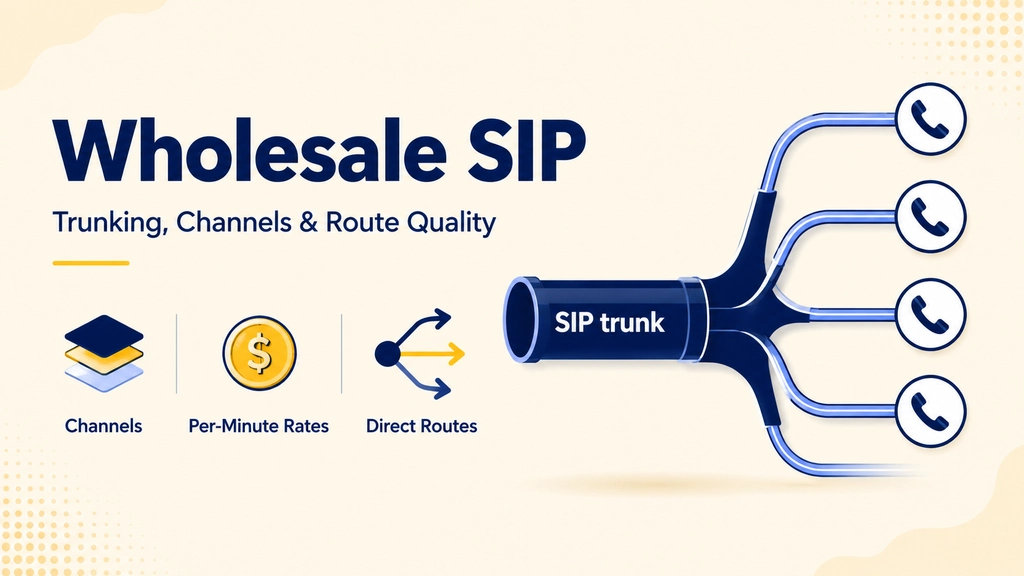
Wholesale SIP Trunking Explained: Channels, Minutes & Margin

How wholesale SIP trunking differs from retail, how channels and per-minute rates are actually priced, and the route-quality metrics — ASR, PDD, MOS — that matter more than the rate card.

Read article