Wholesale VoIP Termination Rates: What Your Rate Card Isn't Telling You
The gap between rate-card pricing and effective cost — billing increments, ASR, ACD, PDD, FAS, and regulatory layers that move your real per-connected-minute price.
Wholesale bandwidth is network capacity bought in bulk rather than per user. For voice, it decides how many concurrent calls your network can carry. This guide covers how to size it, what codecs cost you, and how it connects to wholesale VoIP termination.
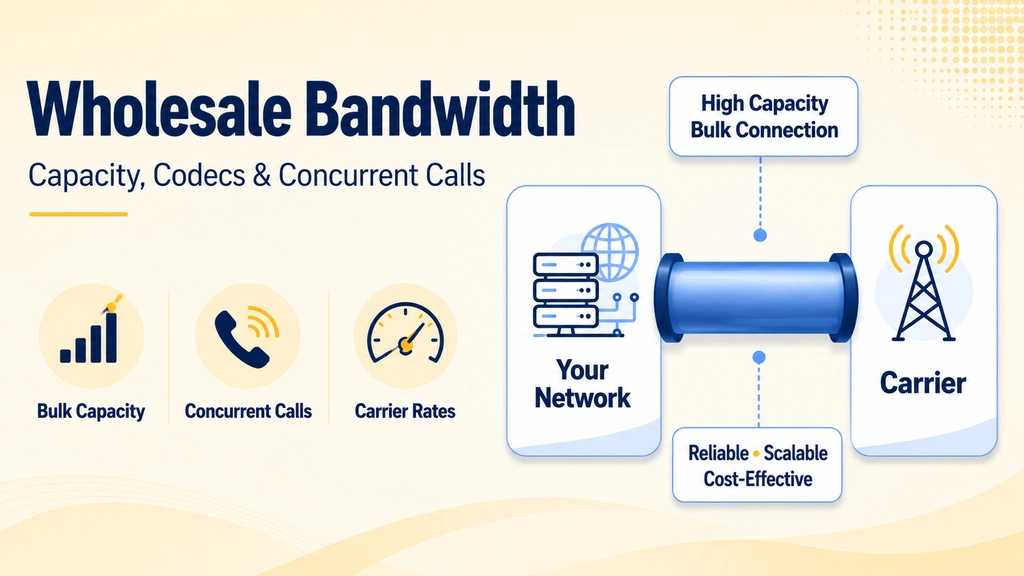
Wholesale bandwidth is network capacity purchased in bulk, at carrier rates, rather than per seat or per user. Carriers, resellers, and high-volume enterprises buy it the same way they buy voice minutes: in volume, on commercial terms, with quality guarantees attached.
For anyone running voice traffic, bandwidth is not an abstract number. It sets a hard ceiling on how many concurrent calls your network can carry before quality degrades. Undersize it and calls break up during your busiest hour.
In retail terms, bandwidth is what an office buys from an ISP — a fixed monthly line, priced per connection. Wholesale is different. Capacity is sold in bulk at carrier rates, usually with a committed minimum and burstable headroom above it.
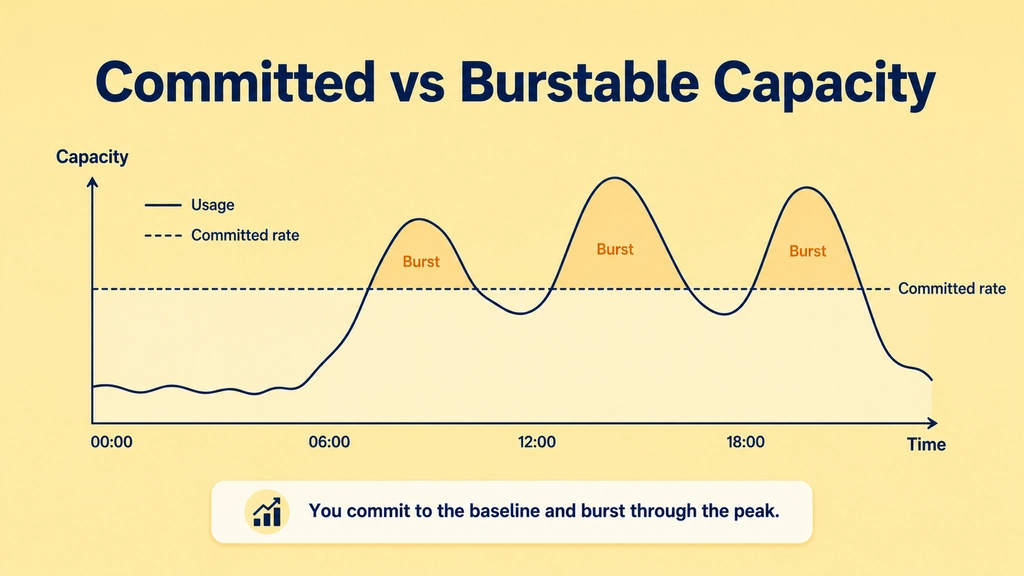
Most wholesale contracts separate two things. The committed rate is the capacity you pay for every month regardless of use. Burstable capacity sits above it, letting you exceed the commit during peaks and pay for the overage.
This structure suits voice well, because call volume is rarely flat. A contact centre may sit at 30% of capacity overnight and hit 100% at 10am. You commit to the baseline and burst through the peak.
Carriers commonly bill on the 95th percentile rather than peak usage. Samples are taken across the month, the top 5% are discarded, and you pay on what remains. It means short spikes do not define your bill.
This is where capacity planning becomes concrete. A voice call consumes far less bandwidth than video or data, but it is unforgiving about consistency. The codec you run decides the number.
| Codec | Payload | Approx. with IP overhead | Typical use |
|---|---|---|---|
| G.711 | 64 kbps | ~87 kbps | Best quality, domestic routes, ample capacity |
| G.722 | 64 kbps | ~87 kbps | HD voice, wideband audio |
| G.729 | 8 kbps | ~31 kbps | Constrained links, international, high density |
The overhead matters. Raw payload figures understate real consumption, because every packet carries IP, UDP, and RTP headers on top of the audio itself. Plan against the overhead figure, not the payload.
The arithmetic is simple. On G.711 at roughly 87 kbps per call, 100 concurrent calls need about 8.7 Mbps in each direction. The same 100 calls on G.729 need closer to 3.1 Mbps.
That difference is why codec choice is a commercial decision, not just a technical one. Denser codecs let you carry far more traffic over the same committed capacity, at some cost to audio quality.
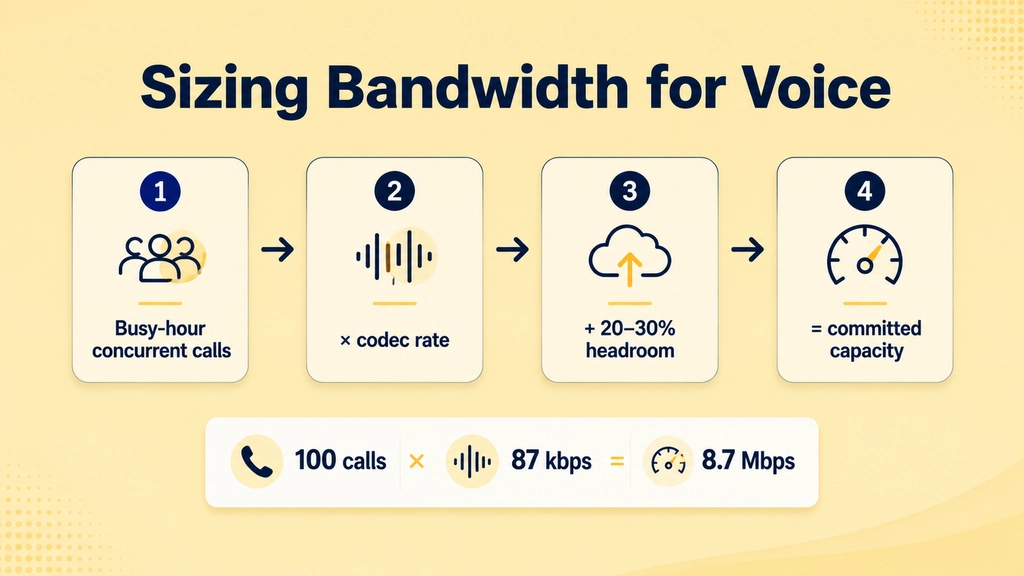
The most common sizing mistake is planning against average traffic. Averages smooth away exactly the peak that causes problems. Size against your busy hour — the heaviest sustained sixty minutes in a normal week.
For a reseller, this exercise doubles as a margin calculation. Capacity is a fixed monthly cost, so the closer you run to your commit without breaching quality, the better your economics look. Compare rate structures across our wholesale VoIP providers guide before committing to a contract length.
Voice is unusual. It needs very little bandwidth but is highly sensitive to how consistently that bandwidth arrives. A cheap high-capacity link with erratic delivery will sound worse than a modest, well-managed one.
| Metric | What it measures | Voice tolerance |
|---|---|---|
| Latency | One-way delay end to end | Under ~150 ms before conversation feels awkward |
| Jitter | Variation in packet arrival timing | Low and stable — buffers only absorb so much |
| Packet loss | Packets that never arrive | Very low; even small loss is audible as clipping |
This is why buying capacity purely on price tends to disappoint. Grey routes and oversubscribed links show good headline numbers and poor real-world audio. Ask providers about jitter and loss under load, not just the committed rate.
Capacity alone does not complete a call. Bandwidth carries the traffic across the network; wholesale VoIP termination hands it off to the destination carrier and connects it to the called party. You need both.
The two are usually bought together for a practical reason. If your capacity and your termination routes come from different places, diagnosing a quality problem means arguing across two vendors while calls keep dropping.
For resellers, this is the difference between a workable margin and a fragile one. Read our guide to wholesale VoIP termination rates for how the per-minute side is priced.
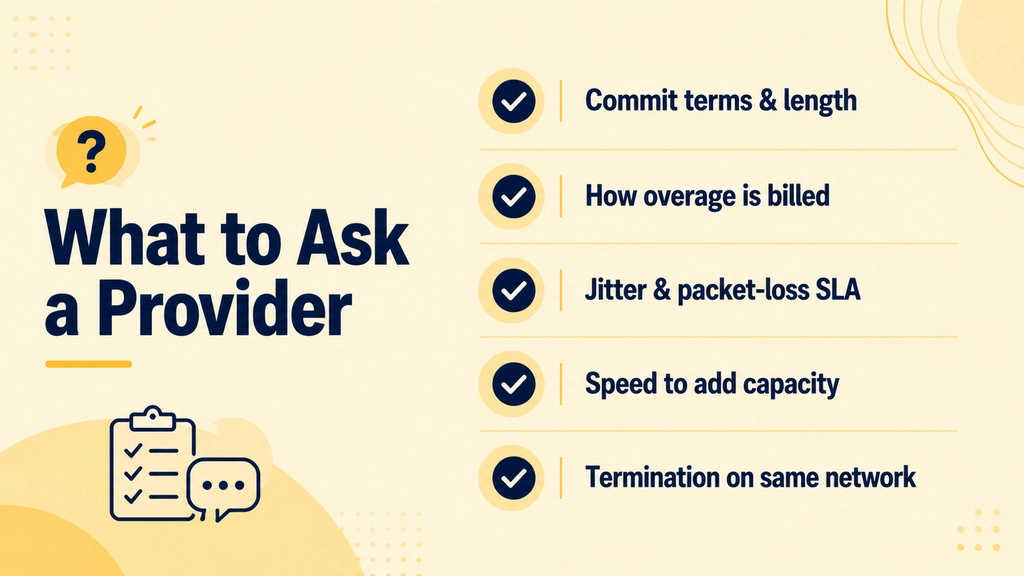
Most providers will quote a rate quickly. The useful questions are the ones that reveal what happens when things go wrong or when you grow. For a latency benchmark, ITU-T Recommendation G.114 defines the widely used 150ms one-way delay threshold for acceptable voice quality.
Wholesale bandwidth is straightforward once you stop thinking in megabits and start thinking in concurrent calls. Work out your busy hour, apply your codec figure, add headroom, and you have a defensible capacity number.
The harder part is quality. Capacity is easy to buy and easy to compare on price, but jitter and packet loss are what your customers actually hear. Buy capacity and wholesale voice termination from a provider that will answer for both.
Wholesale bandwidth is network capacity bought in bulk at carrier rates rather than per user or per seat. It typically comes with a committed monthly minimum plus burstable headroom above it, and is bought by carriers, VoIP resellers, and high-volume enterprises.
It depends on the codec. G.711 uses roughly 87 kbps per call once IP, UDP and RTP overhead is included, while G.729 uses closer to 31 kbps.
So 100 concurrent calls need about 8.7 Mbps on G.711 or about 3.1 Mbps on G.729, in each direction.
Find your busy-hour concurrent call count from your switch or SBC, multiply it by the with-overhead figure for your codec, then add 20–30% headroom.
Size against the busy hour rather than a daily average — averages hide the peak that actually degrades call quality.
Committed capacity is the baseline you pay for every month whether you use it or not. Burstable capacity sits above that commit, letting you exceed it during peaks and pay for the overage. The structure suits voice, since call volume is rarely flat across the day.
Not necessarily. Voice needs relatively little bandwidth but is very sensitive to consistency. Latency, jitter, and packet loss affect what callers actually hear far more than raw capacity does, which is why a cheap oversubscribed link can sound worse than a smaller well-managed one.
It is usually simpler. Bandwidth carries the traffic and termination completes the call, so if they come from different vendors, diagnosing a quality problem means coordinating across both while calls are still failing. A single provider gives you one point of accountability.
Generally yes, for bursty traffic. Samples are taken across the month, the top 5% are discarded, and you are billed on what remains — so short spikes do not set your bill. It works well for voice, where volume peaks predictably during business hours.
AI receptionists, wholesale routes, virtual numbers — built on one platform with transparent pricing and a 24/7 NOC.